




- sufficiently high crankshaft speed (provided at the moment of starting by a starter or other energy source external to the engine);
- formation of a working mixture capable of ignition due to its composition;
- sufficiently high energy of the spark ignition of the working mixture.
In Zhiguli cars, the designers have incorporated the prerequisites for fulfilling these three conditions in a variety of cases, including at low air temperatures (-25°C and below), due to which the starting qualities of Zhiguli engines are higher than those of any other domestic cars.
The first condition is met by a large-capacity battery with high electrical characteristics and a powerful starter, as well as good viscosity characteristics of the oils poured into the engine (primarily winter ones, which do not thicken excessively at low temperatures). The second condition is met by a carburetor with an effective semi-automatic starting device, which prepares a highly flammable working mixture during the starting process. The third condition - sufficient spark energy - is met by a capacious battery and sufficiently high efficiency of the ignition system elements.
Thus, when the battery, carburetor and ignition system are in good condition and the driver's actions are correct, starting does not cause any difficulties, and the engine starts working after no more than two or three starts. However, it is not uncommon, especially in autumn and winter, to see a motorist unsuccessfully trying to start the engine of his car after a night's parking. This is the result of the unsatisfactory condition of the relevant devices or incorrect actions of the driver.
First of all, it should be borne in mind that it is wiser and easier to do it in advance (especially with the onset of autumn) check and bring into proper condition all devices and units that determine the ease of starting the engine, than to find and eliminate malfunctions in the rain and cold after you have already tried unsuccessfully to start the engine many times and "killed" the battery. To do this, you need to know the condition of which units and parts that affect the starting qualities of the engine deteriorate during operation and require systematic monitoring and control. Such units and parts include: battery; distributor contacts; protective caps for high voltage wires; ignition coil top cover; distributor cap; distributor rotor; spark plugs; carburetor starting device.
Under normal conditions, the battery life is 3-4 years, but even long before that it may be discharged and unable to provide a sufficiently high engine shaft speed when starting. The main reasons for the decrease in battery performance (with a working generator) may be:
- loosening of fan, generator and water pump drive belt tension;
- decrease in electrolyte level in cans;
- oxidation of terminals.
The methods for eliminating the first two faults do not require special explanations. As for the third, to restore good electrical contact, you need to carefully sand not only the terminals of the battery itself, but also the inner surfaces of the wire tips (especially the "positive"); in case of severe oxidation it may be necessary to remove a thin layer of oxidized metal from the terminals and tips with a knife.
It is important to keep in mind that if the charge indicator light in a Zhiguli does not light when the engine is running, this does not mean that the battery is charging normally, but mainly that the generator is working properly; for example, if the fan, generator and water pump drive belts are loose, the indicator light will not come on, but the battery will still not receive a proper charge.
The battery charge level can be determined using a hydrometer (densitometer). You should not use a load fork, since the terminals of individual elements in the Zhiguli battery are under a layer of mastic, which would have to be destroyed in the process of measuring the voltage. At the same time, it is useful to know that a good and quite accessible indicator of the battery charge level is the blinking frequency of the turn signals, which is most conveniently judged by the control lamp on the instrument panel; when the battery is discharged, the blinking frequency is noticeably reduced compared to normal.
If the battery is very discharged at the time the fault is detected, it is advisable (especially in winter) remove it from the car and charge it with a charger, which is useful for every car enthusiast to have.
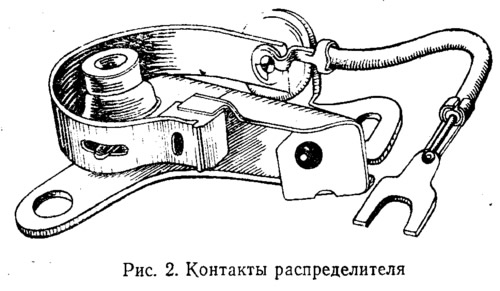
The distributor contacts gradually become oily and burnt. In addition, over time, the gap between them in the open state changes (usually decreases) compared to the required. All this reduces the electrical characteristics of the ignition system (reduces spark energy) and sharply worsens the starting qualities of the engine. If the contacts (Fig. 2) are dirty, they should be removed from the distributor, for which it is enough to unscrew the two screws with which they are attached to the platform, and disconnect the wire from the low voltage terminal of the distributor. Then the contacts should be thoroughly washed in clean gasoline and wiped with a lint-free cloth, after which the same cloth soaked in gasoline should be used to wash the platform to which the contacts are attached, wipe it, install the contacts in place and adjust the gap between them in accordance with the instructions.
The reason that excludes the possibility of starting the engine, especially in damp weather and at relatively low (from +5° to 0°C) air temperature, may be a leak of high-voltage current to ground through damaged protective caps of high-voltage wires (primarily through the central wire caps placed on the ignition coil terminal and on the central terminal of the distributor cap). This malfunction is easily diagnosed in the dark by sparks that jump when trying to start the engine along the surface of the ignition coil cover, distributor cap or between high-voltage wires (the underhood light should not be on at this time). Such a malfunction should be eliminated by replacing the punctured rubber caps and cleaning the surfaces of the ignition coil cover and distributor. If there are no rubber caps in stock, it is permissible to use caps from any other domestic car, but this measure can only be temporary, since such caps do not quite fit the "Zhiguli" and quickly tear. You can also temporarily replace the damaged caps of the central high-voltage wire with caps from spark plug wires. If this does not help and sparks continue to jump along the cleaned surface of the distributor cap, it can be assumed that the insulation of the latter is punctured, and the cap should be replaced. You can verify this by inspecting the cap, which should not have cracks or thread-like traces of soot on either the outside or the inside.
In the first Zhiguli cars, the terminal of the high-voltage wire of the ignition coil is located very close to the metal clamp holding the bundle of wires. As a result, the protective cap is often broken near the clamp and the high-voltage current goes through the clamp to the ground, which is visible by the spark jumping in this place. In this case, before replacing the cap, you need to increase the gap between it and the clamp by bending the ignition coil in the right direction.
Therefore, it is necessary to systematically clean the top cover of the ignition coil, the distributor cap and the high-voltage wires from the layer of oil and dirt that forms on them. Failure to comply with this requirement may lead to breakdown of the cover insulation and its complete failure.
Spark plugs for Zhiguli cars are quite reliable, but in winter it is better to use new spark plugs with a mileage of no more than 5-8 thousand km and preferably A7.5XX or A7.5CC brands to facilitate starting. The latter are used in Moskvich-412 engines and are designed for a key size of 22 mm (the standard candle key for Zhiguli has a different size-21 mm); therefore, when using them, it is useful to have a suitable spark plug wrench, although you can also use a regular 22 mm wrench, which is included in the tool kit.
It is necessary periodically (including before the onset of cold weather) check the gap between the spark plug electrodes and set it using the wire feeler gauge included in the tool kit.
The automatic carburetor starting device (Fig. 3) in combination with the manual air damper drive ("choke") is designed to enrich the working mixture to the required degree at the moment of starting a cold engine. If for some reason it deteriorates in its operation, starting a cold engine will be difficult, or even impossible, due to the fact that the working mixture entering the cylinders will be poorly capable of ignition in its composition or completely incapable of ignition. A sign of a malfunction of the starting device is the stopping of a cold engine that has started to work when the carburetor air damper control button is completely pulled out.
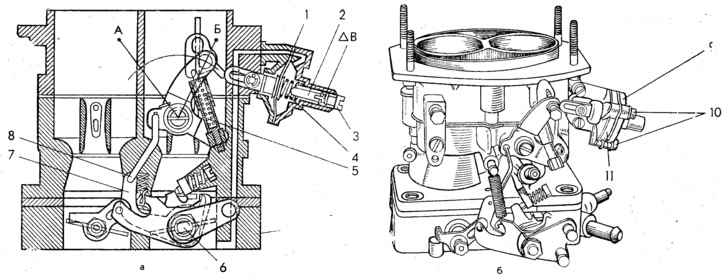
Fig. 3. Automatic carburetor starting device:
1 - diaphragm; 2 - starting device adjustment screw; 3 - cork; 4 - spring; 5 - telescopic rod; 6 — primary chamber throttle axis; 7 - lever; 8 - a rod connecting the primary chamber throttle with the starting device drive; 9 — lid; 10 - cover screw; 11 — body of the diaphragm of the starting device; dV — the gap between the adjusting screw 2 and the plug 3.
To check the operation of the starting device, remove the cover and the air filter housing, pull the air damper control handle all the way out and make sure that it completely covers the primary chamber of the carburetor, and when the handle is fully pressed in, it opens all the way (if this is not the case, you need to adjust the manual air damper drive). At the same time, it is necessary to make sure that the rod 8 (Fig. 3) will turn the primary chamber throttle axis 6 through the lever 7 at a certain angle. If after this the engine does not start or starts poorly (stalls after a few flashes), it can be assumed that the automatic starting device is faulty. To check it, you need to make sure that:
- the tightening of screws 10 securing cover 9 to housing 11 of the diaphragm of the starting device has not been loosened;
- the cork tightening did not come loose 3;
- diaphragm not ruptured 1;
- adjusting screw 2 did not unscrew and did not fall into the cavity;
- the clearance of the DV between the adjusting screw 2 and the plug 3 is not broken (the gap of the DV should be 0.5-1.0 mm);
- the telescopic traction device 5 did not lose its mobility.
Any detected faults must be corrected.
When removing cover 9, care must be taken not to lose spring 4 inserted into the housing, as well as adjusting screw 2, if it has unscrewed and fallen into the cavity. When assembling, care must be taken not to tear the edge of the diaphragm with screws 10 passing through it.
After troubleshooting the starting device, you need to check its operation. To do this, start a cold engine with the air filter cover removed and make sure that it does not stall when the choke handle is fully extended and that, in addition, the starting device automatically opens the choke to a certain angle.
Let us now consider the driver's actions when starting the engine, his possible mistakes and ways to eliminate the consequences of these mistakes.
The greatest difficulties may arise when starting a cold engine after it has been parked, especially for a long time (especially in the spring after the car has not been used for several months). In this case, it is advisable to pre-charge the battery, turn out and burn the candles, for example, with the flame of a home gas stove burner (burning time is 10-15 minutes; the flame must be in direct contact with the spark plug electrodes). Do not worry about the safety of the spark plug - it is designed to withstand high temperatures. In addition, before the first attempt to start the engine, you need to manually pump up the fuel. The latter should always be done if the car has not been used for more than two or three days.
The next steps are the same in all cases when more than a few hours have passed since the engine stopped, but not more than three days. Apply the handbrake, disengage the clutch, pull the carburetor air damper control handle all the way out and turn on the starter for 10-15 seconds (if the engine starts earlier, the starter, naturally, must be turned off faster).
It should be borne in mind that the case when the engine started working as a result of such actions, i.e. without touching the accelerator pedal, is ideal. In reality, many engines have their own individual characteristics, which can also change over time, since they depend on the features of the carburetor adjustment. The air damper control handle must be pulled out completely when starting a cold engine under all conditions, and as for the accelerator pedal, it may turn out that it is useful to "pump" it several times both before the first starter is turned on and during the start. Therefore, every car enthusiast should study the features of starting their engine and adapt to them, and the need to "pump" the accelerator pedal should not be considered a malfunction of any engine systems.
If the engine does not start on the first try, you need to repeat it after an interval of 30 seconds. If the engine does not start after the third try, you need to find and fix the fault in the power supply and ignition systems in the order that has already been discussed and will be discussed below in the section "You got in the way".
However, often failure to start is not the result of these faults, but rather the driver's incorrect actions.
The first possible error is that the driver does not pull the carburetor choke control handle all the way out or keeps the pedal pressed at the moment of starting. In this case, starting the engine will be extremely difficult.
The second very common mistake is multiple attempts to start the engine by briefly turning on the starter for 2-3 seconds. In this case, not only does the probability of a successful start decrease and the service life of the battery and starter decrease, but there is also a danger (the same as with multiple launch attempts that fail for other reasons) a sharp enrichment of the mixture in the cylinders, in which each subsequent attempt can only worsen the situation. Most of the "incomprehensible" failures during starting, when the fuel and ignition systems are in good working order, are associated with excessive enrichment of the mixture due to incorrect actions of the driver. In addition, multiple attempts to start often lead to a discharged battery, which complicates the matter even more.
In light of the above, in a similar situation, which most often occurs in winter during severe frost, we recommend the following procedure.
If the battery is not yet discharged, try to "blow" the engine. To do this, fully open the carburetor choke, press the accelerator pedal all the way down and, holding it in this position, turn on the starter for 10-15 seconds. If the engine starts running, set the pedal speed slightly higher than low idle speed and simultaneously pull the carburetor choke control handle halfway. Then proceed as usual. In order to prevent over-enrichment of the mixture, it is useful to "blow" the engine after every two unsuccessful attempts to start.
However, the described method will help only when the mixture enrichment is not particularly large. Therefore, if the first attempt at "blowing" was unsuccessful, you should unscrew the spark plugs, burn them out, immediately, if possible, not allowing them to cool down completely, put the spark plugs back in place and try to start again, acting in the usual way. If the battery has already been discharged, you can use the battery of another "helping" car, using for this purpose additional starter cables with quick-release clamps, which it is advisable to have with you (especially in winter).
If the described methods do not produce results, the only option left is to start the engine by towing the vehicle.
Let's now consider the procedure for starting a hot engine. Here, you should strictly follow the main rule - remember that it is unacceptable to completely or partially close the carburetor air damper in this case. On the contrary, if a hot engine stalls, for example, due to unstable low idle speed, you need to start it with "blowing", i.e. with the accelerator pedal fully depressed.
Particular attention should be paid to difficulties with starting that may arise after washing the engine with a copious stream of water. In this case, first of all, do not direct the stream at the electrical equipment. If the engine does not start, you need to carefully wipe the surface of the upper cover of the ignition coil, remove the high-voltage wire from its terminal, wipe it, dry the inner cavity of the terminal if water has gotten in, and wipe dry both the outside and inside of the distributor cap. A situation similar to that described above may also arise after fording.