

Open large image in new tab »
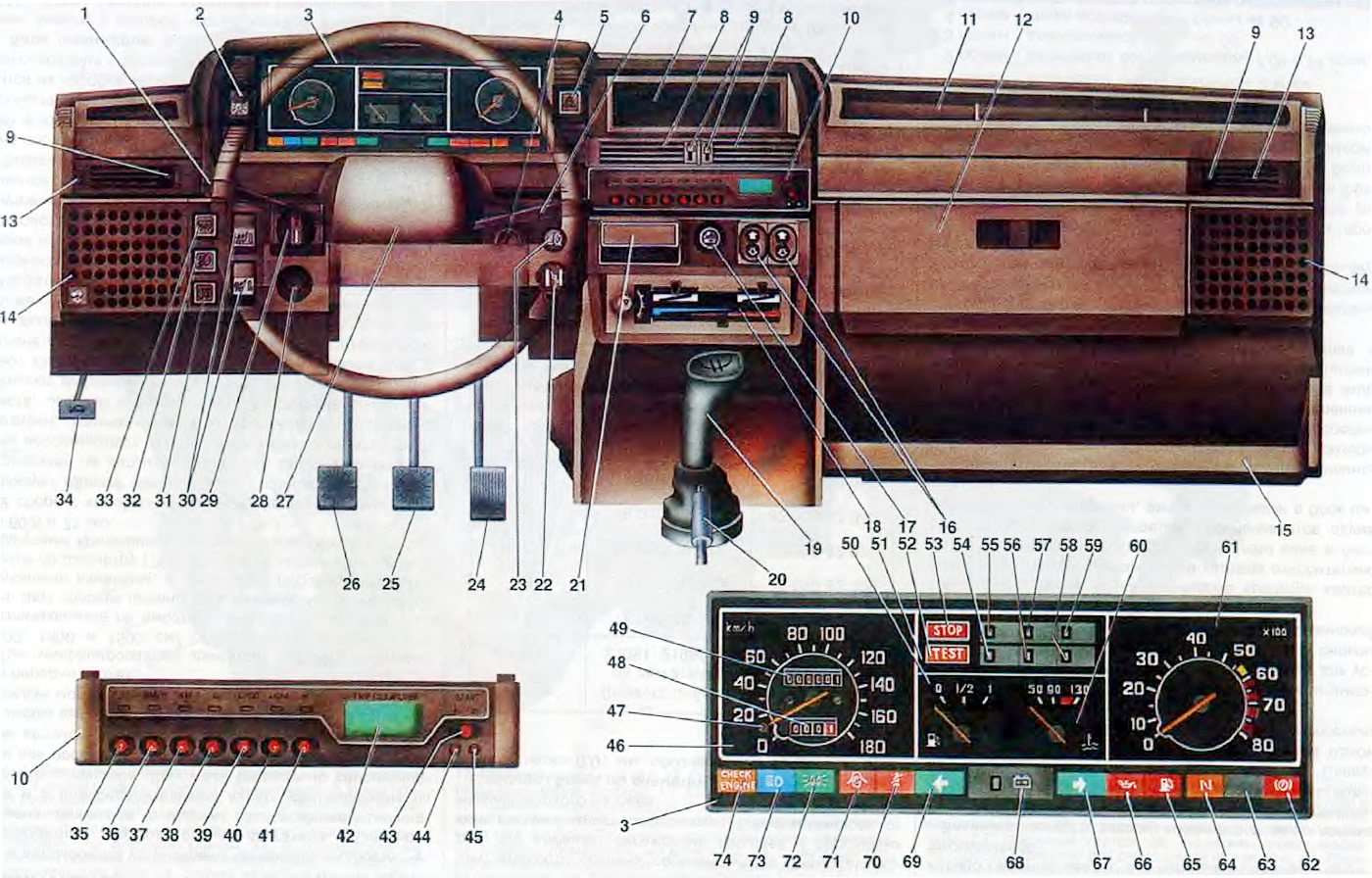
1. Light switch lever.
2. Outdoor lighting switch.
3. Instrument cluster.
4. Ignition switch.
5. Alarm switch.
6. The lever of the switch of screen wipers and washers.
7. Nest for installation of radio equipment.
8. Central nozzles of the ventilation and heating system.
9. Nozzle closing levers.
10. Trip computer. It is installed by order and is designed to measure, accumulate and display one of the seven parameters on a digital display:
- travel time;
- average speed of movement;
- the distance traveled;
- total, average or current fuel consumption;
- current time.
Before the trip at the touch of a button "START" all parameters are set to zero except for "current fuel consumption" And "current time". The digital display sequentially indicates the value of the parameter after pressing the corresponding control button. When the ignition is turned off, the trip computer indicator turns off, but the accumulated information and the course of the clock are preserved. If the battery is disconnected, all accumulated information is lost.
11. Dashboard.
12. Glove box.
13. Side nozzles of the ventilation and interior heating system.
14. Facing the loudspeaker.
15. Magazine shelf.
16. Power window switches are installed on vehicles equipped with power windows in the front doors. When you press the upper or lower shoulder of the key, the glass is raised or lowered, respectively.
17. Cigarette lighter.
18. Control panel for the interior ventilation and heating system.
19. Gearshift lever.
20. Parking brake lever.
21. Ashtray.
22. Carburetor choke control knob.
23. The wiper and headlight washer switch is installed on parts of cars. By pressing the button of the switch at the included low beam cleaners and a headlight washer turn on.
24. Accelerator pedal.
25. Brake pedal.
26. Clutch pedal.
27. Horn switch.
28. Switch (regulator) instrument lighting.
29. Headlight hydrocorrector handle.
30. The front seat heating switches are installed on vehicles equipped with a seat heating system and are turned on by pressing the lower shoulder of the key. The switched on heating is signaled by a control lamp in the key itself.
31. Rear fog light switch.
32. The fog lamp switch is connected on vehicles with installed fog lamps and is turned on by pressing the key when the outdoor lighting is on.
33. Rear window heating switch.
34. Lever drive hood lock.
35. The travel time button displays the time in hours and minutes up to 99.59, excluding stops and parking with the ignition off.
36. The average speed button displays the average vehicle speed in km/h, not including stops and parking with the ignition off.
37. The distance traveled button displays the distance traveled in km up to 999.9.
38. The button of the total fuel consumption indicates the fuel consumption in liters up to the value of 624.9.
39. The average fuel consumption button displays the fuel consumption in l/100 km.
40. The current fuel consumption button displays the current fuel consumption in l/100 km at a vehicle speed of more than 10 km/h or in l/h at a vehicle speed of less than 10 km/h.
41. The current time button displays the time in hours and minutes up to 23.59.
42. Digital display.
43. Button "START".
44. Clock setting button.
45. Button for setting minutes.
Setting a new time value is done by successively pressing the buttons for setting hours and minutes. Pressing the corresponding button continuously increases the hours or minutes by two digits. give me a sec. By pressing the button "START" the minutes and seconds digits are reset (binding to radio signals of exact time).
46. Speedometer.
47. Handle for resetting the daily counter of the distance traveled. Reset (zeroing) is performed by turning the handle clockwise with the vehicle stopped.
48. Daily counter of the distance traveled.
49. Total distance traveled counter.
50. Fuel gauge.
51. Onboard control system.
52. Scoreboard "TEST" lights up in the self-monitoring mode of signaling devices. After 4 s. the display goes out and the signaling devices switch to the mode of indicating the actual parameters of the systems and components of the vehicle.
53. Scoreboard "STOP" lights up together with a control lamp or signaling device specifying the type of malfunction, without which further movement is unacceptable.
54. The signaling device for the failure of the threads of the stoplight lamps and side lights lights up in the event of a malfunction of the stoplight lamps when the brake pedal is pressed or the side light lamps when the outdoor lighting is turned on. Connected to parts of produced cars.
55. The service brake system alarm indicator lights up when the brake fluid level drops below the permissible limit.
56. The front brake pad wear indicator lights up when you press the brake pedal and stays on until the ignition is turned off if the front brake pad linings are worn out. It is connected on cars equipped with pad wear sensors.
57. The low coolant level indicator lights up when the liquid level in the expansion tank drops below the mark "MIN".
58. The indicator of insufficient oil level in the engine crankcase lights up if the oil level has dropped below the mark "MIN" pointer.
59. The indicator of insufficient level of washer fluid in the washer reservoir lights up when the fluid level drops below the permissible limit.
60. Coolant temperature gauge.
61. The tachometer indicates the engine speed. The yellow zone of the scale indicates the engine operating mode with a high crankshaft speed, the red zone indicates modes that are dangerous for the engine.
62. Parking brake warning lamp.
63. Backup control lamp.
64. Carburetor air damper control lamp.
65. The fuel reserve warning lamp lights up if there is less than 4-6.5 liters of gasoline left in the fuel tank.
66. Oil pressure warning lamp.
67. A control lamp of inclusion of indexes of the right turn.
68. Control lamp for charging the battery.
69. Control lamp for turning on the left turn indicators.
70. Control lamp for unfastened driver's seat belts. It is connected on cars equipped with seat belts with signaling about unfastened driver's belts.
71 The door open warning light comes on when the doors are not fully closed. Connected to parts of produced cars.
72. A control lamp of dimensional light.
73. Control lamp high beam headlights.
74. Pilot lamp "CHECK ENGINE" (check engine). It is connected on vehicles equipped with a fuel injection system. The lamp lights up when the ignition is switched on and goes out after the engine is started. If the lamp comes on or flashes when the engine is running, it warns of a malfunction in the system, the elimination of which should be carried out at the nearest service shop.