




Contents: Governing bodies ↓ Control devices ↓ Lighting and signaling controls ↓ Driver's seat equipment ↓
The arrangement of controls and instruments shown in the illustration is typical for modern passenger cars designed for right-hand traffic.
Symbolic images are placed on the ends of handles, keys, and control lamp filters to help remember their purpose.
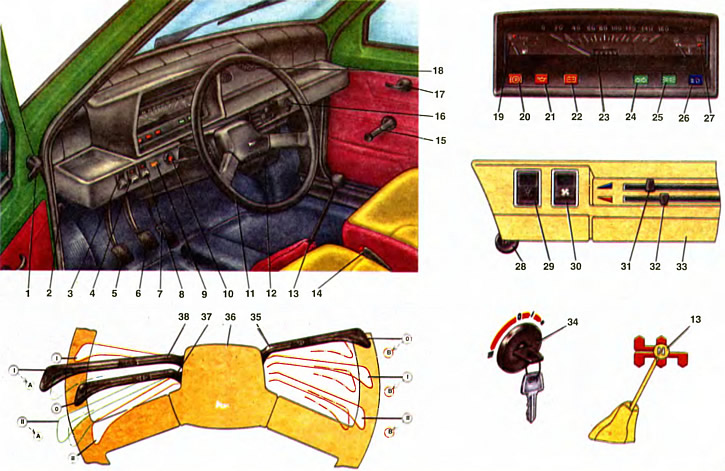
1. Outside mirror adjustment handle. 2. Bonnet release lever. 3. Rear window wiper and washer switch. 4. Rear window defogger switch. 5. Clutch pedal. 6. Brake pedal. 7. Carburetor throttle control pedal. 8. Rear fog light switch. 9. Carburetor choke cover indicator lamp. 10. Hazard warning light switch. 11. Steering wheel. 12. Heater housing cover. 13. Gear shift lever. 14. Parking brake lever. 15. Window lift handle. 16. Cigarette lighter. 17. Door lock handle. 18. Rotating deflectors. 19. Fuel level gauge with fuel reserve indicator lamp. 20. Parking brake and brake fluid level indicator lamp. 21. Oil pressure indicator lamp. 22. Low battery indicator lamp. 23. Speedometer. 24. Direction indicator lamp. 25. Exterior lighting indicator lamp. 26. Headlight high beam indicator lamp. 27. Coolant temperature gauge. 28. Carburetor choke control handle. 29. Exterior lighting switch. 30. Heater fan motor switch. 31. Air intake flap control lever. 32. Heater tap control lever. 33. Ashtray. 34. Ignition switch. 35. Windshield wiper and washer switch lever. 36. Horn switch. 37. Direction indicator switch lever. 38. Headlight switch lever.
Governing bodies
Gear shift lever 13. Move to the required position according to the diagram engraved on its handle. The neutral position of the lever is determined by its free movement to the left, while the lever tends under the action of the spring to become in the position of inclusion of III and IV gears.
When the lever is moved left and right, gears are selected, and when it is turned on the axis, (movement of the handle back and forth) gear shifting.
It should be remembered that the reverse gear should be engaged only after the car has come to a complete stop. When the reverse gear is engaged, the reversing lights in the rear lights turn on simultaneously, signaling that the car is moving backwards.
Lever 14 of the parking brake serves to brake the car when parked or on an incline. By moving the lever upwards until it stops, the brake shoes of the rear wheels are activated. At the same time, the control lamp 20 lights up with a flashing red light.
In case of emergency, the parking brake can be used as an emergency brake while the vehicle is moving. To return the lever to its original position, press the button on the end of the lever handle.
Pedal 7 for controlling the carburetor throttle valves. Starting a cold engine is done without pressing the pedal. It is not recommended to press the pedal after starting a cold engine until the engine warms up and starts working steadily, without interruptions. And vice versa, if you need to start a hot engine, you need to press the pedal about a third of its travel, and after starting, as soon as the engine starts working without interruptions, gradually release it.
Switch 34 (ignition lock). The key in the lock can occupy four positions:
- 0 — everything is off, except for the circuits to which voltage is supplied regardless of the key position. These are the power supply circuits for the horn and hazard warning lights, brake lights, cigarette lighter, external and internal lighting (except for the headlights). The key cannot be removed from the lock; the anti-theft device is not turned on.
- I — ignition and power supply of all electrical consumers except the starter circuit are on. Used before starting the engine and when the car is moving. The key is not removed from the lock, the anti-theft device is not turned on.
- II — the starter and ignition are on. Voltage is also supplied to the power supply circuits of the direction indicators, control instruments and windshield wiper. It is used to engage the starter and start the engine. The key is not fixed in the lock and cannot be removed, the anti-theft device is not activated.
- III - everything is off except for circuits to which voltage is supplied regardless of the key position (see position 0). When the key is removed, the anti-theft device is activated. It is used when stopping or parking outside the garage. To turn off the anti-theft device, insert the key into the lock and, slightly turning the steering wheel to the right and left, turn the key to position 0.
Brake pedal 6. Serves to brake the car, which should be smooth and long-lasting. You should get used to considering the brakes as an emergency system, which will reduce tire wear and fuel consumption, and create comfort for passengers while driving. Use sharp, intensive braking with the brake pedal only in exceptional cases.
Handle 28 for controlling the carburetor air damper pushed in all the way when the damper is fully open and is fixed in any intermediate position when the engine is warming up. When the handle is pulled out all the way, the damper is completely closed. Full closing of the carburetor air damper is used when starting a cold engine to enrich the combustible mixture. After warming up, do not forget to open the damper by pushing the handle in. When the handle is pulled out, the control lamp 9 for closing the air damper lights up.
Clutch pedal 5 serves to activate the mechanical clutch release drive.
Steering wheel 11 it is used to set the direction of the vehicle's movement. Its design ensures visibility of all control devices.
Control devices
All control devices are collected in the instrument cluster and operate only when the ignition is on (except for the speedometer). The speedometer works when the car is moving.
Speedometer 23 with a total meter of the distance traveled by the car in kilometers. The red dots on the scale near the numbers 40, 60 and 100 indicate the speeds that are not recommended to be exceeded when driving in 1st, 2nd and 3rd gears, respectively.
Coolant temperature gauge 27 in the engine cooling system. The transition of the arrow to the red field of the scale indicates excessive engine heating. In this case, it is necessary to immediately reduce the engine speed to a minimum (without stopping him). If overheating is not eliminated, it is necessary to check the operation of the electric fan of the cooling system and the thermostat.
Fuel level indicator 19 in the tank with a fuel reserve indicator light that lights up orange when there are 4...6.5 liters of gasoline left in the fuel tank.
Parking brake indicator lamp 20 (red) and the brake fluid level lights up with a flashing light when the parking brake lever 14 is moved upward. The same lamp lights up continuously when the fluid level in the reservoir drops below the permissible limit due to fluid consumption or damage to the system.
Warning lamp 21 (red) low oil pressure in the engine lubrication system lights up when the oil pressure drops below the permissible level.
Control lamp 22 (red) battery discharge lights up when the ignition is turned on and goes out after the engine starts. If the lamp lights up when the engine is running, this indicates a malfunction in the battery charging system or weak tension (breakage) of the generator drive belt.
Indicator lamp 24 (green) for turning on direction indicators lights up with a flashing light when the turn signal is turned on.
Indicator lamp 25 (green) for side light switching on lights up when the outside lighting is turned on.
Control lamp 26 (blue) for high beam headlights lights up simultaneously with the high beam headlights. The burning lamp reminds the driver of the need to turn off the high beam in a timely manner when meeting another car, entering illuminated sections of the road, and also in all cases when it can blind other drivers. If you are following a car in front and do not intend to overtake it, turn on the low beam and, keeping the appropriate distance from it, you will drive safely, without disturbing the car in front of you.
Control lamp 9 (orange) carburetor air damper cover.
Lighting and signaling controls
Switch 36 sound signal it is activated by pressing on the plastic cover in the steering wheel hub that covers the contact parts of the switch.
Switch 29 outdoor lighting. When the lower arm of the key is pressed to the first fixed position, the side lights and instrument lighting are turned on, and when pressed to the second position, the headlight circuits are additionally energized.
Switch 10 of the emergency signaling. When you press the button, the flashing light of all direction indicators and the control lamp in the button turns on. When you press the button again, the alarm turns off.
Switch 8 rear fog light. The rear fog light is switched on by pressing the switch button. At the same time, the orange indicator lamp in the switch button lights up.
Lever 37 of the turn signal switch has three positions:
- 0 - direction indicators off;
- I — right turn signals are on;
- II — left turn signals are on.
Lever 38 of the headlight switch functions as follows (with ignition on):
- I — low beam headlights are on. If switch 29 turns on the headlights;
- II — high beam is on if headlights are switched on by switch 29. At the same time, the blue indicator lamp in the instrument cluster signals that high beam is on.
A - (the lever is pulled back) the high beam headlights are on regardless of the position of switch key 29.
Used to briefly turn on the high beam to illuminate the road or to signal pedestrians and drivers. When released, the lever returns to its place.
Driver's seat equipment
Lever 35 wiper and washer switch windshield (under the steering wheel on the right) may occupy the following positions:
- 0 - all disabled;
- I — intermittent windshield wiper mode is on;
- II - continuous windshield wiper mode is enabled;
- B — (towards you) turns on the windshield washer for the time the lever is held in this position (non-fixed lever position).
Rear Window Wiper and Washer Switch 3. When you press the lower shoulder of the key to the first fixed position, the cleaner is turned on, and to the second (not fixed position) - and also a rear window washer.
Switch 4 rear window heating. The glass heating is switched on by pressing the button. At the same time, the orange control lamp in the button lights up.
Interior and exterior rear view mirrors are designed to monitor the road behind the car. The interior mirror is fixed in two positions for day and night. If the light from the headlights of a car behind is in the way, the angle of the mirror is changed with the lever. The exterior mirror is adjusted from the inside of the car with handle 1.
Sun visors they have a hinged mount, which allows them to be installed either at the top of the windshield or parallel to the door glass, depending on the direction of the sun's rays.
Cigarette lighter 16 is switched on by pressing the handle of the cartridge until it stops. The spiral of the cigarette lighter heats up in about 15 seconds. After heating, the cartridge automatically returns to its original position, ready for use.
Ashtray 33 it opens towards you by the protruding edge of its front wall, and for cleaning it is removed from the socket by pressing on the spring stop inside the ashtray.
Lever 2 of the hood lock drive opens the hood lock if you pull it towards you.
Headrests the front seats are height adjustable and held in the desired position by spring clamps.
Slide Latch Lever the front seat lever is located on the right side of the seats. To move the seat forward and backward, pull the lever up.
Backrest tilt adjustment handles the front seats are located at the base of the backrest, on the door side. The coarse adjustment handle is made in the form of a lever. By lifting this handle up, you can turn the backrest to the desired position. For example, tilt it forward for easy boarding of passengers in the back seat, or, conversely, recline the backrest to create a place to rest. By rotating the other handle, you can smoothly adjust the tilt of the backrest within small limits.
Lighting plafond the interior is switched on and off by a switch built into it.
The ventilation and heating control system of the passenger compartment includes the following elements:
Switch 30 of the heater fan electric motor serves to turn on the electric fan to the appropriate mode when it is necessary to increase the amount of air entering the passenger compartment.
Heater housing cover 12 designed to direct heated air to the feet of the driver and passengers.
Lever 32 for controlling the heater tap regulates the flow of hot liquid from the engine into the heater radiator and, thus, the temperature of the air passing through the heater radiator.
Lever 31 for controlling the air intake hatch cover regulates the amount of air passing through the heater. When the lever is moved to the extreme left position, the cover closes; when the lever is moved to the right, the cover opens and outside air enters the car interior for ventilation or heating in winter.
Rotating deflectors 18 change the direction of air flow from the heater.