




Open large image in new tab »
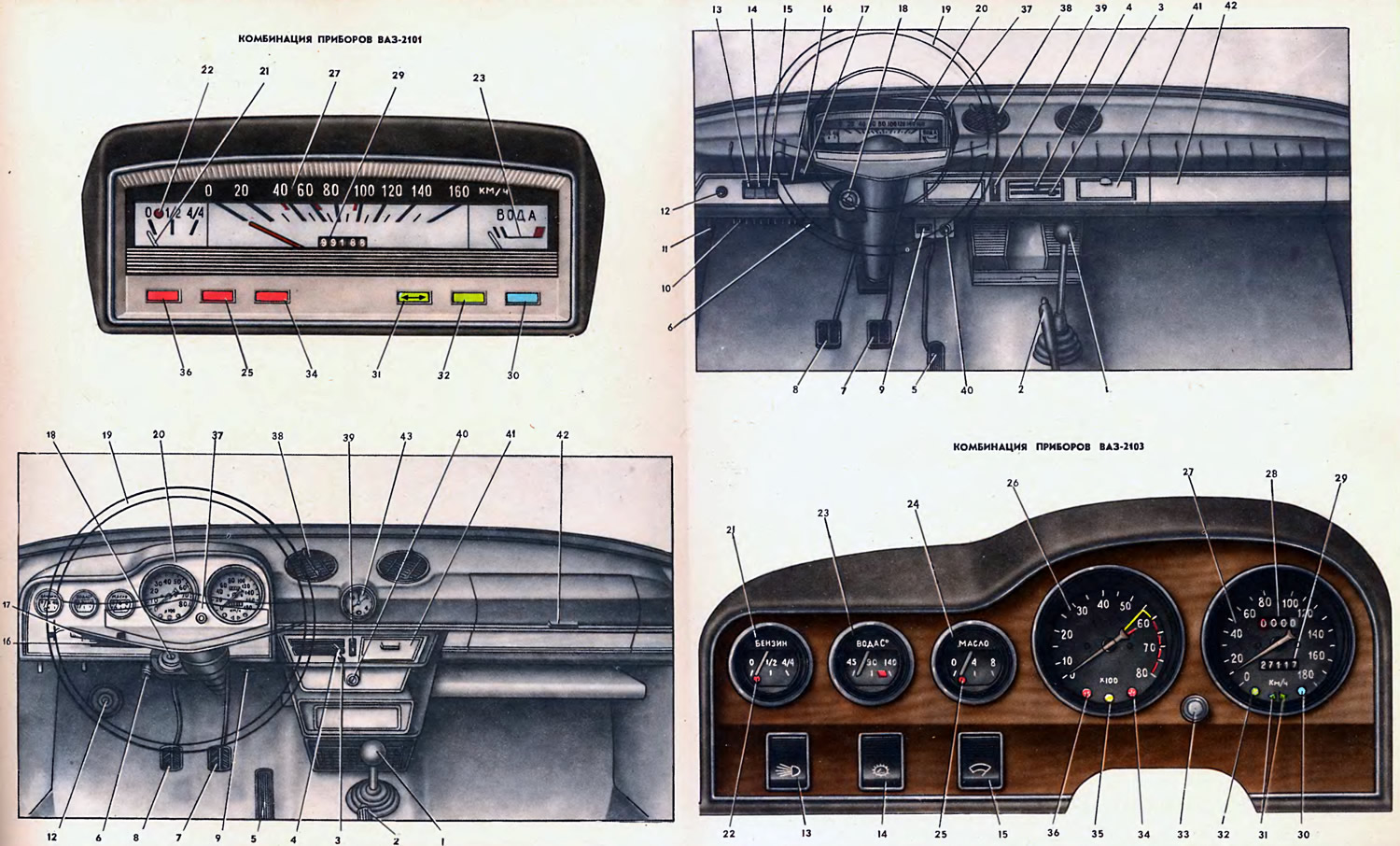
1. Gear shift lever. 2. Handbrake lever. 3. Heater valve control lever. 4. Air intake hatch control lever. 5. Throttle pedal. 6. Portable lamp socket. 7. Brake pedal. 8. Clutch pedal. 9. Carburetor choke control handle. 10. Fuse box. 11. Bonnet lock lever. 12. Windscreen washer pump button. 13. Exterior lighting switch. 14. Instrument lighting switch. 15. Three-position windscreen wiper switch, 16. Headlight changeover lever. 17. Direction indicator switch lever. 18. Ignition switch. 19. Steering wheel. 20. Instrument cluster. 21. Fuel level gauge. 22. Low fuel reserve indicator lamp (lights up when there is less than 4-6.5 liters of gasoline in the tank). 23. Coolant temperature gauge. 24. Oil pressure gauge. 25. Low oil pressure indicator lamp. 26. Tachometer. 27. Speedometer. 28. Trip meter. 29. Totalizing trip meter. 30. High beam indicator lamp. 31. Direction indicator lamp. 32. Side light indicator lamp. 33. Trip meter zero reset handle. 34. Battery charge indicator lamp. 35. Air damper cover indicator lamp. 36. Handbrake indicator lamp. 37. Horn switch. 38. Rotating deflectors. 39. Three-position heater motor switch. 40. Cigarette lighter. 41. Ashtray. 42. Glove compartment. 43. Clock.
The vehicle's controls are simple and easy to use.
Gear shift lever 1. The neutral position of the lever is determined by its free movement left and right, while the lever tends to take the extreme right position under the action of the release spring.
Lever 2 of the handbrake is used to brake the car when parked or on an incline. In case of emergency, the handbrake can be used as an emergency brake while the car is moving. To release the lever, press the button located on the end of the handle. It is easier to press the button if you lift the lever slightly up before releasing the brake. When the lever returns to the extreme lower position, the red control lamp goes out.
Lever 3 of the heater tap control regulates the flow of hot liquid from the engine into the heater radiator.
Lever 4 controls the air intake hatch cover. When the lever is moved to the extreme left position, the hatch closes; when the lever is moved to the right, the hatch cover opens and outside air enters the car interior for ventilation or heating in winter.
Pedal 5 of the throttle control. After starting a cold engine, it is not recommended to press the pedal until the engine has warmed up and started to work steadily, without interruptions. And vice versa, if you need to start a very hot engine, you need to press the pedal all the way, and after starting, as soon as the engine starts to work without interruptions, gradually release it.
When starting a hot engine, do not press the pedal again to avoid over-enriching the combustible mixture, which makes it difficult to start the engine.
The brake pedal 7 is used to brake the car, which should be smooth and long-lasting. You should get used to considering the brakes as an emergency system, which will increase the stability of the car, reduce tire wear and fuel consumption, and create comfort for passengers when driving. Use sharp, intensive braking with the brake pedal only in exceptional cases.
The handle 9 of the carburetor air damper control is fixed in any intermediate position when warming up the engine. Full closing of the carburetor air damper is used when starting a cold engine to enrich the combustible mixture. After warming up, do not forget to open the damper by pushing the handle in.
Button 12 (pedal of the VAZ-2103 car) windshield washer pump.
To wash the windshield, you need to press the button several times and turn on the windshield wiper switch. In the VAZ-2103, pressing the washer pump pedal turns on (at the end of the pedal stroke) and also a windshield wiper.
Switch 13 of external lighting. When the lower arm of the button is pressed and the ignition key is turned to position I or III, the side lights, high beam or low beam headlights are switched on (depending on the position of the lever), lamps for lighting the cigarette lighter socket and the trunk, a license plate light, as well as a lamp for lighting the engine compartment when the hood is open.
Switch 14 of the instrument lighting is energized when switch 13 is on and the ignition key is turned to position I or III. The lighting is switched on by pressing the lower arm of the key.
The three-position switch 15 of the windscreen wiper is energized when the ignition key is turned to position I or III, and the switch can be in three positions:
- 1) the lower arm of the key is pressed all the way down - the windshield wiper operates continuously;
- 2) intermediate position of the key - the windshield wiper works intermittently;
- 3) the upper arm of the key is pressed all the way down - the windshield wiper does not work.
The brushes return to their original horizontal position automatically.
The headlight switching lever 16 can be set in three positions:
- extreme top - only side lights are on, headlights are off;
- extreme bottom - high beam headlights on;
- intermediate position - low beam headlights are on.
In this case, the headlights and lanterns are on if switch 13 is on.
The headlights are also turned on by moving the lever towards you. It is not necessary to turn on switch 13 (flashing light during daytime). The headlights remain on as long as the lever is pressed.
Lever 17 of the turn signal switch. To turn on the flashing lamps in the sidelights and rear lights that signal a turn, turn the lever up and down with your fingers. When turned up, the right turn signals light up, when turned down, the left turn signals light up.
Ignition switch 18. The switch key can occupy four positions:
(The original is posted on Internet resource: VAZBOOK.RU)
- 0 - the key is in a horizontal position - everything is off (parking in garage, anti-theft device not on, key can be removed).
- I — the key is turned clockwise until it clicks — the ignition is on.
- II — the key is turned clockwise all the way, overcoming the spring force, the ignition and starter are on. In this position, the key is not fixed, and for the starter to work, the key must be held by hand. When the hand force is removed, the key returns to position I.
- III — the key is turned counterclockwise from position 0 — the anti-theft device and parking light are on, additionally switched on by the headlight switch lever and the exterior lighting switch (the key can be removed). To turn the anti-theft device on and off, gently rock the steering wheel in both directions while turning the key.
The key should never be left in position I when the engine is not running. Nor should the key be turned to position 0 when the vehicle is moving, turning off the ignition to save fuel. This could lead to an accident if the key is accidentally turned further to position III when the ignition is turned on and the anti-theft device is activated.
Steering wheel 19 has a hub lowered below the rim and two offset from the center, lying on one straight line, spokes that do not interfere with the observation of the readings of the control instruments. All control instruments are assembled into a cluster of instruments.
The main elements of the instrument cluster are as follows.
Indicator 23 coolant temperature in the engine cooling system. The light zone of the scale refers to the normal operating temperature of the engine; the arrow moving into the red field of the scale indicates excessive engine heating.
Indicator 24 of oil pressure in the lubrication system of the VAZ-2103 engine. The working oil pressure should be within 3.5-4.5 kg/cm².
Control lamp 25 (red) for insufficient oil pressure in the engine lubrication system. The lamp lights up when the ignition key is turned from position 0 to position I, and goes out after the engine is started, when the oil pressure becomes sufficient to provide lubrication (0.4-0.8 kg/cm² — the calibration limits of the lamp sensor of the VAZ-2101 and VAZ-2103 engines), and should not light up under normal engine operating conditions. If the engine is overheated or running at very low speeds, the lamp may light up even with a functioning lubrication system. In all other cases, the lamp lights up indicating a lack of oil in the crankcase or a malfunction in the lubrication system, which must be quickly identified and eliminated, since the engine may be damaged if the oil pressure is insufficient.
Operation of the engine with a lubrication system that does not provide sufficient oil pressure is unacceptable.
Tachometer 26 with electronic drive from the ignition distributor. Yellow color indicates engine operating modes at high speeds, red color indicates dangerous engine modes.
Speedometer 27 with a totalizer of the distance traveled by the car in kilometers; the VAZ-2103 car, in addition, with a daily counter of the distance traveled in kilometers. The red marks on the speedometer scale of the VAZ-2101 car near the numbers 40, 60 and 100 show that these speeds of the car are not recommended to be exceeded when driving in 1st, 2nd and 3rd gears, respectively.
The indicator lamp 30 (blue) for switching on the high beam headlights lights up simultaneously with switching on the high beam headlights.
Indicator lamp 31 (green) of the direction indicators lights up with a flashing light if the switch lever is moved to the right or left turn position.
Indicator lamp 32 (green) for turning on the side lights lights up when the outside lighting is turned on.
Handle 33 is used to set the daily trip meter to zero. The counter is set to zero by turning the handle counterclockwise. It is strictly forbidden to perform this operation while the vehicle is moving.
The 34 (red) battery charge indicator lamp lights up when the ignition key is turned from position 0 to position I and goes out after the engine is started. If the lamp lights up when the engine is running, this indicates a fault in the charging system that must be eliminated.
Control lamp 35 (orange) for turning on the carburetor air damper control handle (for starting a cold engine) lights up when handle 9 is pulled towards you. The carburetor starter is only turned on to warm up the engine. Do not forget to turn it off, as the mixture becomes excessively rich.
Control lamp 36 (red) for turning on the handbrake and (for VAZ-2103) indication of insufficient fluid level in the brake hydraulic system tanks.
Flashing light when the handbrake lever is moved up. A constant light of this lamp in a VAZ-2103 indicates that the fluid level in one of the two tanks of the hydraulic drive system has dropped below the permissible limit due to fluid consumption or damage to the brake system.
Three-position switch 39 of the heater electric motor is energized when the ignition key is turned to position I or III.
The switch has three locking positions:
- 1) the upper arm of the key is pressed all the way down - the electric motor is turned on at low speed;
- 2) the lower arm of the key is pressed all the way down - the electric motor is turned on at high speed;
- 3) in the middle position of the key the electric motor is turned off.
Electric clock 43 with a handle for moving the hands. The clock works regardless of the position of the ignition key.