

Open large image in new tab »
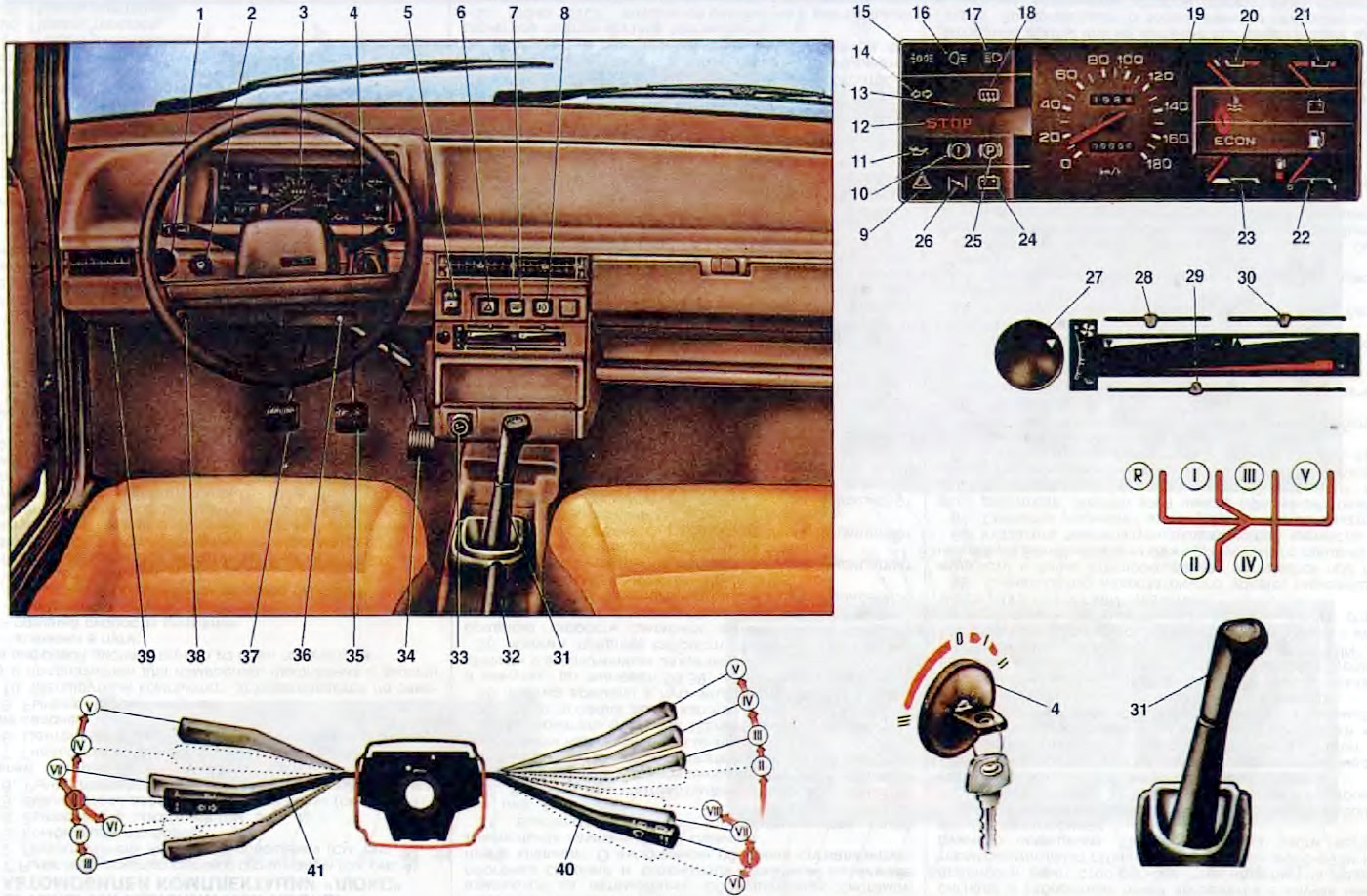
1. Headlight hydrocorrector handle. Serves to adjust the angle of inclination of the headlight beam depending on the vehicle load. It is installed on a part of produced cars.
2. Switch (regulator) instrument lighting. It is energized when outdoor lighting is on. Turning the knob turns on the instrument lighting and adjusts its brightness.
3. Instrument cluster.
4. Ignition switch The key in the lock can occupy four positions:
- 0 - everything is off, except for circuits that are energized regardless of the key position. The key cannot be removed from the lock. the anti-theft device is not included.
- 1 - the ignition is on and the power supply to all consumers of electricity, except for the starter and parking light circuits. It is used before starting the engine and while driving. The key cannot be removed from the lock, the anti-theft device is not included.
- II - the starter and ignition are on. Voltage is also supplied to the power supply circuit for outdoor lighting, alarms and instruments, to the power supply circuit of the windshield wiper. The key is not fixed in the lock and cannot be removed, the anti-theft device is not included.
- III - ignition off, parking light power circuits on (on cars produced before 1988). outdoor lighting and instrument lighting. With the key removed, the anti-theft device is activated. To turn off the anti-theft device, insert the key into the lock and, slightly turning the steering wheel to the right and left, turn the key to the position "0".
5. Outdoor lighting switch. When you press the lower shoulder of the key to the first fixed position, the parking lights are turned on, and when pressed to the second position, the headlight circuits are additionally energized.
6. Alarm switch. When the button is pressed, the flashing light of all direction indicators and indicator lamp 9 in the instrument cluster is switched on. Pressing the button again turns off the alarm.
7. Rear window heating switch. The glass heating is switched on by pressing the button and switched off by pressing the button again.
8. Rear fog light switch. The rear fog light and indicator lamp 16 are switched on by pressing the button and switched off by pressing the button again.
9. The alarm indicator lamp lights up with a flashing light when the alarm is turned on.
10. A control lamp of level of a brake liquid. Illuminates when the fluid level in the tank falls below the allowable limit due to fluid consumption or due to system damage.
11. Oil pressure warning lamp. In the engine lubrication system, it lights up when the oil pressure drops below the permissible value.
12. Scoreboard "Stop". Lights up red when there is insufficient pressure in the engine lubrication system, when the brake fluid level is insufficient, and when the parking brake lever is raised. The board lights up together with a control lamp indicating the type of malfunction, without which the further movement of the car is unacceptable.
13. Backup control lamp.
14. A control lamp of indexes of turn. Lights up with a flashing light when the direction indicators are turned on.
15. A control lamp of dimensional light. Illuminates when the outdoor lighting is turned on.
16. Fog light control lamp. Illuminates when the rear fog light is on.
17. Control lamp high beam headlights. Lights up at the same time as the high beam headlights are switched on.
18. A control lamp of heating of back glass. Illuminates when the heating is turned on.
19. Speedometer with daily and total meters of the distance traveled by the car in kilometers. The red digit of the daily counter shows tenths of a kilometer. The readings of the daily counter can be reset with the handle 38.
20 Coolant temperature gauge in the engine cooling system. The transition of the arrow to the red field of the scale indicates excessive heating of the engine. In this case, immediately reduce the engine speed to a minimum (without stopping him). If the overheating persists, check the operation of the electric fan and thermostat.
21. The voltmeter allows you to control the voltage of the car's on-board network. The arrow of the device with the engine running in the red zone of the beginning of the scale indicates the battery is low, and in the red zone at the end of the scale - to recharge the battery. In either case, you should check the operation of the generator.
22. Fuel level indicator with a reserve indicator lamp, which lights up in orange if there are 4-6.5 liters of gasoline left in the fuel tank.
23. Econometer helps to select the most economical driving mode in terms of fuel consumption. The arrow of the device in the white zone of the scale - economy mode, in the yellow zone - fuel consumption is increased.
24. The battery charging indicator lamp lights up when the ignition is turned on and should go out after the engine is started. If the lamp is on when the engine is running, this indicates a malfunction in the charging system or low tension (cliff) generator drive belt.
25. The parking brake warning lamp lights up when the parking brake lever is raised.
26. The carburetor choke control lamp lights up when the carburetor choke is closed.
27. Heater motor switch. Serves to turn on the heater electric fan to the appropriate mode if it is necessary to increase the amount of air entering the passenger compartment.
28. Air supply lever down. Designed to direct heated air to the feet of the driver and passengers.
29. Air heating control lever. Regulates the flow of hot fluid from the engine to the heater core and the air flow through the heater core.
30. The windshield air supply lever controls the amount of air supplied to the windshield and door glass.
31. The gear lever is moved to the desired position according to the diagram engraved on its handle. The neutral position of the lever is determined by its free movement to the left, while the lever tends under the action of the spring to become in the position of switching on III and IV gears.
It should be remembered that the inclusion of reverse gear should be done only after the car has come to a complete stop. When reverse gear is engaged, the reversing lamps in the rear lights are simultaneously turned on, signaling the vehicle is moving backwards.
32. Parking brake lever. Serves for braking the car in the parking lot or on the rise. By moving the lever up to failure, the rear wheel brake pads are activated. At the same time, the control lamp 25 lights up. In case of emergency, the parking brake can be used as an emergency brake while the car is moving. To return the lever to its original position, press the button on the end of the lever handle.
33. The cigarette lighter is turned on by pressing the handle to failure. The cigarette lighter coil heats up in about 15 seconds. After heating, the cartridge automatically returns to its original position, ready for use.
34. Accelerator pedal. Starting a cold engine is carried out without pressing the pedal. It is not recommended to press the pedal after starting a cold engine until the engine warms up and starts to work steadily, without interruptions. And vice versa, if you need to start a hot engine, then you need to press the pedal about a third of its travel, and after starting, as soon as the engine starts to work without interruption, gradually release it.
35. Brake pedal. Serves for braking the car, which should be smooth and long. You should get used to considering the brakes as an emergency system, which will reduce tire wear and fuel consumption, and create a comfortable ride for passengers.
36. The carburetor choke control knob is pushed all the way in when the damper is fully open and is fixed in any intermediate position when the engine warms up. When the handle is pulled out to failure, the damper closes completely.
The full cover of the carburetor air damper is used when starting a cold engine to enrich the combustible mixture. After warming up, do not forget to open the damper by pushing the handle. When the handle is pulled out, the control lamp 26 of the air damper cover lights up.
37. The clutch pedal is used to actuate the mechanical drive for disengaging the clutch.
38. Handle for zeroing the daily counter of the speedometer. On some cars, the handle is mounted directly on the speedometer. To reset the daily counter of the speedometer, the handle must be turned counterclockwise with the vehicle stopped.
39. Lever drive bonnet lock. It is located on the left under the instrument panel. The lever opens the hood lock by pulling it towards you.
40. The wiper and washer switch lever can take the following positions:
- I - starting position. Windshield wipers and washers are off;
- II - intermittent operation of the windshield wiper is on (not fixed position);
- III - intermittent operation of the windshield wiper is on (fixed position);
- IV - the first speed of the windshield wiper is on;
- V - the second speed of the windshield wiper is on;
- VI - (to myself) the washer and windshield wiper are turned on for the time the lever is held in this position (not fixed position). If the headlights are turned on, then the cleaner and headlight washer work;
- VII - rear window cleaner on (fixed position);
- VIII - rear window wiper and washer included (not fixed position).
41. The light signal switch lever functions as follows (with the ignition on):
- I - the dipped headlights are on, if the headlights are energized with switch 6,
- II - left turn indicators are on (no fixed position);
- III - left turn indicators are on (fixed position);
- IV - right turn indicators are on (not fixed position);
- V - right turn indicators are on (fixed position);
- VI - (to myself) high beam is on regardless of switch position 5 (not fixed position). It is used when the high beam is switched on for a short time to illuminate the road or give a light signal to pedestrians and drivers. When released, the lever returns to its place;
- VII - (Push) the main beam of the headlights is on, if the headlights are energized with switch 5 (fixed position). At the same time, the high beam is signaled by a blue indicator lamp in the instrument cluster.