Open large image in new tab »
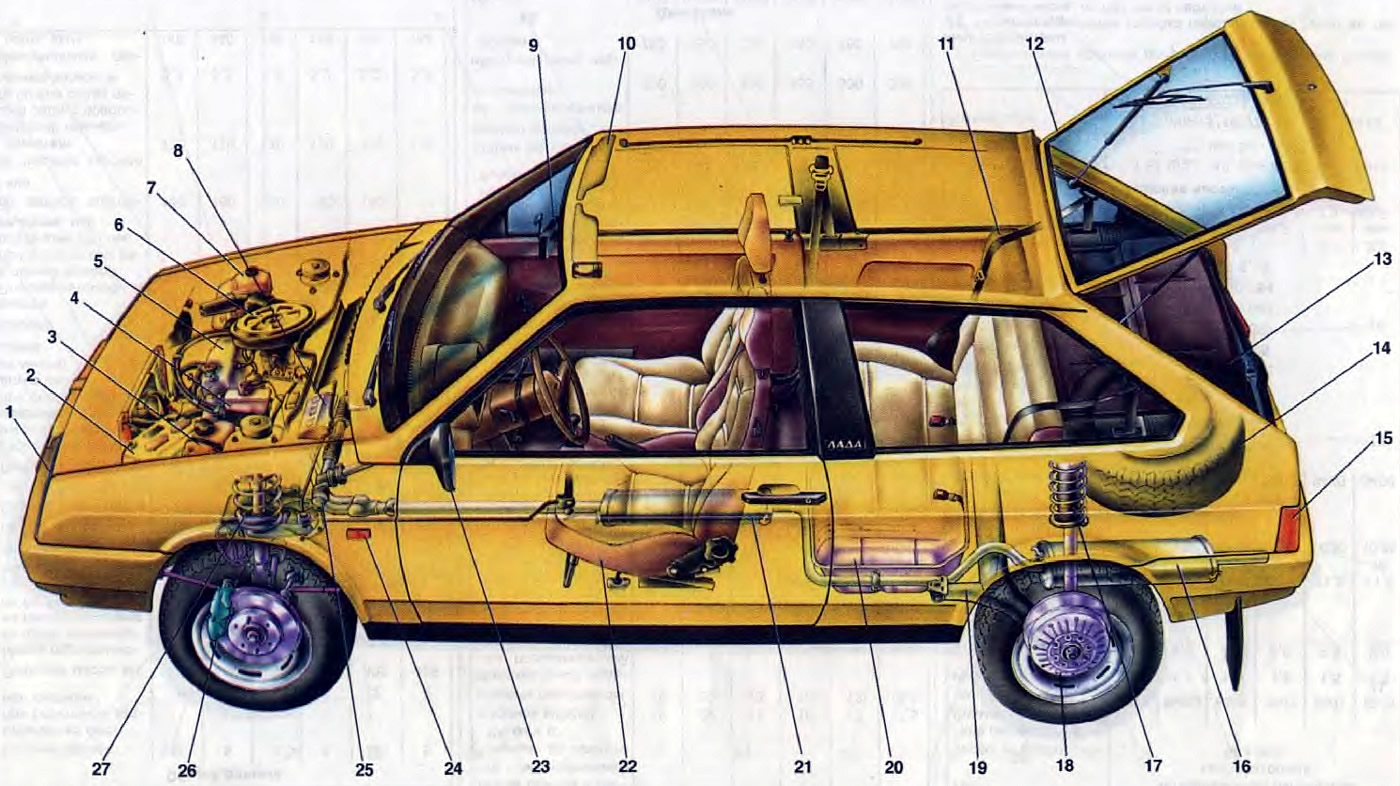
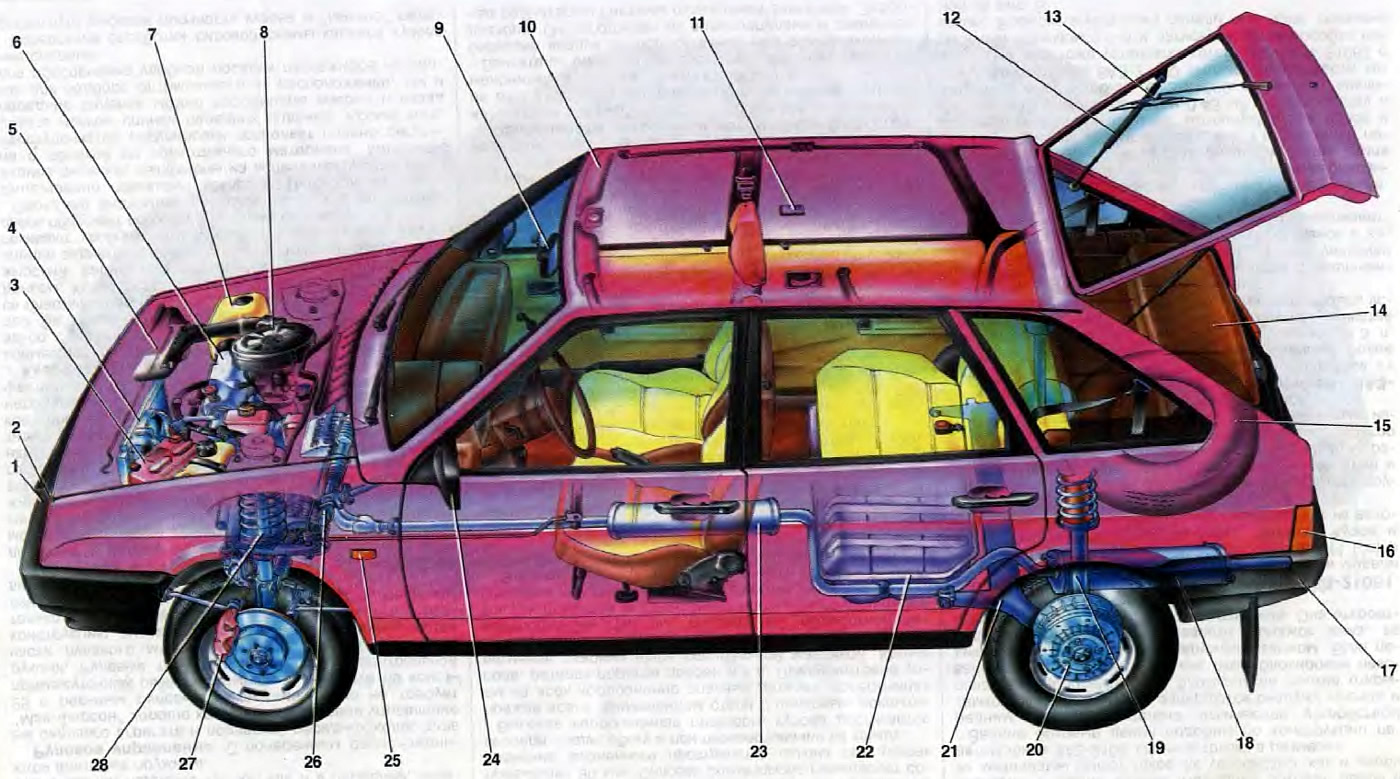
Fig. 1. The layout of the VAZ-2108 cars: 1. Block headlight; 2. Rechargeable battery; 3. Expansion tank of the cooling system; 4. Tank for hydraulic brake fluid; 5. Engine; 6. Engine air filter; 7. Reservoir for glass washer fluid; 8. Mounting block with fuses and relays; 9. Interior rearview mirror; 10. Sun visor; 11. Rear seat; 12. Tailgate; 13 Folding shelf; 14. Spare wheel; 15. Rear light; 16. Main muffler; 17. Rear suspension shock absorber; 18 Rear axle; 19. Rear suspension beam; 20. Fuel tank; 21. Additional muffler; 22. Front seat, 23. Outside rearview mirror, 24 Side turn signal; 25 Steering gear; 26. Front brake: 27. Telescopic front suspension strut.
Cars VAZ-2108, VAZ-2109 and modifications based on them are primarily front-wheel drive cars. Their layout is characterized by the front and transverse arrangement of the power unit (engine assembly with gearbox, final drive and differential) From it, the torque is transmitted to the front wheels using shafts of unequal length, at the ends of which hinges of equal angular velocities are installed. The front drive wheels create high vehicle stability against side skidding. The coincidence of the direction of the traction force on the front drive wheels with the direction of movement of the wheels provides the vehicle with good handling, maneuverability and maneuverability, especially on slippery and icy roads.
The front-wheel drive layout, in comparison with the rear-wheel drive, allows you to better use the length of the car and reduce its weight, make the cabin and the landing of the driver and passengers more comfortable. The useful volume of the car increases without increasing its dimensions. This is due to the fact that there are no intermediate transmission links (driveline, rear axle) and therefore does not require the gearbox housing, which took up a lot of legroom on rear-wheel drive cars, and a large tunnel on the floor for the driveline. On front-wheel drive vehicles, only the exhaust system and the parking brake actuator are located in a small floor tunnel.
Very compact and the rear of the car. The fuel tank 20 is located under the rear seat, and the spare wheel 14 is located in the niche of the trunk floor. Thanks to this, a significant amount of luggage space has been obtained.
The wedge-shaped shape of the body makes it possible to improve its aerodynamic characteristics, i.e. reduce air resistance while driving. This is facilitated by smoothed outer surfaces of the body, a large slope of the front and rear windows, as well as a smooth transition of the outer surface of the front bumpers into the shaping surface of the body.
Low aerodynamic resistance, a new more economical engine, as well as the installation of new tires with reduced rolling resistance, made it possible to obtain low fuel consumption. With a decrease in fuel consumption is closely related to the reduction in vehicle weight, because. each kilogram of the car's own weight costs about 20 g of fuel per 100 km of track. The front-wheel drive layout of the car contributed to the weight reduction (no heavy rear axle, driveline), and a rational power circuit of the body, the widespread use of lightweight plastics and new structural materials.
Bumpers, various casings, heater parts, interior lining and trunk lining are made of plastic. The mass of plastic parts reaches 80 kg. The radiator and many parts of the gearbox are also made of aluminum alloys, which also made it possible to reduce the weight of both the power unit and the car as a whole.
Engine
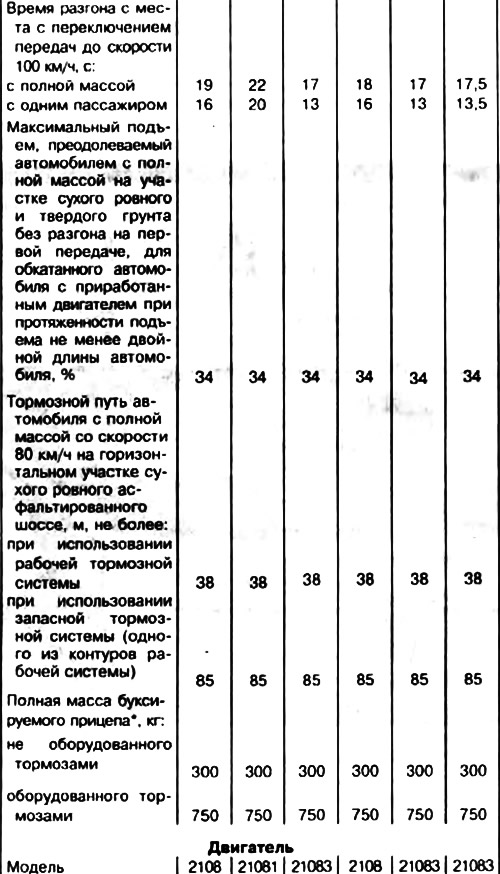
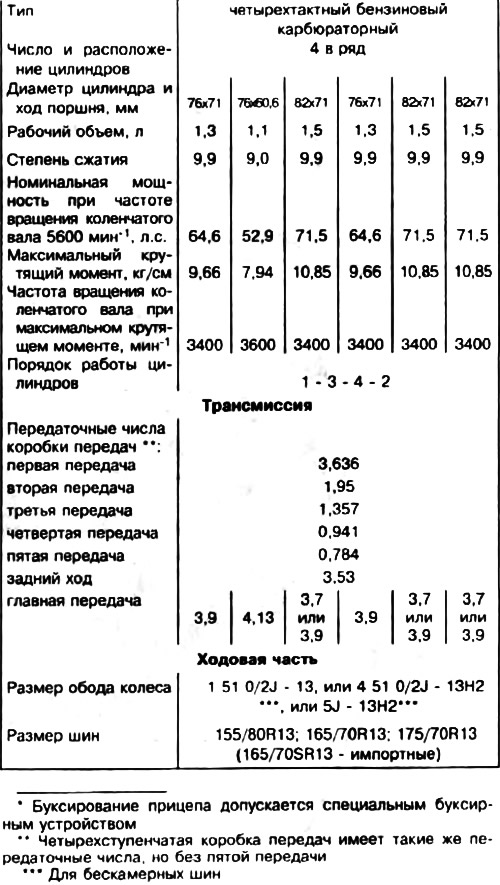
The car has a new engine, specially designed for a transverse arrangement, for which its length has been reduced to the maximum. The selection of the optimal combustion process, valve timing, the shape of the combustion chamber and gas channels - all this made it possible to bring the compression ratio in the engine to 9.9. Combined with a new carburetor and a non-contact ignition system, this improved engine efficiency.
Engine cooling system liquid closed type with forced circulation of liquid. Coolant pump of original design, located in front of the cylinder block and driven by a camshaft drive belt. Aluminum radiator with plastic tanks.
The engine lubrication system has an original oil pump with internal gears. The pump is located at the front end of the crankshaft and does not have any additional drive. The oil filter is unified with the one used on the car VAZ-2105.
A fine fuel filter is installed in the power supply system. To stabilize the pressure at the inlet to the carburetor, a return fuel branch is provided to drain excess fuel back into the tank. A new carburetor has been used, which provides economical mixture formation in various engine operating modes.
Electronic non-contact engine ignition system The non-contact sensor in the ignition distributor is based on the use of the Hall effect, the correction of the ignition timing is mechanical due to centrifugal and vacuum regulators. High-voltage transistor switch The electronic ignition system increases the stability of the engine at low speeds and improves its efficiency.
Transmission
The transmission of the car is simple, compact and reliable. It is combined into a single unit, consisting of a clutch and gearbox with final drive and differential. The compactness of this unit made it possible to place the power unit across the car and drive the front wheels directly from the gearbox, which allows the most efficient use of engine power and reduce fuel consumption. The transmission has retained the high reliability and performance of previous models, while at the same time reducing the overall weight and noise level.
The gearbox is made according to a two-shaft scheme. All forward gears are synchronized. Most of the gearboxes are produced in a five-speed version, but the production of four-speed gearboxes is also envisaged. The use of low-viscosity engine oil in the gearbox reduces losses during transmission of torque and makes it easier to start the car in winter.
Single-disk dry clutch with a diaphragm pressure spring and increased wear resistance of friction linings. The clutch drive is cable, which makes it easier. There are no gaps in the drive, and the clutch release bearing is constantly pressed against the diaphragm spring with a force of 5-7 kgf.
Wheel suspension
The cars used a fundamentally new suspension of 27 front wheels of the type "rocking candle", also called the pendant after its inventor "McPherson". The spring in such a suspension is actually located above the axis of the rotary device and is loaded less than in a double-lever type suspension. There is only one arm in the suspension - the lower one. The suspension is compact, lightweight, has a large wheel travel and is more elastic.
The front suspension roll arm is negative, since the point of intersection of the wheel's axis of rotation with the roadbed lies outside the outer part of the vehicle. This helps to increase the stability of the car during braking, when the left and right wheels have different grip on the roadbed, and also reduces the effect of traction forces on steering.
The suspension of the front wheels is in good agreement with the rear suspension 19 of two levers swinging in the longitudinal plane, interconnected by a cross member that plays the role of a stabilizer. The elastic element in the rear suspension, as well as in the front, are helical springs.
Steering
With a transverse arrangement of the power unit and front wheel suspension type "McPherson" steering 25 is well assembled with rack and pinion steering. It does not require intermediate levers, is compact and simple in design. Steering rods are attached to the central part of the steering mechanism, which has simplified the design of the steering gear, since only two ball joints are used. This type of steering provides little effort on the steering wheel (9-12 kgf).
Brake system
The braking system has efficient front disc and rear drum brakes. Brake drive with vacuum booster, dual-circuit, with diagonal separation of circuits. One circuit serves the brake mechanisms of the left front and right rear wheels, the other - the right front and left rear wheels. This division of the circuits is the simplest and meets the requirements for brake efficiency in the event of failure of one of the circuits, when the car maintains a straight direction of movement and no more than 50% of the braking efficiency is lost.
Body
Body three-door two-volume type "hatchback". It combines the versatility of a cargo-passenger body with the sweeping lines of a sports car. The luggage compartment is separated from the passenger compartment by a folding plastic shelf installed behind the rear seat. The body can be easily transformed into a cargo-passenger version by folding the rear seat cushion and backrest forward. Large side doors make it easy for passengers to get in and out, while the back door makes it easy to load and unload luggage.
Front anatomical seats with headrests significantly increase comfort. They, as well as the rear seat, are made of foamed polyurethane with upholstery in knitted material. The stepless adjustment mechanism allows you to smoothly adjust the backrest of the front seats. In addition, the front seats can be moved forward and backward, both to select their optimal location, and to provide comfortable seating for passengers in the back seat.
Due to the development of the power circuit of the body frame, high strength of the body was achieved and "soft" dampening impact energy in the event of an accident. So in case of a frontal impact on a fixed obstacle at a speed of about 50 km / h, the windshield remains in the opening, the doors open easily, and the movement of the steering wheel into the passenger compartment does not exceed 90 mm. The power circuit of the body guarantees the preservation of the living space of the cabin during front, rear, side impacts and when turning over onto the roof.
High corrosion resistance of the body is achieved primarily by the use of zinc-coated steel on all corrosive parts, floor cross members, door sill parts, etc. Welded seams are sealed with special mastic. In addition, an increase in corrosion resistance is achieved by cataphoretic primer, special treatment of closed cavities and the application of an epoxy protective coating during the final processing of the body.
Electrical equipment
Electrical equipment is almost completely original. Electronics and specialized integrated circuits are widely used in devices and assemblies (voltage regulator, ignition switch, alarm relays). The vehicles are equipped with a low-maintenance or maintenance-free battery, a small-sized starter with an end collector, an electronic non-contact ignition system, a system of built-in sensors with instruments that controls the operation of the most important vehicle systems.
A new device has been introduced - an econometer, which allows you to select the most economical mode of movement. In addition to control devices, cars are equipped with a special diagnostic system. The connector for turning on the diagnostic equipment of service stations is located under the hood. It is connected to all control points of the electrical system. The diagnostic system allows you to examine the technical condition of the generator, voltage regulator, ignition system, battery, etc.
The electric windshield wiper has three operating modes - two permanent (but with different brush speeds) and one intermittent. Headlight cleaners are installed on some of the manufactured cars. For improvement of work of cleaners there is a washer of glasses.
Features of the device car VAZ-2109
Open large image in new tab »
Pic. 2. The layout of the VAZ-2109 cars: 1. Front bumper, 2. Block headlight; 3. Rechargeable battery; 4 Cooling system radiator; 5. Cold air intake; 6. Engine; 7. Reservoir for glass washer fluid; 8 Air filter; 9. Interior rearview mirror; 10. Sun visor; 11. Plafond interior lighting; 12. Tailgate stop; 13. Rear window cleaner; 14. Folding shelf; 15. Spare wheel; 16. Rear light; 17. Rear bumper; 18 Main muffler. 19. Rear suspension shock absorber; 20. Rear brake; 21. Rear suspension beam; 22. Fuel tank; 23. Additional muffler; 24. Outside rearview mirror; 25. Side direction indicator. 26. Steering gear; 27. Front brake. 28. Telescopic front suspension strut.
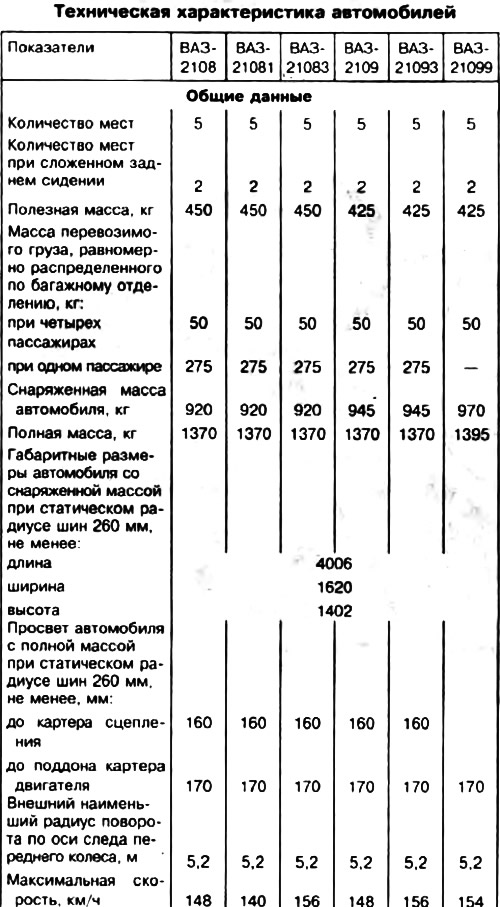
VAZ-2109 car (pic. 2) differs from the VAZ-2108 car in a five-door body and minor changes in the engine power system.
The engine is equipped with a cold air intake that takes air directly under the radiator grille. It is made of polypropylene and is fixed over the radiator of the engine cooling system. The intake is connected to the air filter thermostat with a polypropylene air duct.
Body frame of a different shape, with two openings for the front and rear doors. The front side doors and their mechanisms have the same device as the doors of the VAZ-2108 car. The difference is only in size.
The rear side doors are similar in design to the front. but slightly differ in the arrangement of the door locks. The locks are not locked from the outside with a key and are equipped with an additional blocking against opening the lock from the inside. The lever for this lock is located at the end of the door under the outer lock. If you move the lever down before closing the door, the door cannot be opened from the inside. It will only open with the outside door handle.
Features of the device car VAZ-21081
This car is equipped with a VAZ-21081 engine with a reduced displacement (1.1 l) and only a four-speed gearbox. The body and all other components and mechanisms are the same as on the VAZ-2108 car.
Engine (compared to model 2108) has a different cylinder block, cylinder head, crankshaft and camshaft. Due to the reduced engine displacement, a carburetor with different calibration data is installed, as well as a slightly modified exhaust system.
Features of the device of cars VAZ-21083 and VAZ-21093
These cars differ from the VAZ-2108 and VAZ-2109 cars by installing a more powerful 21083 engine with a displacement of 1.5 liters. In addition, they only use a five-speed gearbox. On some vehicles, a digital ignition system can be installed.
Engine 21083 has a cylinder block with an increased cylinder diameter (82 mm). Also increased the diameter of the pistons and the diameters of the intake valves and channels in the cylinder head. The carburetor is installed with other calibration data.
Features of the device of cars VAZ-21099
Open large image in new tab »
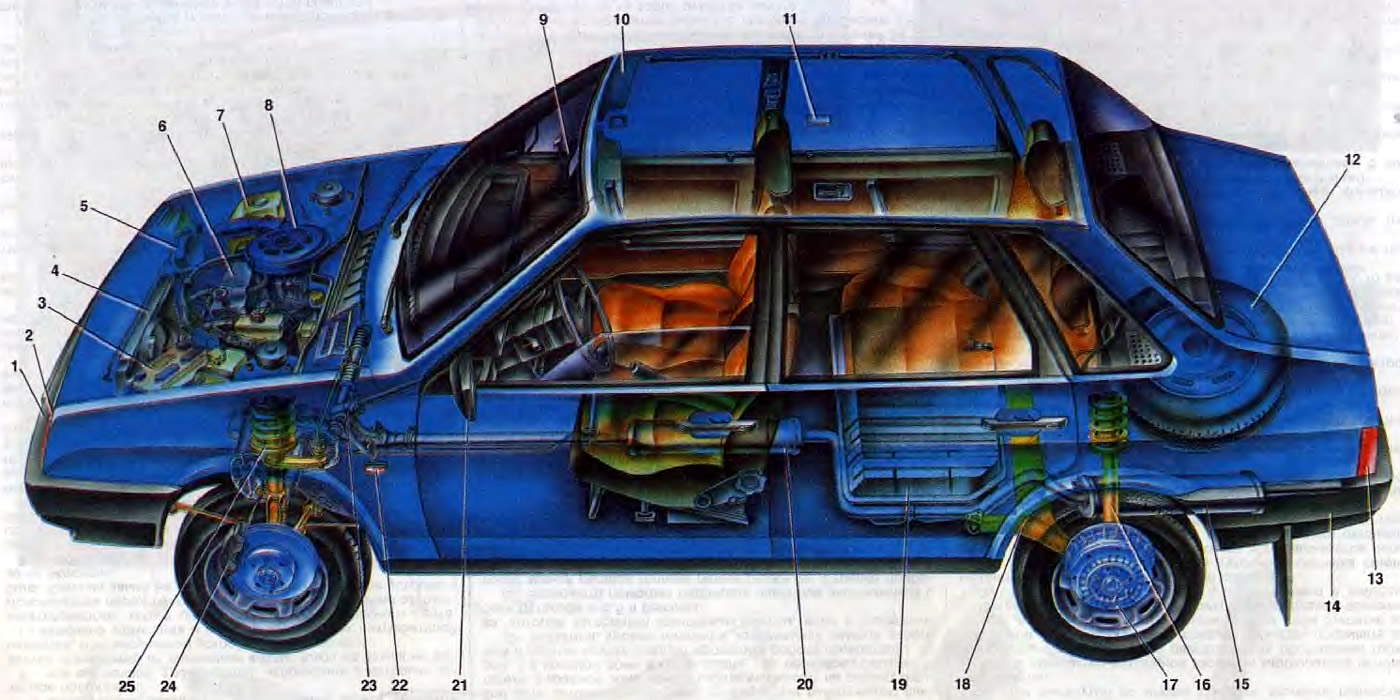
Pic. 3. Layout of cars VAZ-21099: 1. Front bumper; 2. Block headlight; 3. Rechargeable battery; 4. Cooling system radiator; 5 Cold air intake; 6. Engine, 7. Glass washer fluid reservoir; 8. Air filter; 9. Interior rearview mirror; 10. Sun visor; 11. Plafond interior lighting, 12. Spare wheel; 13. Rear light; 14. Rear bumper; 15. Main muffler; 16. Rear suspension shock absorber; 17. Rear brake; 18 Beam rear suspension; 19. Fuel tank; 20. Additional muffler; 21. Outside rear view mirror; 22. Side direction indicator; 23. Steering gear; 24. Front brake; 25. Telescopic front suspension strut.
The VAZ-21099 car differs from all the above cars in a four-door body type "sedan". His body is three-volume, i.e. divided by partitions into three volumes: engine compartment, saloon and luggage compartment with a volume of 0.43 m33. According to the device and layout, the VAZ-21099 car is completely similar to the VAZ-21093 car (except for the rear). It also has a 21083 engine with a displacement of 1.5 liters and a five-speed gearbox. It is possible to install the instrument panel shown in fig. 5.