




Sequence of execution
1. Prepare the car for work (see "Preparing the car for maintenance and repair").
Warning! The coolant level should be checked on a cold engine. A slight increase or decrease in the coolant level when the engine is warmed up and cooled down is not a malfunction. This is due to the thermal change in the volume of the liquid.
2. Check the coolant level in the expansion tank, which should be 25-30 mm above the "MIN" mark on the expansion tank body. If the fluid level is at the "MIN" mark or below, add coolant to the tank (see "Coolant - replacement").
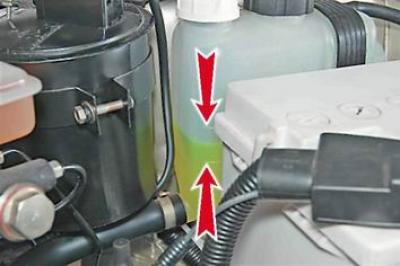
Recommendation: If you have to top up the coolant regularly, you should check the cooling system for leaks.
3. Check for fluid leaks from the radiator drain holes and engine block, temperature sensor installation locations, cooling system rubber hose connections, and their integrity.
Recommendation: Coolant leaks from under the hoses can be eliminated by tightening the hose clamps. Do not overtighten the clamps, as they can cut the hoses.
4. Check the integrity of the expansion tank housing, engine radiator and heater.
[The material is posted on the online resource VAZBOOK.ru]
5. We make sure that the thermostat housing is tight, as well as the connection between the coolant pump and the cylinder block.
6. Check for any leakage of liquid from the pump drain hole (is located at the bottom of the pump), indicating wear of its seal.
7. To check the thermostat, start the cold engine. We control the coolant temperature using the indicator on the instrument panel, and the circulation of the liquid in the small and large circles - by touch, by the change in temperature of the hoses and pipes of the cooling system.
Note: If the engine cooling system is in good condition, then when the coolant temperature is below 90°C, the main thermostat valve should be closed and the coolant should circulate in a small circle. As a result, the lower radiator hose and the radiator itself will be noticeably colder than the thermostat housing, through which the hot coolant circulates. When the coolant temperature reaches about 90°C, the main thermostat valve will open and a gradually increasing flow of hot liquid will begin to flow into the radiator. In this case, first the radiator and then its lower hose will begin to heat up.
When the temperature reaches 102°C, the main thermostat valve will open completely and the entire flow of liquid will circulate through the radiator. In this case, the radiator will be hot in the upper zone and slightly cooler in the lower zone.
8. Leave the engine running until the electric fan of the engine radiator is activated. When the coolant temperature rises to the value when the temperature gauge needle approaches the border of the red zone, the electric fan should turn on, and after the temperature drops, it should automatically turn off.
Recommendation: If the electric fan does not turn on in time, the liquid has boiled, it is necessary to check the serviceability of the engine control system or the serviceability of the fan electric motor.
Note: Checking the coolant temperature gauge sensor is shown in the section "Temperature gauge sensor - checking and replacing".