




The engine cooling system uses special liquids based on a mixture of water and ethylene glycol. They have a low freezing point and a high boiling point. In addition, due to the complex of added additives, the coolant prevents corrosion of the channel walls, does not foam, and extends the service life of the coolant pump seal.
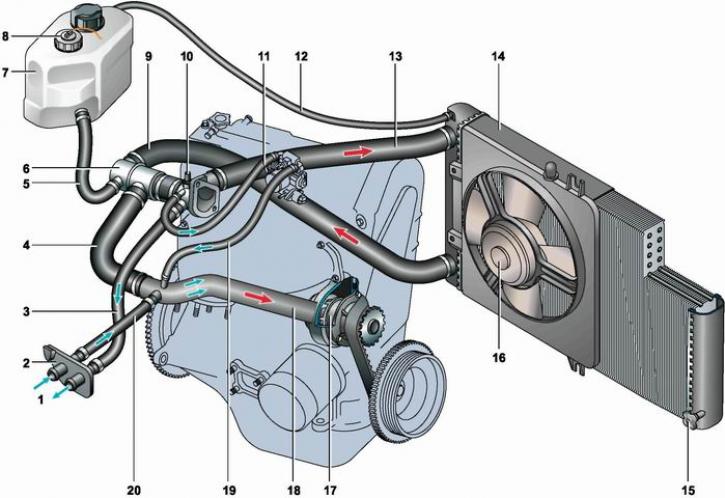
Cooling system: 1 - circulation of liquid through the heater radiator; 2 - heater tap; 3 - coolant supply hose to the heater radiator; 4 - coolant pump inlet pipe hose; 5 - expansion tank hose; 6 - thermostat; 7 - expansion tank; 8 - coolant level sensor in the expansion tank [Installed on some vehicles.]; 9 - hose for draining liquid from the engine radiator; 10 - coolant temperature sensor; 11 - hose for supplying liquid to the throttle assembly; 12 - Engine radiator steam outlet hose; 13 - hose for supplying liquid to the engine radiator; 14 - engine radiator; 15 - radiator drain plug; 16 - electric fan radiator; 17 - Coolant pump; 18 - Coolant pump inlet pipe; 19 - coolant drain hose from the throttle assembly; 20 - coolant drain hose from the heater radiator
The circulation of liquid in the system is provided by a centrifugal pump installed in the cylinder block. The pump is driven by a toothed timing belt.
Depending on the engine temperature, the liquid in the cooling system can circulate in either a small or a large circle. The thermostat controls the direction of the liquid flow in the engine cooling system. It has two valves - the main and the bypass (additional). The main valve controls the circulation of liquid in a large circle, and the bypass valve - in a small circle. The valves are interconnected - when one opens, the second closes, and vice versa.
On a cold engine, the bypass valve (additional) the thermostat valve is open and the liquid circulates in a small circle through the cylinder block, cylinder head, throttle assembly and heater radiator. The heater radiator is built into the engine cooling system and is designed to heat the passenger compartment by circulating hot coolant through it.
The text is copied from the online portal: VazBook.ru
At a temperature of about 87°C, the main thermostat valve begins to open and the bypass valve closes, and for some time the liquid circulates in the small and large circles simultaneously. At a temperature of 102°C, the main thermostat valve is fully open and the bypass valve is closed, and the entire liquid flow passes through the engine radiator, where it is cooled by the oncoming air flow. If the air flow is not intense enough, the radiator is cooled by an electric fan. It is installed behind the engine radiator and is switched on by a signal from the electronic engine control unit.
To compensate for the thermal expansion of the liquid, an expansion tank is installed in the cooling system. The tank cap contains inlet and outlet safety valves, which allows maintaining optimal pressure in the system when the liquid is heated, as well as compensating for the vacuum when it cools down.