




The clutch consists of a basket (pressure plate assembly) and the leading disk. The basket is a steel casing in which a pressure spring and a pressure disk are installed. The pressure disk is fixed in the casing on three pairs of elastic plates. From the casing side, the disk is pressed by a diaphragm-type pressure spring. The clutch basket is attached with six bolts to the flywheel and is closed by an aluminum crankcase. A driven disk is installed between the pressure disk and the flywheel.
Friction linings are riveted to both sides of the driven disk. To dampen torsional vibrations at the moment of clutch engagement, a damper with six cylindrical springs is built into the driven disk. The hub of the driven disk is splined into engagement with the primary shaft of the gearbox.
The clutch pedal is suspended on the same axis as the brake pedal and is attached to the body via the pedal bracket. The upper part of the clutch pedal is designed as a double-arm lever. A release spring is attached to one end of it, and the upper end of the clutch release cable is attached to the other. The cable is laid in a metal sheath with a polyethylene coating. The upper end of the sheath is held in the hole in the engine compartment bulkhead by a rubber buffer, and the lower end is secured with two nuts in the hole in the bracket installed on the gearbox housing. The lower end of the cable is covered with a rubber corrugated cover. The cable is connected to the clutch release fork lever via a metal leash. To prevent spontaneous disconnection of the cable from the fork lever, a protrusion A is made on the leash (see Fig.).
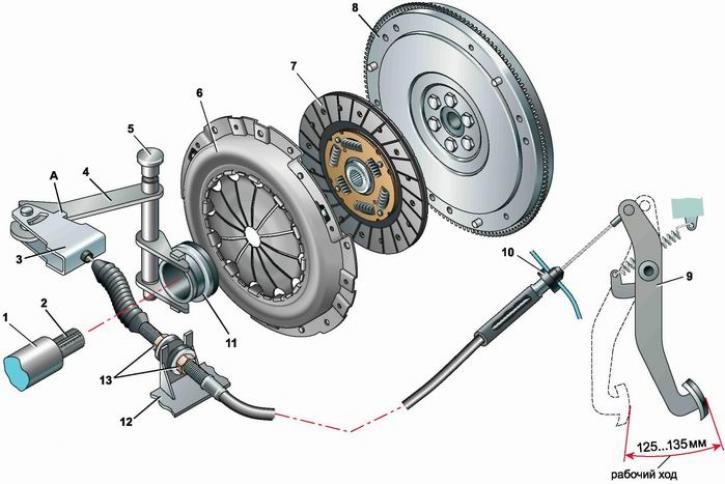
Clutch: 1 - release bearing guide sleeve; 2 - primary shaft of the gearbox; 3 - cable leash (A - protrusion); 4 - clutch release fork; 5 - fork axle bushing; 6 - pressure plate assembly (basket); 7 - driven disk; 8 - flywheel; 9 - clutch pedal; 10 - buffer; 11 - Clutch release sleeve (release bearing); 12 - bracket on the gearbox housing; 13 - cable adjusting nuts
The clutch release fork rotates in two bushings. The upper bushing is plastic and removable, and the lower one is bronze and pressed into the clutch housing. When the fork rotates, the force is transmitted to the petals of the pressure spring through a radial thrust ball bearing (release bearing). The bearing is mounted on the clutch release sleeve, through which it contacts the clutch release drive fork. The constant engagement of the fork and the sleeve is ensured by a U-shaped spring. The clutch release sleeve moves along a guide sleeve mounted on the primary shaft of the gearbox and secured to the clutch housing with three bolts.
The absence of gaps in the clutch release drive is ensured by the clutch pedal return spring. Due to this, the clutch release sleeve is pressed against the petals of the pressure spring, and the release bearing works continuously. The bearing is lubricated for its entire service life.
During operation, the driven disk linings wear out. As they wear out, the clutch pedal rises above the floor and its travel increases. Therefore, when performing maintenance, it is necessary to check the condition of the clutch and adjust the clutch pedal travel.
If the driven clutch disc is not replaced in a timely manner, the metal rivets securing the friction linings may touch the working surfaces of the pressure plate and flywheel, leaving grooves on them.