Contents: Engine ↓ Transmission ↓ Transmission ↓ Steering ↓ Front wheel suspension ↓ Rear wheel suspension ↓ Brakes ↓ Electrical equipment ↓ Car body ↓
Open large image in new tab »
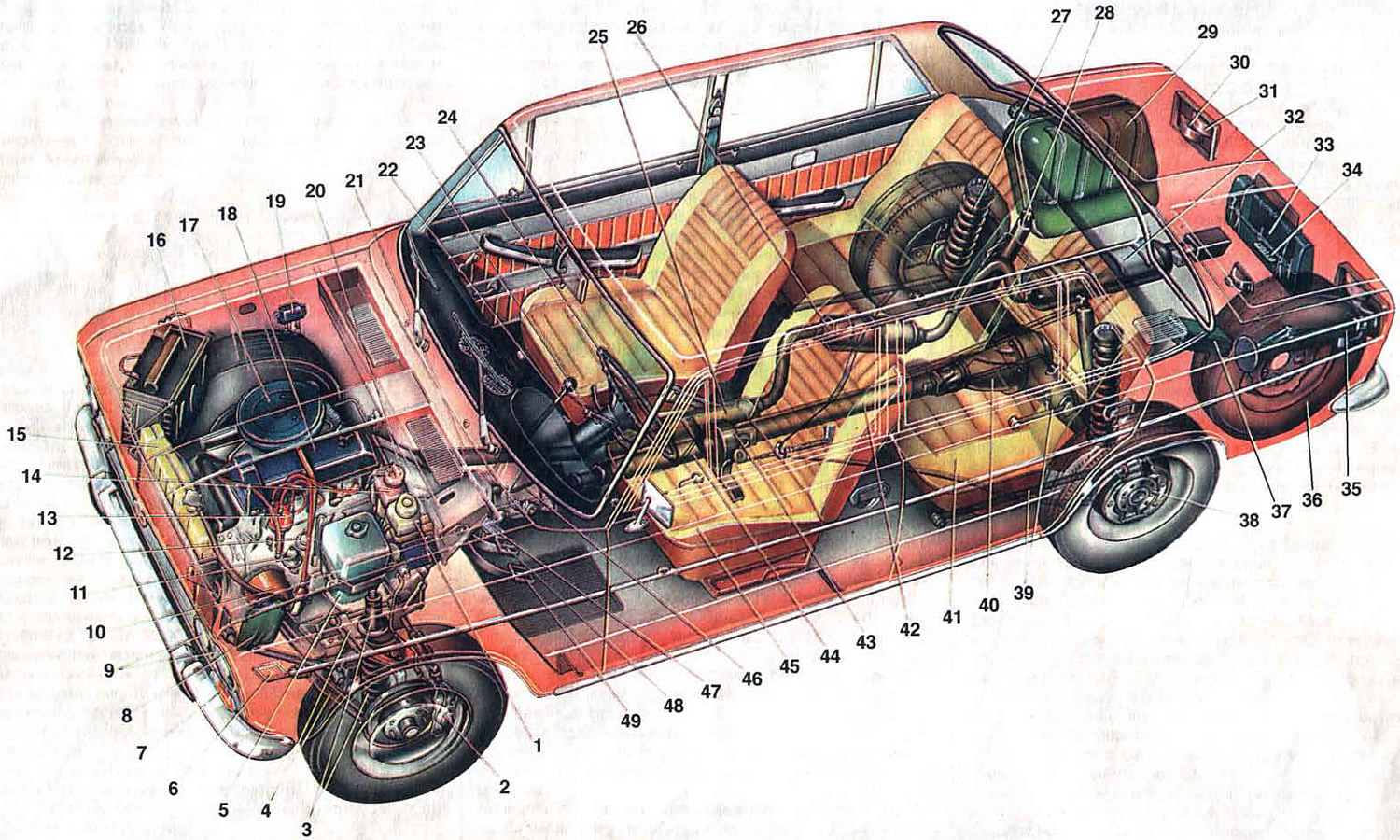
Fig. 1. Layout of VAZ-2103 cars.
1. Clutch fluid reservoir; 2. Front brake; 3. Front suspension spring shock absorber; 4. Front suspension arms; 5. Expansion tank of the engine cooling system; 6. Side direction indicator; 7. Sidelight; 8. Windshield washer reservoir; 9. Headlights; 10. Oil filter; 11. Fuel pump; 12. Oil level indicator; 13. Ignition distributor; 14. Brake fluid reservoir; 15. Radiator; 16. Battery; 17. Air filter; 18. Engine; 19. Battery charge indicator lamp relay; 20. Clutch housing; 21. Muffler inlet pipe; 22. Gear shift lever; 23. Parking brake lever, 24. Steering wheel; 25. Front additional muffler; 26. Rear additional muffler; 27. Rear suspension spring; 28. Rear shock absorber; 29. Fuel tank; 30. Rear direction indicator, 31. Brake light and parking light; 32. Main muffler; 33. Tool bag; 34. Registration plate light; 35. Jack; 36. Spare wheel; 37. Toolbox; 38. Rear brake; 39. Longitudinal reaction rods of the rear suspension; 40. Rear axle; 41. Back seat; 42. Rear propeller shaft; 43. Intermediate support of the cardan transmission; 44. Front propeller shaft; 45. Front seat; 46. Gearbox; 47. Throttle pedal; 48. Wheel brake hydraulic pedal; 49. Clutch hydraulic pedal.
1. Clutch fluid reservoir; 2. Front brake; 3. Front suspension spring shock absorber; 4. Front suspension arms; 5. Expansion tank of the engine cooling system; 6. Side direction indicator; 7. Sidelight; 8. Windshield washer reservoir; 9. Headlights; 10. Oil filter; 11. Fuel pump; 12. Oil level indicator; 13. Ignition distributor; 14. Brake fluid reservoir; 15. Radiator; 16. Battery; 17. Air filter; 18. Engine; 19. Battery charge indicator lamp relay; 20. Clutch housing; 21. Muffler inlet pipe; 22. Gear shift lever; 23. Parking brake lever, 24. Steering wheel; 25. Front additional muffler; 26. Rear additional muffler; 27. Rear suspension spring; 28. Rear shock absorber; 29. Fuel tank; 30. Rear direction indicator, 31. Brake light and parking light; 32. Main muffler; 33. Tool bag; 34. Registration plate light; 35. Jack; 36. Spare wheel; 37. Toolbox; 38. Rear brake; 39. Longitudinal reaction rods of the rear suspension; 40. Rear axle; 41. Back seat; 42. Rear propeller shaft; 43. Intermediate support of the cardan transmission; 44. Front propeller shaft; 45. Front seat; 46. Gearbox; 47. Throttle pedal; 48. Wheel brake hydraulic pedal; 49. Clutch hydraulic pedal.
Open large image in new tab »
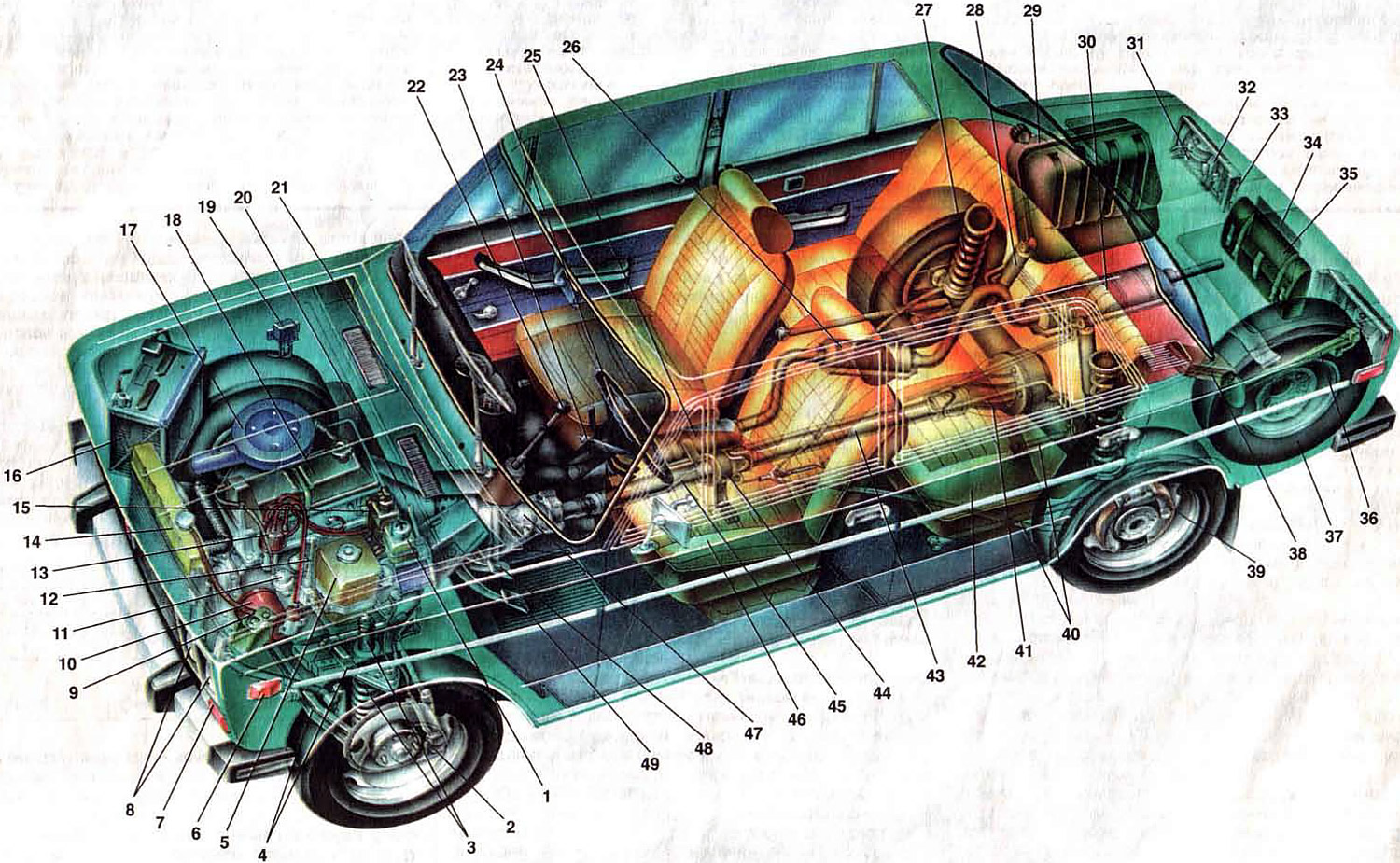
Fig. 2. Layout of VAZ-2106 cars.
1. Clutch fluid reservoir; 2. Front brake; 3. Front suspension spring and shock absorber; 4. Front suspension arms; 5. Expansion tank of the engine cooling system; 6. Side direction indicator; 7. Sidelight; 8. Headlights; 9. Windshield washer reservoir; 10. Oil filter; 11. Fuel pump; 12. Engine oil level indicator; 13. Ignition distributor; 14. Radiator; 15. Brake fluid reservoir; 16. Battery; 17. Air filter; 18. Engine; 19. Battery charge indicator lamp relay; 20. Clutch housing; 21. Muffler inlet pipe; 22. Gear shift lever; 23. Parking brake lever; 24. Steering wheel; 25. Front additional muffler; 26. Rear additional muffler; 27. Rear suspension spring; 28. Rear shock absorber; 29. Fuel tank; 30. Main muffler; 31. Rear direction indicator; 32. Brake light; 33. Registration plate light; 34. Registration plate; 35. Tool bag; 36. Jack; 37. Spare wheel; 38. Toolbox; 39. Rear brake; 40. Longitudinal reaction rods of the rear suspension; 41. Rear axle; 42. Back seat; 43. Rear propeller shaft; 44. Intermediate support of the cardan transmission; 45. Front propeller shaft; 46. Front seat; 47. Gearbox; 48. Wheel brake hydraulic pedal; 49. Clutch hydraulic pedal.
1. Clutch fluid reservoir; 2. Front brake; 3. Front suspension spring and shock absorber; 4. Front suspension arms; 5. Expansion tank of the engine cooling system; 6. Side direction indicator; 7. Sidelight; 8. Headlights; 9. Windshield washer reservoir; 10. Oil filter; 11. Fuel pump; 12. Engine oil level indicator; 13. Ignition distributor; 14. Radiator; 15. Brake fluid reservoir; 16. Battery; 17. Air filter; 18. Engine; 19. Battery charge indicator lamp relay; 20. Clutch housing; 21. Muffler inlet pipe; 22. Gear shift lever; 23. Parking brake lever; 24. Steering wheel; 25. Front additional muffler; 26. Rear additional muffler; 27. Rear suspension spring; 28. Rear shock absorber; 29. Fuel tank; 30. Main muffler; 31. Rear direction indicator; 32. Brake light; 33. Registration plate light; 34. Registration plate; 35. Tool bag; 36. Jack; 37. Spare wheel; 38. Toolbox; 39. Rear brake; 40. Longitudinal reaction rods of the rear suspension; 41. Rear axle; 42. Back seat; 43. Rear propeller shaft; 44. Intermediate support of the cardan transmission; 45. Front propeller shaft; 46. Front seat; 47. Gearbox; 48. Wheel brake hydraulic pedal; 49. Clutch hydraulic pedal.
The VAZ-2103 and VAZ-2106 family cars are models of consistent development of the design of small-capacity Zhiguli cars. They are distinguished by good dynamic qualities and comfort. At the same time, for the most complete satisfaction of customer requests, based on the basic VAZ-2103 and VAZ-2106 models, the plant produces modifications of cars that differ mainly in the installation of engines with a different working volume of cylinders.
Layout (arrangement of units and assemblies) vAZ-2103 and VAZ-2106 cars - classic, i.e. the engine is located in front along the centerline of the car, and the rear wheels are the driving wheels. Torque from the engine is transmitted to the rear wheels through transmission units, which include the clutch, gearbox, cardan transmission, main gear, differential and rear axle axle shafts. The engine, together with the clutch and gearbox, forms a power unit, which is attached to the car at three points on rubber supports.
The design of the cars takes into account the requirements of active and passive safety, which have always been given great attention at the Volga Automobile Plant. The cars meet all the safety requirements of the UN Economic Commission for Europe.
Engine
The cars are equipped with unified VAZ engines of varying power depending on the car model or its modification. The engines are four-stroke, carburetor, in-line, with an overhead camshaft.
The engine lubrication system is equipped with a full-flow oil filter 10 and is designed for the use of special oils with a complex of additives that give the oil high lubricating properties, resistance to oxidation and allow operation in a wide range of temperatures. The crankcase ventilation system is a closed type, provides for the suction of gases from the crankcase into the intake manifold and increases the durability of the engine.
The cooling system is liquid, closed type. The engine cooling system includes a body heater, into which the liquid comes from the cylinder head through the tap and is diverted to the pump. The cooling liquid is a special one with a low boiling point, does not affect metals and rubber. The liquid is poured at the factory, and does not require replacement for two years.
The engine fuel system includes an air filter 17, a carburetor, a fuel pump 11 with a manual fuel pumping lever and a fuel tank. The falling flow carburetor has two sequentially switched mixing chambers.
The carburetor is equipped with a highly efficient dry-type air filter, which has a paper filter element with an additional cleaner made of non-woven synthetic fiber. The fuel tank 20 is located in the trunk.
The exhaust system is equipped with three consecutively located mufflers. The system units, connected with clamps, are fastened to the body floor with two rubber belts on the main muffler body and a rubber cushion for the exhaust pipe.
Transmission
The clutch is a single-disk dry clutch with a diaphragm pressure spring and a torsional vibration damper (damper) on the driven disk. The clutch is controlled by a foot pedal with a servo spring and a hydraulic drive.
Transmission
Gearbox 46 has four forward gears and one reverse gear. A five-speed gearbox can be installed on cars in a variant design. All forward gears are equipped with synchronizers, which equalize the rotation speeds of the connected parts before the gears are engaged. The selected gear ratios provide confident starting, good acceleration and high efficiency.
The cardan transmission transmits torque from the gearbox to the main gear and consists of two shafts with an intermediate support 43, a rubber coupling and two cardan joints on needle bearings.
The main gear and differential are located in the rear axle housing. The main gear is bevel gear, hypoid engagement, the differential is double-satellite.
Steering
The steering consists of a steering mechanism and a steering drive that transmits the driver's force to the steered wheels. The steering gear reducer is a worm gear with a globoid worm and a double-ridge roller. The gear ratio of the reducer is 16.4. The steering drive is three-link, includes one middle and two lateral symmetrical rods, a pitman arm, a pendulum and rotary levers.
Front wheel suspension
The front suspension is independent, on wishbones, with cylindrical springs, telescopic hydraulic shock absorbers of double action and an anti-roll bar. The shock absorbers are located inside the springs.
The stamped upper and lower 4-arm suspension arms are connected to the forged steering knuckle via two ball joints.
Using rubber-metal hinges, axles, bolts and nuts, the lower arms are connected to the front suspension crossmember, and the upper arms are connected to the supporting part of the body.
The torsion stabilizer bar reduces the lateral tilt of the body when turning and reduces lateral body swings. It is connected to the body and lower arms using brackets that cover the rubber pads of the stabilizer bar.
Rear wheel suspension
The rear wheel suspension is dependent, with cylindrical springs and hydraulic telescopic shock absorbers of double action. It is a rigid beam (rear axle) 40, connected to the body by one transverse and four longitudinal rods 39. Has three compression buffers located at the ends of the rear axle beam and in the center. Shock absorbers 28 are installed outside the springs and are attached from above to the body, and from below - to the ends of the rear axle beam through conical rubber bushings.
Brakes
The brake system is equipped with a hydraulic drive to the wheel mechanisms, is controlled by a suspended pedal and acts on all wheels. Parking and spare brake system (emergency) braking (i.e. handbrake) is controlled by lever 23 (Fig. 2) and acts only on the rear wheels. This system has a mechanical cable drive.
Front brakes 2 - disc, consist of a disc and a support. The disc is attached to the wheel hub, and the support, covering the brake disc, is attached to a bracket mounted on the pivot pin. Inside the support are wheel hydraulic cylinders with pistons that transmit forces to the pads with friction linings.
The rear brakes 39 are drum brakes with self-adjusting shoes, driven by one main cylinder or by a mechanical drive lever. The aluminum drum of the rear brake contains a cast iron working ring.
The hydraulic brake drive consists of two independent circuits (systems) for braking the front and rear wheels. Therefore, the reservoir has two capacities for brake fluid, and the main cylinder has two independent cavities with two pistons. Two independent systems are introduced for safety: if one of them is damaged, (liquid leak or pipeline damage), the second one remains in operation. The pressure regulator in the rear cable drive system reduces the likelihood of wheel locking when braking.
Electrical equipment
The electrical equipment of cars is made according to a single-wire circuit, in which the negative terminals of current sources and electricity consumers are connected to the "ground", which acts as a second wire.
The current sources in the system are an alternating current generator of the G-221 type with a built-in semiconductor rectifier and a lead-acid battery of the 6ST-55 type.
To start the engine, a ST-221 starter with an electromagnetic traction relay and a roller overrunning clutch is used.
The ignition system includes an ignition coil, an ignition distributor with a breaker, a centrifugal automatic device and a vacuum corrector of the ignition timing angle, high and low voltage wires, spark plugs and an ignition switch.
The lighting and light signaling system of vehicles provides low and high beam illumination of the road, designation of the vehicle dimensions with signal lights, illumination of control and measuring instruments and interior lighting of the body, as well as light signaling of vehicle turns and the operation of individual engine and vehicle systems.
The main external lighting devices are headlights, sidelights, side direction indicators, rear lights, reflectors and license plate lights.
The interior is illuminated by two lamps, which are switched on by switches located on the lamp housings. In addition, there are door switches on the pillars of the front and rear doors. When either door is opened, both lamps are switched on.
The instrument panel contains a tachometer, a speedometer with trip meters, a coolant temperature gauge, a fuel gauge with a reserve indicator lamp, and an oil pressure gauge with a low pressure indicator lamp. In addition, the speedometer and tachometer contain six indicator lamps.
The original is available on the online resource: vazbook.ru
Car body
The car body is of the "sedan" type, all-metal, load-bearing structure, i.e. the one to which the power unit is attached (engine assembly with gearbox and clutch) and all other units and mechanisms of the car. The body shell is a welded spatial truss, the main parts of which are the side pillars, the side members and sills of the floor, the side beam of the roof and various crossbars. These box-section elements in combination with the load-bearing internal and external panels and connecting parts give the structure the required rigidity.
The front doors with front hinges have two safety glasses: the front one is a rotary one with a handle and a lock, the rear one is a drop-down one with a drive from the window lifter handle. The front doors are locked with a key from the outside and a button from the inside; a locked door can be opened with an internal handle.
The rear doors with front hinges have two safety glasses: the front one is a drop-down glass with a handle drive, the rear one is fixed. The rear door lock has a lock. The door is locked from the inside with a button; a locked door cannot be opened with the inside handle. The locking device of each door consists of a lock, an internal drive of the lock with a handle, an outside handle and a latch located on the body pillar.
The windshield is of the "triplex" type, consisting of two layers of glass with a transparent plastic film between them, even if cracked, remains transparent. The rear and side windows are safe, tempered.
The hood, which opens in the direction of the vehicle's movement, is hung on the body along the front edge and secured at the rear at one point with a lock. The trunk is located in the rear part of the body. The trunk lid lock is locked and unlocked with a key. The trunk contains a spare wheel 37, a jack, and a set of driver's tools and accessories.
The front seats are separate with folding backrests and a mechanism for adjusting the seat position and backrest tilt. The rear seat is fixed and one-piece.
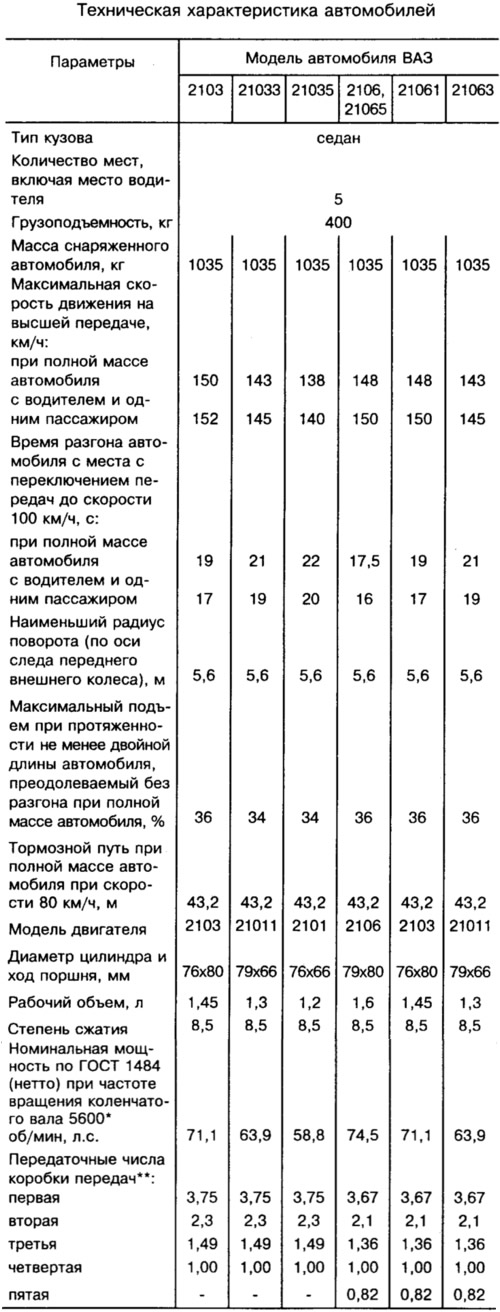
Modifications of VAZ-2103 cars differ in the installation of engines of different power (see "Technical characteristics of cars").
The VAZ-2106 car differs from the VAZ-2103 by installing a more powerful engine with a working volume of 1.6 liters, internal and external body design, and a modified equipment scheme. The VAZ-21061 and VAZ-21065 modifications differ from the VAZ-2106 by installing engines with a different working volume.
The VAZ-2106 modification is equipped with a 2106 engine, like the VAZ-2106 car, but is equipped with a five-speed gearbox and a final drive with a gear ratio of 3.9. A contactless ignition system and a 21053-1107010 carburetor (type "Solex"), halogen headlights, and an electrically heated rear window can be installed on the VAZ-21065. The upholstery and headrests of the seats have been changed in the body.