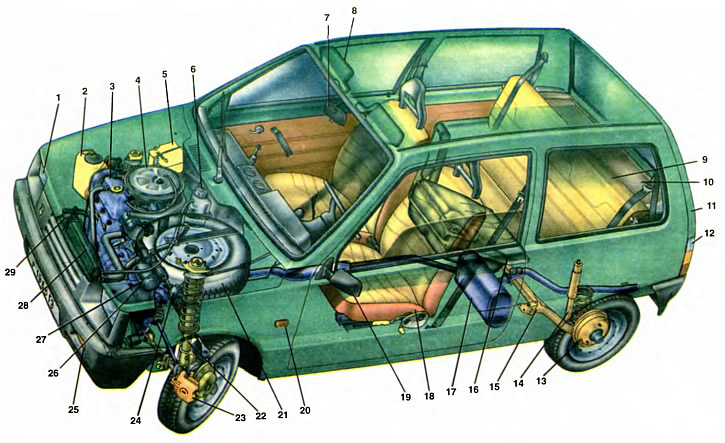
1. Headlight. 2. Windshield washer reservoir. 3. Engine. 4. Air filter. 5. Battery. 6. Expansion tank. 7. Inside rearview mirror. 8. Sun visor. 9. Rear seat. 10. Luggage compartment shelf. 11. Rear door. 12. Tail light. 13. Rear wheel brake drum. 14. Rear suspension shock absorber. 15. Rear suspension beam. 16. Fuel tank. 17. Main muffler. 18. Front seat. 19. Outside rearview mirror. 20. Side direction indicator. 21. Spare wheel. 22. Front suspension strut. 23. Front brake
The VAZ-1111 and VAZ-11113 models are a family of front-wheel drive cars belonging to the first group of the especially small class, which have not been produced by our industry before. They are designed for operation at ambient temperatures from -40° to +45°C on paved roads.
The layout of the car is characterized by a front transverse arrangement of the power unit (engine with gearbox, final drive and differential). From it, torque is transmitted to the front wheels using shafts of unequal length, at the ends of which are constant velocity joints.
Direct connection of the power unit with the drive wheels without intermediate transmission links (cardan transmission, rear axle) allowed to obtain good characteristics of the capacity of the cabin. The useful volume of the body is quite large with its relatively small dimensions. There is no gearbox casing in the footwell, and the body tunnel is also small, since it houses only the exhaust system, gearbox control drive and parking brake drive.
To reduce vibration loading of the body from the power unit, which occurs due to the uneven torque of the two-cylinder engine, the power unit is attached to the subframe, and not to the body side members. The front suspension assembly with brakes and the steering mechanism are also attached to the subframe. The subframe is connected to the body via elastic rubber bushings.
The rear of the car is also compact. The fuel tank is located under the rear seat, and the spare wheel is in the engine compartment.
The internal dimensions of the body allow to place four people of average height in it at the same time with the necessary comfort and a load weighing 40 kg. With the rear seats folded, the space for luggage increases and the weight of the transported cargo can reach 190 kg. At the same time, it provides transportation of large-sized items. The volume of the trunk with four passengers is 205 dm³.
The small dimensions of the car and the small radius of the front wheel tracks provide good maneuverability and make it easier to park the car in a small space.
The aerodynamic characteristics of the car are not inferior to similar cars. The average fuel consumption is 4.5 liters per 100 km at a speed of 90 km/h.
The car uses a front suspension of the "swinging candle" type, also called "McPherson" by the name of the inventor of the suspension. The spring in such a suspension is located actually above the axis of the turning device. The suspension is compact, has a small mass, a large wheel travel and is more elastic.
The front suspension is well combined with the rear suspension on longitudinal interconnected levers. The elastic element in the rear suspension, as well as in the front, are coil springs.
With a transversely mounted power unit and front suspension of the "swinging candle" type, the steering with a rack and pinion steering mechanism is well combined.
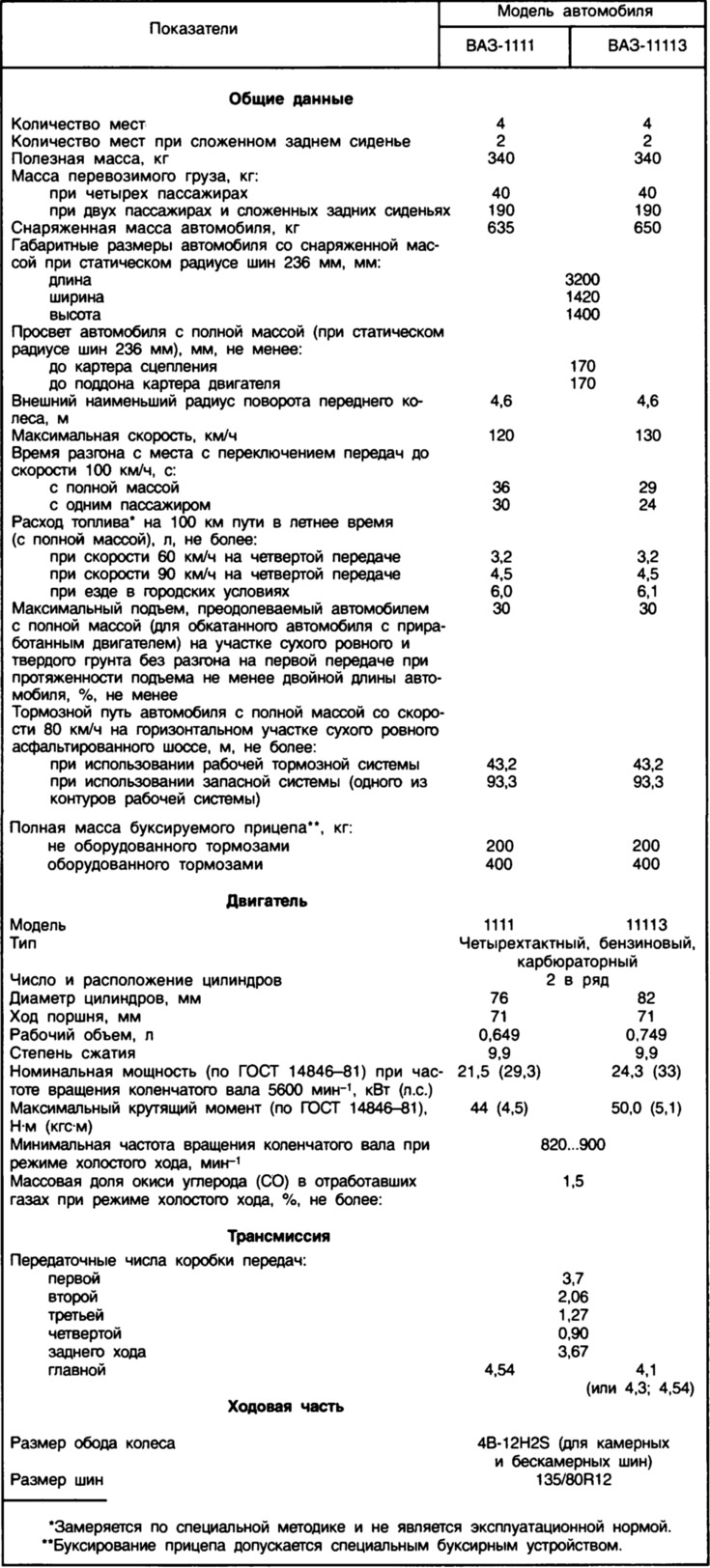
The main units, components and systems of front-wheel drive vehicles are characterized by the following data.
Engine. A family of engines has been developed for equipping cars, which includes two unified engines with a working volume of 0.65 and 0.75 liters, differing from each other in cylinder diameters (76 and 82 mm).
Improvement of the combustion chamber shape, increase of the compression ratio to 9.9, selection of optimal adjustments of the fuel and ignition systems and reduction of mechanical losses in the engine made it possible to provide sufficient power, responsiveness and high efficiency of the engine.
With a transverse arrangement of the power unit, its supports perceive not only vibrations, but also the torque transmitted to the wheels. In addition, a two-cylinder engine is more unbalanced compared to a four-cylinder engine. To balance the centrifugal forces of inertia of reciprocating masses and their moments, as well as to dampen vibrations caused by unbalanced forces and moments, a balancing mechanism is used in the engine.
The engines operate stably in all modes without detonation on AI-93 gasoline.
The engine cooling system is liquid, closed type. with forced circulation of liquid, with a compensation circuit. The coolant pump, borrowed from the VAZ-2108 model, is located in the engine block. The radiator is aluminum with plastic tanks, the electric fan and the temperature sensor are unified with previously produced models.
The engine lubrication system is combined. The oil pump is internally geared, interchangeable with the VAZ-2108 pump. The oil filter is unified with the filter VAZ-2105the lubrication system has a pressure reducing valve that opens at a pressure of 0.5 MPa (5 kgf/cm²).
[The original is available on the online resource: VAZbook.ru]
The fuel system has a two-chamber carburetor. This is explained by the fact that a single-chamber carburetor does not provide good mixture formation and rated power in all modes.
The carburetor control drive is cable-operated, similar in design to the VAZ-2108, but differs in the length of the cable.
The fuel pump is unified with the VAZ-2108 and differs in the direction and diameter of the fittings.
The ignition system is electronic, contactless. The spark moment sensor is built using the Hall effect, the ignition moment correction is mechanical due to the centrifugal regulator and vacuum corrector. The switch is on high-voltage transistors in discrete or integral design. Structurally, the ignition system is made in such a way that high voltage is supplied simultaneously to both spark plugs.
The transmission is compact and structurally made in one unit, consisting of a clutch, a gearbox combined with the main gear and differential, and a front wheel drive.
The clutch is single-disc, dry, with a central diaphragm spring and self-aligning clutch release bearing.
The clutch drive is cable-operated, there are no gaps in the drive.
The gearbox is four-speed, made according to the two-shaft scheme. All forward gears are synchronized, synchronizers are unified with the VAZ-2108.
The gearbox is combined with the main gear and differential. The main gear is cylindrical, helical. The differential is conical, two-satellite.
The front wheels are driven by two shafts through constant velocity joints.
The body is three-door, load-bearing, and has a niche behind the rear seat for cargo: the rear seats fold out, which allows for the transportation of large cargo.
The body frame ensures its high strength and "soft" absorption of impact energy in the event of an accident. The power scheme of the body guarantees the preservation of the living space of the passenger compartment in case of impacts from the front, rear, side and when rolling over onto the roof
Monoblock plastic bumpers also contribute to increased safety.
The corrosion resistance of the body is achieved by using zinc-coated steel on a number of parts (front fenders etc.). Sealing of welded seams with a special mastic is provided. In addition to the above, an increase in corrosion resistance is achieved by cataphoretic primer, special treatment of closed cavities and application of an epoxy protective coating.
Electrical equipment. Electronics and specialized integrated circuits are widely used in devices and units (voltage regulator, ignition system switch, signal relays).
The vehicles are equipped with a low-maintenance or maintenance-free battery, a compact starter with an end manifold, and an electronic ignition system.
The electric windshield wiper has two operating modes: continuous and intermittent.
The vehicle lighting and light signaling system provides low and high beam illumination of the road, designation of the vehicle dimensions with signal lights both when moving and when parked, illumination of control and measuring instruments and interior lighting of the body, as well as light signaling of turns and emergency conditions of the vehicle, reversing and the operation of individual engine and vehicle systems.
The main external lighting devices of the car are the headlights, side turn signals and rear lights with side lights, turn signals, reversing lights and brake lights. The license plate is illuminated by two lights. Some cars may be additionally equipped with a rear fog light.
The interior is illuminated by a lamp located in the center or on the side.
In addition, there are instrument lighting lamps and a cigarette lighter.
Technical specifications