




Open large image in new tab »
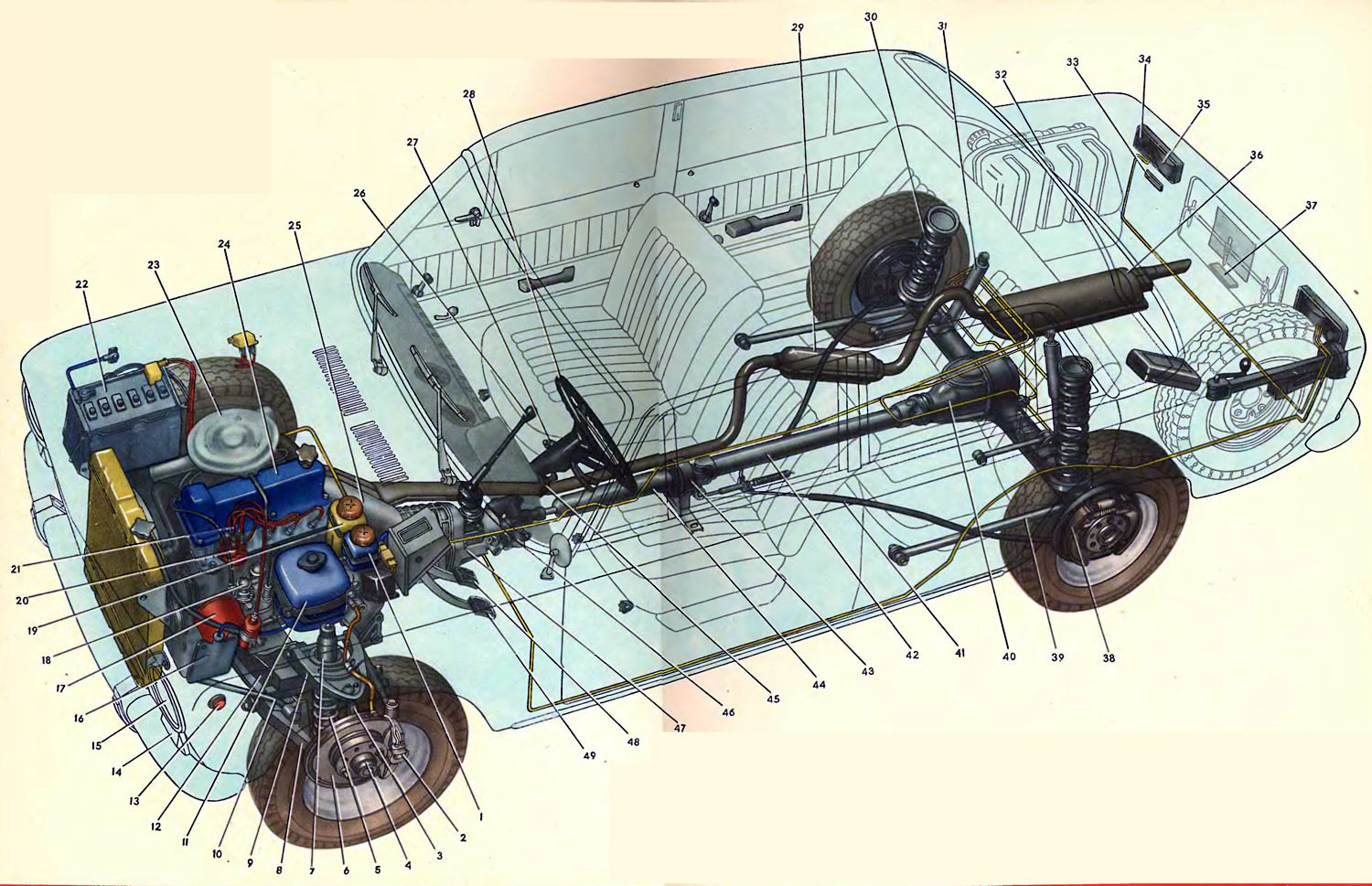
1. Hydraulic clutch fluid reservoir. 2. Front brake. 3. Rotary trunnion. 4. Front wheel hub. 5. Front suspension spring. 6. Front brake disc. 7. Front shock absorber. 8. Lower front suspension arm. 9. Upper arm of the front suspension. 10. Stabilizer bar. 11. Expansion tank of the engine cooling system. 12. Front engine suspension crossbar. 13. Side turn signal light. 14.Front light. 15. Headlight. 16. Windshield washer fluid reservoir. 17. Oil filter. 18. Fuel pump. 19. Hydraulic brake fluid reservoir. 20. Ignition distributor. 21. High voltage wires. 22. Rechargeable battery. 23. Air filter. 24. Engine. 25. Grip. 26. Gear shift lever. 27. Handbrake lever. 28. Steering wheel. 29. Additional silencer. 30. Rear suspension spring. 31. Rear shock absorber. 32. Fuel tank. 33. Light reflector (cataphot). 34. Rear turn signal light. 35. Brake light and marker light. 36. Main silencer. 37.License plate light. 38. Rear brake. 39. Longitudinal rods of the rear suspension. 40. Rear axle. 41. Cable operated handbrake. 42. Rear driveshaft. 43. Intermediate gimbal support. 44. Front driveshaft. 45. Ignition switch. 46. Elastic (elastic) cardan gear coupling. 47. Gearbox. 48. Brake pedal. 49. Clutch drive pedal.
VAZ cars are equipped with a four-stroke carburetor engine with an overhead camshaft. All engine units that require adjustment or maintenance are installed in easily accessible places.
The engine lubrication system is equipped with a full-flow oil filter 17 and is designed for the use of special oils with a complex of additives that provide the oil with high lubricating properties, resistance to oxidation and allow operation in a wide range of temperatures.
The engine crankcase ventilation system is a closed type, provides for the extraction of gases from the crankcase into the intake manifold and the inflow of fresh air filtered by a special filter element, increasing the durability of the engine.
Engine cooling is liquid. The cooling liquid is special with a low freezing point and a high boiling point, does not affect metals and rubber. The liquid is poured at the factory and does not require replacement for two years.
The cooling system is a closed type with a bypass channel and expansion tank 11, which compensates for changes in the volume and pressure of the liquid when the engine heats up.
The water pump is driven by a rubber V-belt. A four-bladed plastic fan is mounted on the pump shaft.
The thermostat in the cooling system serves to accelerate the warming up of the engine, its intake system and to automatically ensure the thermal regime of the engine.
The tubular-plate radiator is mounted on two rubber cushions and is attached to the front of the body with two bolts through steel struts and rubber bushings. The engine cooling system includes a body heater, into which liquid enters from the cylinder head through a tap and is diverted to the pump.
The exhaust system is equipped with two sequentially located mufflers 29 and 36.
The fuel system includes an air filter 23, a fuel tank 32, a fuel pump 18 and a carburetor. The carburetor with a falling flow has two sequentially switched on mixing chambers. The carburetor is equipped with a highly efficient dry-type air filter, which has a paper filter element with an additional cleaner made of non-woven synthetic fiber. Fuel tank 32 is located in the trunk. The filler neck is located on the VAZ-2101 and VAZ-2103 cars on the right rear side of the body, and on the VAZ-2102 - on the left.
The engine cylinder block, clutch housing and gearbox housing are connected to each other and form a compact power unit, which is mounted on the vehicle at three points on rubber cushions.
Torque from the engine crankshaft to the driving rear wheels of the car is transmitted through mechanisms and units that make up the transmission of the car. The transmission includes: clutch, gearbox, cardan transmission, main gear, differential and axle shafts. The cars are equipped with a single-disk dry clutch 25 with a diaphragm pressure spring, with a torsional vibration damper (damper) on the driven disk.
The clutch is controlled by a foot pedal 49 with a servo spring and a hydraulic release drive with a fluid reservoir mounted on the vehicle's front panel.
Gearbox 47 has four forward gears. All forward gears have synchronizers, which equalize the rotation speeds of the connected parts before the gears are engaged. The selection of gear ratios provides the car with confident starting, good acceleration and high efficiency. Gear shift lever 26 is located on the body floor.
The cardan transmission, consisting of two shafts 42 and 44 with an intermediate support 43 and equipped with two cardan joints on needle bearings and a rubber coupling 46, transmits torque from the gearbox to the main gear.
The main transmission, consisting of a pair of bevel gears with spiral hypoid teeth, increases the supplied torque and transmits it at a right angle to the axle shafts. The transmission of torque from the driven gear to the axle shafts occurs through a bevel differential with two satellites. The differential provides the driving wheels of the car (left and right) rotation at uneven speeds when turning corners.
The chassis of the car consists of front and rear wheel suspension units with shock absorbers and a 10 anti-roll bar in the front suspension, wheel hubs 4 and wheels with tires.
Front wheel suspension is independent, lever-spring, with 5 coil springs, with 7 double-acting telescopic hydraulic shock absorbers to dampen body vibrations on elastic suspension elements; it is equipped with a 10-bar anti-roll bar to increase the vehicle's stability and two compression buffers that limit the suspension travel.
The coil springs 5 of the suspension are placed between the lower arms and the mudguard pillar supports.
The torsion stabilizer 10 of transverse stability, which reduces the lateral tilt of the body when turning and reduces lateral rocking of the body, is connected to the body and lower arms by means of brackets that cover the rubber cushions of the stabilizer bar.
Hydraulic shock absorbers 7, located inside spring 5, have an eye at the bottom for fastening to the lower arm, and at the top - a rod with a threaded end for fastening to the body.
Hub 4 of the front wheel rotates on two tapered roller bearings mounted on journal 3.
The rear wheel suspension consists of two cylindrical coil springs 30 with telescopic hydraulic shock absorbers 31 of double action, four longitudinal 39 and one transverse rod, two compression buffers located at the ends of the rear axle beam DO, and one central one located in the middle. Coil springs 30 with rubber insulating rings at the top and plastic ones at the bottom rest with their upper end on the body, and with their lower end on cups welded to the rear axle beam.
Shock absorbers 31 of the rear suspension are installed outside the springs and are attached to the body from above, and to the ends of the rear axle beam from below through conical rubber bushings. Rubber buffers attached to the body floor above the axle beam 40 are designed to soften possible impacts of the rear axle beam that may occur when driving on poorly maintained roads. The buffer above the front neck of the main gear housing limits the upward travel of the housing, preventing the cardan shaft from touching the body floor.
The car wheels are disc, stamped, with removable decorative caps. Diagonal or radial tires with tubes are mounted on the wheels. The front wheels are fastened with five bolts to the flanges of the hub 4, the rear wheels - to the flanges of the axle shafts. The wheels with tires in the assembly are balanced statically and dynamically using weights fixed to the rim.
Control mechanisms, which include steering and brakes, are used to change the direction of movement, brake the car and keep it stationary.
The steering system consists of a steering mechanism and a steering drive that transmits force from the driver to the steered wheels.
The steering wheel 28, through the steering gear and drive, turns the front wheels, thereby changing the direction of movement of the car.
The worm gear housing of the steering gear is attached to the left side member of the body on the inside of the engine compartment. On the opposite side, the pendulum arm bracket is attached to the right side member.
The steering gear consists of two levers of the steering trapezoid, a pitman arm, a pendulum arm and three rods: one middle and two outer rods. The middle rod is one-piece and has ball joints at the ends for connection with the pendulum arm and the steering knuckle. Each outer rod consists of two threaded tips connected to each other by split adjusting couplings. By rotating them, the length of the side rods is changed and the toe-in of the wheels is adjusted. The adjusting couplings are fixed on the rods with clamping clamps. Each of the outer rods has ball joints at the ends for connection with the levers of the steering knuckles, the pendulum arm or the steering knuckle.
The vehicle braking system serves to reduce the speed of movement, stop and hold the vehicle stationary and has two independently operating drives.
The service brake system has a hydraulic drive to the wheel brake mechanisms, is controlled by a suspension-type pedal 48 and acts on all wheels.
Parking and spare system (emergency) braking - the handbrake is controlled by lever 27, installed on the floor between the front seats; the brake acts only on the rear wheels.
The hand brake has a mechanical cable drive 41.
The front brakes are disc brakes, consisting of a disc 6 and a support. Disc 6 is attached to the hub 4 of the wheel, and the support, which covers the brake disc, is attached to a bracket mounted on the pivot pin. Inside the support are wheel hydraulic cylinders with pistons that transmit force to the pads with friction linings.
The rear brakes 38 are drum brakes with self-adjusting shoes, driven by one cylinder with two pistons or by a mechanical drive lever. The aluminum rear brake drum has a cast iron working ring.
The hydraulic brake drive consists of two independent circuits (systems) for braking the front and rear wheels, so there are two tanks 19 for brake fluid or a tank with two capacities for brake fluid, and in the main cylinder there are two independent cavities with two pistons. Two independent systems are introduced for safety: in case of damage to one.
of them (liquid leak and pipeline damage) the second one remains in action.
A pressure regulator is installed in the hydraulic drive to the rear wheel brake mechanisms, which adjusts the braking pressure of the rear wheels depending on the load on them. The regulator is controlled by a torsion lever, which is attached at one end through a shackle to the rear axle, and at the other end is connected to the regulator piston.
The electrical equipment of cars is made according to a single-wire circuit, in which the negative terminals of the sources and consumers of electrical energy are connected to the ground, which acts as the second wire.
The current sources in the system are an alternating current generator with a built-in semiconductor rectifier and a lead-acid battery of the 6ST-55 type.
The ignition system includes an ignition coil, a distributor with an interrupter, high and low voltage wires, spark plugs and an ignition switch.
The lighting and light signaling system of vehicles provides low and high beam illumination of the road, designation of the vehicle dimensions by signal lights in a parking lot, illumination of control and measuring instruments and interior lighting of the body, as well as light signaling of vehicle turns and the operation of individual engine and vehicle systems.
The main external lighting devices are headlights, sidelights, side direction indicators, rear lights, reflectors and a license plate light.
The interior is illuminated by two lamps and, in addition, there are lamps for illuminating the instruments, glove compartment and cigarette lighter.
To illuminate the engine compartment, there is an underhood lamp with a push-button switch built into the socket. The underhood lamp turns on when the hood is opened. The trunk is illuminated by a lamp connected by a wire to the side lights.
The VAZ-2101 and VAZ-2102 cars are equipped with a combination of instruments consisting of a speedometer with a trip meter, a fuel level indicator with a fuel reserve lamp, and a temperature indicator of the liquid in the engine cooling system, all combined in one housing. In addition, the combination of instruments has six more control lamps.
The VAZ-2101 and VAZ-2102 cars can be equipped with radio receivers of the A-370 or RA-3602 model with the AP-108 antenna for both radio receivers.
The body of the VAZ-2101 car is a four-door, all-metal load-bearing structure.
The front doors with front hinges have two safety glasses: the front one is a rotary one with a handle and a lock, the rear one is a drop-down one with a drive from the window lifter handle. The front doors are locked with a key from the outside and a button from the inside; a locked door can be opened with an internal handle.
The rear doors with front hinges have two safety glasses: the front one is a drop-down glass with a handle drive, the rear one is fixed. The rear door lock has a lock: the door is locked from the inside with a button; the locked door cannot be opened with the inside handle. The doors are locked with rotary locks.
The hood, which opens in the direction of the vehicle's movement, is hung on the body along the front edge and secured at the rear at one point with a lock; the hood lock handle is located inside the body under the instrument panel on the left side.
The trunk is located in the rear part of the body. The trunk lid lock is locked and unlocked with a key. The trunk contains a spare wheel, a jack, a bag and a box with a set of driver's tools and accessories.
The windshield and rear windows have safe panoramic glass. The windshield is polished, three-layer, the rear window is tempered. The glass is sealed with rubber seals with decorative metallized plastic edging.
The front and rear bumpers are one-piece stamped steel, chromed, equipped with two metal fangs, on which plastic pads are fixed.
The instrument panel has a soft energy-absorbing coating and decorative trims.
The front seats with folding backs for the most comfortable fit move on runners along the body floor and have an adjustable backrest angle. The longitudinal movement of the seat is fixed by a latch, which is released by pressing the handle located at the front inner edge of the seats.
The mechanism installed on the outside of the seat provides coarse and fine adjustment of the seat back tilt. To return the seat back to its original position, simply pull the handle up.
The back seat is stationary.
Armrests on all doors are plastic; ashtrays are built into the rear seat armrests.
The front and rear floor sections are covered with rubber mats, and the luggage compartment floor is covered with a plastic mat. The interior upholstery of the body, including the seat upholstery, is made of polyvinyl chloride leatherette on a knitted and fabric base and polyvinyl chloride film of various colors and patterns. The headlining has a soft lining of glass wool over the entire surface, and the upholstery of the middle pillars of the sidewall and the windshield pillars is made of semi-rigid plastic.
Various mastics, textile-bitumen and felt materials and rubber mats are used to insulate the body heat and sound, eliminate vibration of its metal panels, and protect against corrosion.
The dust and water resistance of the body is ensured by the use of sealing mastics in the places where parts are connected and rubber seals in the openings of doors, trunk and windows.
The standard equipment of the car consists of:
- a body heating and ventilation system that includes a heater with a fan and casings that direct the air flow to blow the windshield and heat the body;
- two-speed windshield wiper;
- windscreen washer with diaphragm type pump and manual drive;
- an interior rear-view mirror with a handle for switching the mirror to a position in which the headlights of vehicles behind do not blind the driver;
- outside mirror located on the front fender on the driver's side;
- sun visors with soft upholstery that are mounted on hinged brackets that allow the visors to be positioned at the front at the top of the windshield or at the side of the door window;
- cigarette lighter - electric, with automatic switch-off;
- ashtrays in the rear seat armrests and on the dashboard;
- handrails installed above doorways;
- coat hooks on the rear rails.
The information can be read on the website [VAZBOOK.ru]
Each vehicle leaving the factory is equipped with a jack, a hand pump for inflating tires and a pressure gauge, a portable lamp, a crank and a set of tools. The tools and accessories are placed in a bag and a plastic box.
Features of the VAZ-2102 car
Open large image in new tab »
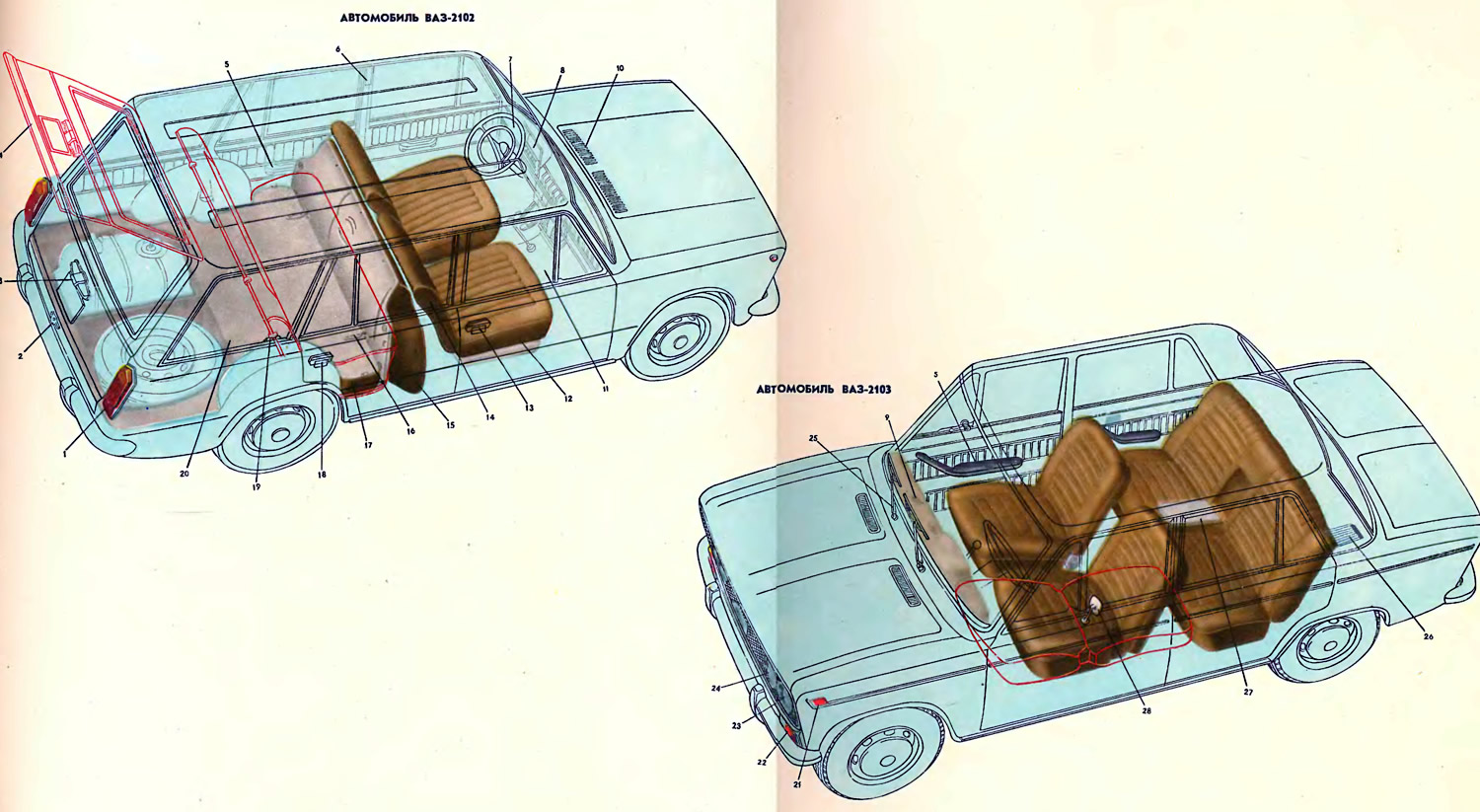
1. Tail light. 2. Tailgate handle with lock. 3. License plate light. 4. Tailgate. 5. Rear seat armrest. 6. Interior light. 7. Instrument panel. 8. Instrument cluster. 9. Air deflectors directing the air flow onto the windshield. 10. Air intake grille of the body ventilation and heating system. 11. Front door window. 12. Front seat. 13. Outer front door handle. 14. Rear door window. 15. Rear seat cushion. 16. Backrest support. 17. Rear seat backrest. 18. Outer rear door handle. 19. Rear seat backrest lock. 20. Side window. 21. Side direction indicator. 22. Sidelight. 23. High and low beam headlights. 24. High beam ball. 25. Windscreen wiper arms with blades. 26. Exhaust ventilation grille. 27. Rear seat center armrest. 28. Outside rearview mirror.
Unlike the VAZ-2101 vehicle described above, the VAZ-2102 vehicle has a station wagon body with four side doors and one rear door.
The single-leaf tailgate 4 with upper hinges and fixed glass serves to access the luggage compartment. In the open raised position, the door is held by a special torsion. The outer handle 2 of the tailgate has a lock with a key for locking the door from the outside. The rear side doors have a frame and glass of a modified shape, and in the sidewall behind the tailgate there is an additional fixed glass 20.
The volume of the luggage compartment can be further increased by folding down the cushion 15 and the backrest 17 of the rear seat. The cushion 15 in the folded state protects the front seats and limits the luggage compartment, and the backrest 17, set in a horizontal position, increases the floor area.
To illuminate the luggage compartment, a lamp with a built-in switch is installed.
The spare wheel and driver's tools are located in a special compartment under the cargo area of the luggage compartment.
The fuel tank is located under the rear floor of the body, and the filler cap is on the left side of the car.
In the VAZ-2102, unlike the VAZ-2101, the shape and location of the license plate light 3, rear lights 1, brake light and turn signal have been changed.
The car's rear suspension springs are different and can withstand greater loads. The wheels have a wider rim and larger tires.
Features of the VAZ-2103 car
Chassis. Wheels with wider rims are installed and radial tires of size 165-13P are used.
Steering. A new design steering wheel has been installed.
Brakes. A vacuum booster has been introduced into the brake drive system, a device for automatically setting the gap between the shoes and the drum has been added to the rear brakes, and a device for signaling a low brake fluid level has been added to the reservoirs. The vacuum booster is installed on a modified clutch and brake pedal bracket.
The handbrake lever design has been changed.
Electrical equipment. The placement of the battery in the front compartment has been changed and a cover has been added to protect the battery plugs. A four-headlight external lighting system with a headlight relay has been introduced. The 22-lamp sidelight with two lamps in a housing divided by a partition has a two-color diffuser; white - in the area of the parking light bulb and orange - in the area of the turn signal bulb. The design of the side turn signals 21 has been changed. The rear lights of the new design are combined with reflectors, which are glued to the red part of the diffuser.
The exterior lighting system has been supplemented with a reversing light mounted under the rear bumper; has a white plastic diffuser and lights up when reverse gear is engaged (if the outside lighting is on).
At the bottom of the front doors, on the end, there are door open signal lights with a red diffuser, which light up when the doors are opened, indicating the dimensions of the parked car with the door open.
The car is equipped with two sound signals of a modified tone, a horn type with a relay for turning on the sound signals.
The instrument panel has been redesigned, with an oil pressure gauge, engine tachometer, electric clock, carburetor air damper closure alarm and low brake fluid level alarm added. A daily trip meter has been added to the speedometer.
Body. The car's front end, exterior trim, interior upholstery and seats have been redesigned, the front and rear fenders, hood, trunk lid, bumpers, exterior and interior rear-view mirrors have been structurally modified. The rear seat has a folding middle armrest 27, and the doors have semi-rigid armrests with an energy-absorbing layer of plastic on a metal frame.
The hood has a heat- and noise-insulating gasket, attached with special buttons. The air intake grilles are made of metallized plastic.
The trunk is lined on the inside with a molded plastic sheet. The spare wheel is covered with a special cover.
The instrument panel has a modified ashtray and plastic-coated trim. At the bottom of the instrument panel is a radio panel in which a radio receiver and loudspeaker can be installed.
The central part of the cushion and seat backs is covered with cloth.
The front and rear floors are covered with moulded synthetic carpets, and the luggage compartment floor is covered with a plastic mat.
The differences in body equipment are as follows:
- the body ventilation system has an exhaust through the rear roof pillars;
- the outside openings of the exhaust ventilation are covered with special grilles 26;
- the windshield wiper has modified levers 25 and brushes, extended by 30 mm compared to the VAZ-2101;
- the windshield washer has a foot-operated pump and a larger capacity reservoir;
- the interior mirror, enlarged in size, is mounted on a ball joint and, for safety reasons, is torn off the bracket when hitting the mirror;
- the outside mirror 28, located on the left front door, has a hinged mounting bracket;
- side ashtrays are installed in the rear door panels.