




Contents: Engine ↓ Transmission ↓ Steering ↓ Chassis ↓ Brakes ↓ Electrical equipment ↓ Body ↓ Features of the VAZ-2104 car ↓
Open large image in new tab »
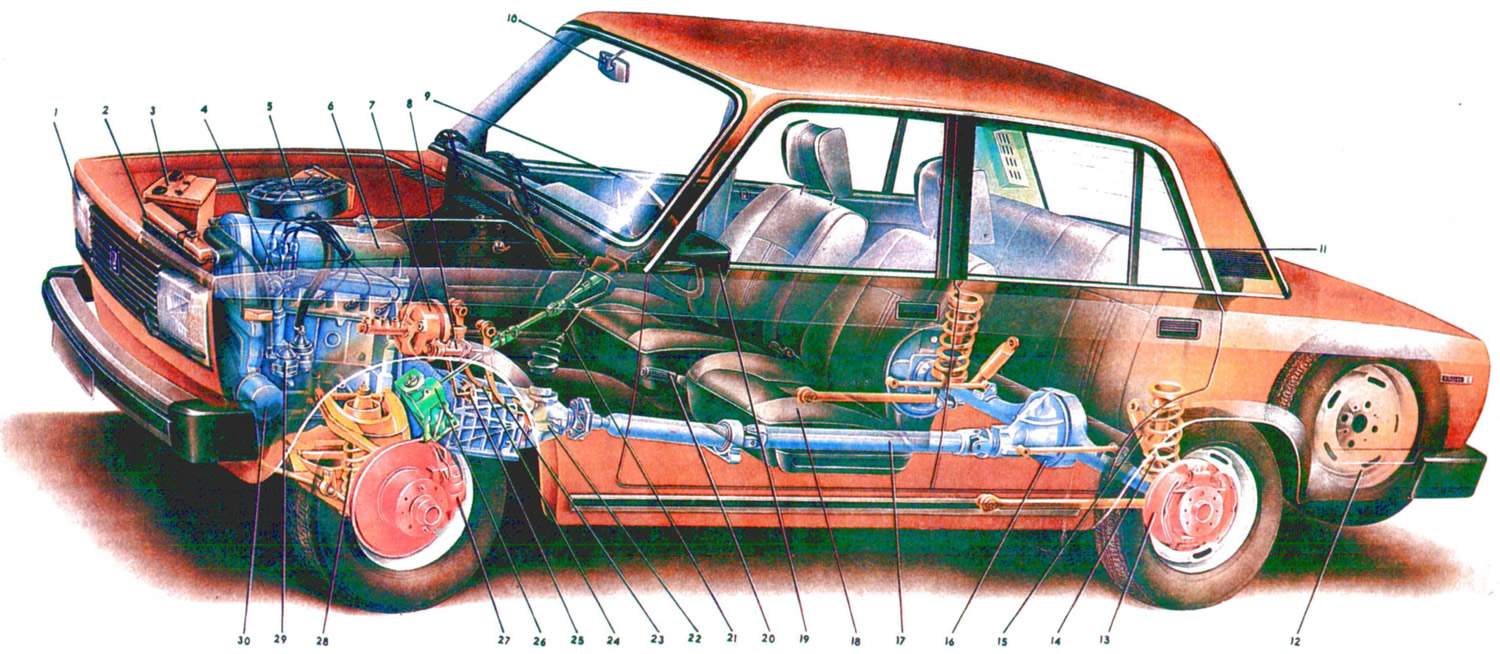
Fig. 1: 1. Headlight with direction indicator. 2. Radiator. 3. Battery. 4. Ignition distributor. 5. Air filter. 6. Engine. 7. Vacuum booster with brake master cylinder. 8. Clutch master cylinder. 9. Steering wheel. 10. Inside rear-view mirror. 11. Rear seat. 12. Spare wheel. 13. Rear brake. 14. Rear suspension spring. 15. Rear suspension shock absorber. 16. Rear axle. 17. Cardan transmission. 18. Front seat. 19. Outside rear-view mirror. 20. Parking brake lever. 21. Gearshift lever. 22. Gearbox. 23. Clutch pedal. 24. Brake pedal. 25. Accelerator pedal. 26. Steering gear. 27. Front brake. 28. Front suspension spring with shock absorber. 29. Fuel pump. 30. Oil filter.
The design of the VAZ-2105 and VAZ-2104 passenger cars, produced by the AVTOVAZ Joint-Stock Company, is described and clearly shown.
The VAZ-2105 model is a modernization of the well-known model of the VAZ-21011 passenger car. The modernization was aimed at giving the car a more modern appearance, increasing its comfort, active and passive safety, efficiency, while simultaneously reducing the impact of the car on the environment.
VAZ-2105 and VAZ-2104 cars meet all safety requirements of the UN Economic Commission for Europe.
Layout (arrangement of units and assemblies) the car is designed according to the so-called classic scheme, i.e. the engine is located in the front, and the rear wheels are the driving wheels. The engine is moved forward as much as possible, which ensures optimal weight distribution along the axles, and therefore good stability of the car on the road. This engine arrangement allows for a spacious passenger compartment with a given wheelbase.
Good comfort of cars, which is also one of the safety factors, is achieved due to ease and convenience of control, good visibility from the driver's seat, low noise in the cabin, minimal impact of vibrations and oscillations of the body and effective ventilation of the cabin. In addition, the shape and softness of the seats, the ability to adjust their position and the angle of the backrest, as well as the convenient placement of controls improve the driver's working conditions and reduce his fatigue. Increases the comfort of cars (especially when driving on poorly paved roads) and the fact that the interior is located inside the base, i.e. in the zone of the best ride smoothness.
Vehicles equipped with a towing device may be used to work with a trailer that has a ball-type towing hitch. The permissible total mass of a towed trailer with brakes is 750 kg, and of a trailer without brakes 500 kg.
Engine
Engine 6, installed on cars, four-stroke, carburetor, in-line, with overhead camshaft. The use of a toothed belt in the camshaft drive and a well-muffled air filter significantly reduced the noise of the engine.
The engine lubrication system is combined: the bearings of the crankshaft, camshaft and auxiliary drive shaft are lubricated under pressure, and the cylinders and valve timing mechanism are lubricated by spraying. The crankcase ventilation system is closed. The system has an oil separator and a flame arrester.
The engine fuel system includes an air filter 5 with a thermostat, a two-chamber carburetor with a falling flow, a diaphragm fuel pump 29 with a manual fuel pumping lever and a fuel tank.
The Ozone carburetor, equipped with an electronically controlled forced idle economizer system, and an ignition distributor with centrifugal and vacuum ignition advance regulators provide reduced fuel consumption and lower toxicity of exhaust gases.
The engine cooling system is liquid, closed type, with a translucent (for visual control of liquid level) expansion tank. The centrifugal pump and fan are driven by a V-belt from the crankshaft pulley. The cooling system has a thermostat designed to speed up warming up and automatically ensure the engine's thermal conditions.
The exhaust system is designed with two sequentially located mufflers.
Transmission
The transmission of a car includes the clutch, gearbox, cardan shaft, final drive, differential and axle shafts. It serves to transmit torque from the engine crankshaft to the driving rear wheels of the car.
Clutch. The cars are equipped with a single-disk dry clutch with a diaphragm pressure spring, with a torsional vibration damper (damper) on the driven disk. The clutch is controlled by a foot pedal with a servo spring and a hydraulic release drive with a fluid reservoir mounted on the front shield of the car.
Transmission 22 has four forward gears (five gears in a variant design) and one gear for reverse. All forward gears are equipped with synchronizers, which equalize the rotation speeds of the connected parts before the gears are engaged. The optimal selection of gear ratios provides the car with confident starting, good acceleration and high efficiency. The gear shift lever is located on the floor of the body.
Cardan transmission 17, consisting of two shafts with an intermediate support and equipped with two cardan joints on needle bearings and a rubber coupling, transmits torque from the gearbox to the main gear. The front cardan shaft is connected to the driven shaft of the gearbox through a rubber elastic coupling and a flange moving along the cardan shaft on splines. The rear cardan shaft is connected through a flange to the gear of the main gear. An intermediate elastic support with a ball bearing supports the middle part of the cardan transmission and absorbs its vibration.
Main gear hypoid, consisting of a pair of bevel gears with spiral teeth, the axes of rotation of which intersect. Torque from the driven gear on the axle shaft is transmitted through a bevel differential with two satellites. The differential allows the drive wheels of the car (left and right) rotate at different speeds when turning corners.
Steering
The steering system consists of a steering mechanism and a steering drive that transmits force from the driver to the steered wheels.
The steering wheel, through the steering gear and drive, turns the front wheels, thereby changing the direction of the car.
The worm gear housing of the steering gear is attached from the inside of the engine compartment to the left side member of the body; on the opposite side, the pendulum arm bracket is attached to the right side member.
The steering gear includes two levers of the steering trapezoid, a pitman arm, a pendulum arm and three rods: one middle and two outer. The middle rod is one-piece, has ball joints at the ends for connection with the pendulum arm and the pitman arm. Each outer rod consists of two threaded tips connected to each other by split adjusting couplings, which change the length of the side rods and adjust the toe-in of the wheels. Adjusting couplings are fixed on the rods with clamping clamps. Each outer rod has ball joints at the ends for connection with levers or the pitman arm.
Chassis
The chassis of the car consists of front and rear wheel suspension units with shock absorbers and an anti-roll bar in the front suspension, wheel hubs and wheels with tires.
Front wheel suspension is independent, lever-spring, with coiled cylindrical springs, telescopic hydraulic shock absorbers of double action to dampen body vibrations on elastic suspension elements; equipped with an anti-roll bar and two compression buffers that limit the suspension travel.
The stamped upper and lower suspension arms are pivotally connected to a forged steering knuckle. Two ball joints are placed in housings and attached to the arms with bolts and nuts. The lower arm is connected to the front suspension crossmember, which is secured to the longitudinal beams, using rubber-metal hinges, an axle, bolts and nuts (spars) body. The upper arms are connected to the supporting part of the body using similar rubber-metal hinges and an axle.
The coil springs of the suspension are placed between the lower arms and the mudguard pillar supports.
The torsion bar stabilizer bar, which reduces the lateral tilt of the body when turning and reduces lateral body sway, is connected to the body and lower arms using brackets that cover the rubber cushions of the stabilizer bar.
The hydraulic shock absorbers, located inside the springs, have an eye at the bottom for fastening to the lower arm, and a rod with a threaded end at the top for fastening to the body. The front wheel hub rotates on two tapered roller bearings mounted on the journal.
The rear wheel suspension consists of two cylindrical coil springs 14 (see fig. 1) with 15 double-acting telescopic shock absorbers, four longitudinal and one transverse rod, two compression buffers located at the ends of the rear axle beam, and one central one located in the middle.
The rear suspension shock absorbers are mounted outside the springs and are attached to the body from above and to the ends of the rear axle beam from below via conical rubber bushings. The rubber buffers attached to the body floor above the rear axle beam are designed to soften possible impacts of the rear axle beam that may occur when driving on poorly maintained roads. The buffer above the front neck of the main gear housing limits the upward travel of the housing, preventing the cardan shaft from touching the body floor.
The wheels of the car are disc, stamped, with removable decorative caps: Radial tires with tubes are mounted on the wheels. The front wheels are fastened with four bolts to the hub flanges, the rear wheels - to the flanges of the axle shafts. The wheels with tires in the assembly are balanced statically and dynamically. The imbalance is eliminated using weights fixed to the wheel rim.
Brakes
The service brake system has a hydraulic drive to the wheel mechanisms, is controlled by a suspended pedal and acts on all wheels.
Parking and spare system (emergency) braking (i.e. handbrake) controlled by a lever mounted on the floor between the front seats; acts only on the rear wheels. This system has a mechanical cable drive.
The front brakes are 27 disc brakes, consisting of a disc and a support. The disc is attached to the wheel hub, and the support, which covers the brake disc, is attached to a bracket mounted on the pivot pin. Inside the support are wheel hydraulic cylinders with pistons that transmit force to the pads with friction linings.
The rear brakes are 13 drum, with self-adjusting shoes, driven by one main cylinder with two pistons or by a mechanical drive lever. The aluminum drum of the rear brake contains a cast iron working ring.
The hydraulic brake drive consists of two independent circuits (systems) for braking the front and rear wheels. Therefore, the reservoir has two capacities for brake fluid, and the main cylinder has two independent cavities with two pistons. Two independent systems are introduced for safety: if one of them is damaged, (liquid leak or pipeline damage) the second remains in operation. The pressure regulator in the rear brake drive system reduces the likelihood of locking the rear wheels when braking. The use of a vacuum booster ensures high braking efficiency with limited pedal force. The vacuum for the booster is taken from the engine intake pipe. Therefore, the booster only operates when the engine is running.
Electrical equipment
The electrical wiring of the cars is made according to a single-wire scheme with a nominal voltage of 12 V, and the negative pole of the current sources is connected to the ground. All relays and fuses are located in the mounting block, on the cover of which there are symbols indicating the purpose of the relay, the fuse numbers and the circuits they protect. This provides great convenience for visually checking the condition of the fuses.
The current sources in the system are an alternating current generator of the G-222 or 37.3701 type with a built-in semiconductor rectifier and electronic voltage regulator and a lead storage battery of the 6ST-55P type. To start the engine, a starter ST-221 or 35.3708 with an electromagnetic traction relay and a roller overrunning clutch is used.
For the first time in the domestic automobile industry, the VAZ-2105 uses rectangular headlights, which combine all the functions of high and low beam, parking lights and turn signals. Halogen lamps have significantly improved the lighting characteristics of the headlights. The rear lights combine parking and fog lights, brake lights, turn signals, and reversing lights.
The cars are equipped with a dashboard with a speedometer with trip meters, a coolant temperature gauge, and a fuel level gauge. In addition, the instruments have control lamps for various systems, located both on the instruments themselves and in a separate control lamp block. The instruments are equipped with antiglare glass.
Body
The body of the VAZ-2105 sedan type and the VAZ-2104 station wagon type is all-metal, of a supporting structure, i.e. one to which the power unit is attached (engine assembly with gearbox and clutch) and all other components and mechanisms of the car.
Narrow windshield pillars, absence of shiny surfaces in the driver's field of vision, large rear-view mirrors, large windshield cleaning area, effective operation of windshield washers at high speed and effective elimination of glass fogging by the ventilation and heating system of the body provide good visibility in cars, and therefore safe driving conditions. To prevent the driver from being blinded by the headlights of cars behind, an internal rear-view mirror with "day" and "night" positions is used.
The windshield is of the triplex type, consisting of two layers of glass with a transparent plastic film between them, even if cracked, it remains transparent. The rear and side windows are safe, tempered.
Front and rear doors with front hinges, have safety glass. Front doors are locked with a key from the outside and a button from the inside; the locked door can be opened with the inside handle. The rear door lock has a lock. The door is locked from the inside with a button. The locked door cannot be opened with the inside handle.
The hood, which opens in the direction of the vehicle's movement, is hung on the body along the front edge and secured at the rear at one point with a lock. The trunk is located in the rear part of the body. The trunk lid lock is locked and unlocked with a key. The trunk contains a spare wheel 12, a jack, and a set of driver's tools and accessories.
The front seats are separate with folding backrests and a mechanism for adjusting the seat position and backrest tilt. The rear seat is fixed and one-piece.
Features of the VAZ-2104 car
Open large image in new tab »
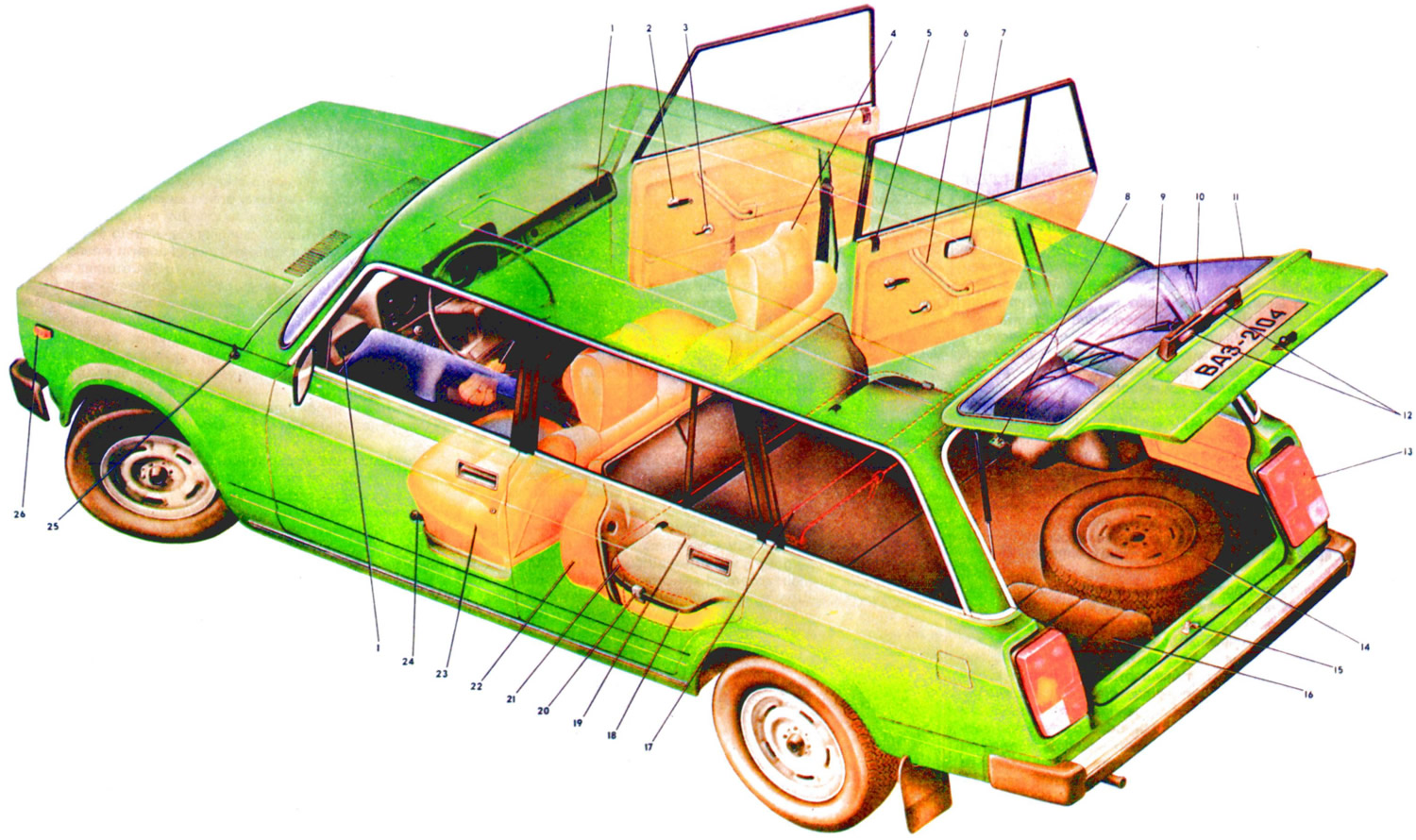
Fig. 2: 1. Side vents for ventilation and heating systems. 2. Window lifter handle. 3. Door opening handle. 4. Front seat headrest. 5. Door lock buttons. 6. Armrest. 7. Ashtray. 8. Rear seatback hinge. 9. Rear window wiper. 10. Gas-filled rear lid striker. 11. Rear lid. 12. Number plate lights. 13. Tail light. 14. Spare wheel. 15. Rear lid lock catch. 16. Fuel tank. 17. Rear seatback in normal position. 18. Rear seatback in reclined position. 19. Rear seatback stop. 20. Rear seatback lock bracket. 21. Rear seat cushion in normal position. 22. Rear seat cushion in reclined position. 23. Front seat. 24. Seatback tilt adjustment handle. 25. Radio antenna. 26. Side direction indicator.
Unlike the VAZ-2105 sedan, the VAZ-2104 has a station wagon body with four side doors and one rear door. This car has the same advantages of sedan cars, such as comfort, speed, economy, and at the same time is suitable for transporting fairly large loads that do not fit in a regular passenger car.
The single-leaf tailgate with upper hinges and fixed glass serves to access the luggage compartment. In the open raised position, the door is held by a special telescopic gas-filled stop. When closing, the door is held by a lock located at the bottom of the door. The door is opened by pressing the lock button built into the outside handle. The door is locked from the outside through the keyhole of the button with the same key as the front side doors. The rear side doors have a frame and glass of a modified shape, and in the side behind the rear door there is a fixed glass.
The original can be found on the website (VAZBOOK)
For the convenience of placing the transported items, a spare wheel 14 (see fig. 2), the tool, accessories and fuel tank 16 are located under the floor of the luggage compartment. The spare wheel niche is closed by a cover secured with a wing screw.
The floor area and the volume of the luggage compartment can be additionally increased by changing the position of the cushion and the backrest of the rear seat. If necessary, the cushion 22 of the rear seat is installed vertically by rotating on the hinges until it stops against the backrests of the front seats. The metal tray of the cushion in this case limits the luggage compartment and keeps the load from moving forward. The backrest 18 of the rear seat, turned relative to the hinges to a horizontal position, increases the floor area. The ends of the backrest stops are installed in the corresponding sockets on the cushion tray. To lay the backrest in a horizontal position, it is necessary to first release the upper part of the backrest by successively pressing the handles of the hooks of the locks.
The design of the rear seat meets safety requirements. The cushion and backrest hinges, as well as the backrest locking mechanism, are designed to withstand overloads in a traffic accident.
The chassis is distinguished by the fact that the rear suspension is equipped with springs that can withstand increased loads.
The electrical equipment of the car is slightly different from the electrical equipment of the VAZ-2105 cars as follows: a lamp with a built-in switch is installed to illuminate the rear part of the cabin; the shape and location of the rear lights have been changed; the optional version can be equipped with a rear window wiper and washer, as well as electric heating of the rear door window.