




Contents: Ventilation ↓ Windshield washer ↓
Open large image in new tab »
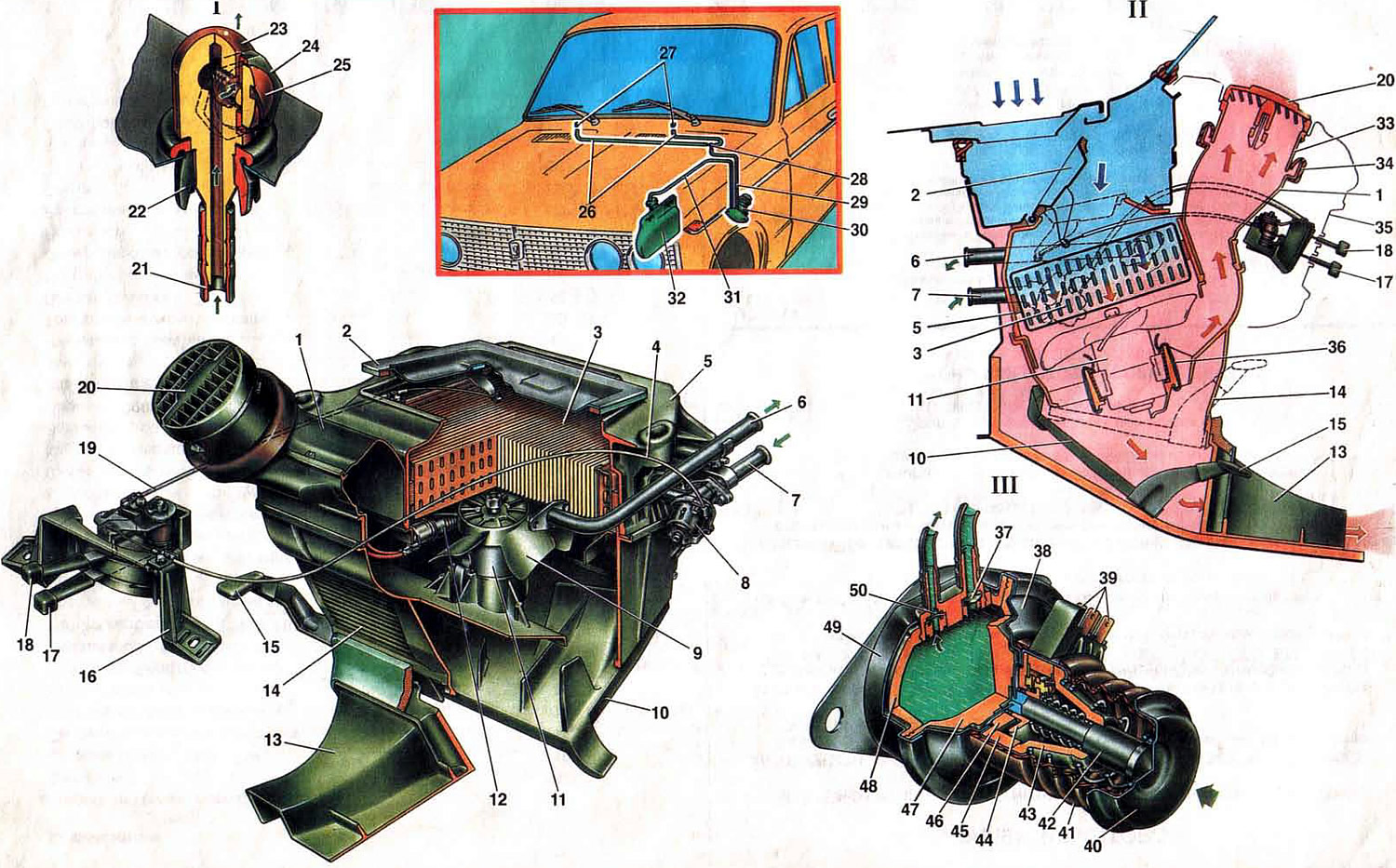
Fig. 34. Heater and washer.
1. Air duct; 2. Air intake cover; 3. Radiator; 4. Flexible rod of the heater tap; 5. Radiator shroud; 6. Discharge pipe; 7. Supply pipe; 8. Heater tap; 9. Fan impeller; 10. Air distribution cover; 11. Electric motor; 12. Additional resistor; 13. Internal ventilation duct; 14. Fan casing; 15. Air distribution cover lever; 16. Control lever bracket; 17. Air intake cover control lever handle; 18. Heater valve control lever handle; 19. Flexible air intake cover rod; 20. Left rotating deflector directing air flow to the windshield or into the car interior; 21. Liquid supply pipe; 22. Bushing; 23. Jet body with fitting; 24. Sprayer; 25. Screw; 26. Liquid supply pipe to the jet; 27. Windshield washer jets; 28. Tee; 29. Liquid supply pipe from the pump; 30. Pump; 31. Tube for collecting fluid from the washer reservoir; 32. Liquid tank; 33. Deflector pipe; 34. Air duct seal; 35. Instrument panel; 36. Electric motor mounting spring bracket; 37. Inlet valve; 38. Lid; 39. Contact plugs; 40. Button; 41. Cover; 42. Rod; 43. Rod guide; 44. Holder of moving contacts; 45. Block with contacts; 46. Holder guide; 47. Diaphragm; 48. Pump body; 49. Casing; 50. Exhaust valve; I. Washer nozzle; II. Heater operation diagram; III. Washer pump.
1. Air duct; 2. Air intake cover; 3. Radiator; 4. Flexible rod of the heater tap; 5. Radiator shroud; 6. Discharge pipe; 7. Supply pipe; 8. Heater tap; 9. Fan impeller; 10. Air distribution cover; 11. Electric motor; 12. Additional resistor; 13. Internal ventilation duct; 14. Fan casing; 15. Air distribution cover lever; 16. Control lever bracket; 17. Air intake cover control lever handle; 18. Heater valve control lever handle; 19. Flexible air intake cover rod; 20. Left rotating deflector directing air flow to the windshield or into the car interior; 21. Liquid supply pipe; 22. Bushing; 23. Jet body with fitting; 24. Sprayer; 25. Screw; 26. Liquid supply pipe to the jet; 27. Windshield washer jets; 28. Tee; 29. Liquid supply pipe from the pump; 30. Pump; 31. Tube for collecting fluid from the washer reservoir; 32. Liquid tank; 33. Deflector pipe; 34. Air duct seal; 35. Instrument panel; 36. Electric motor mounting spring bracket; 37. Inlet valve; 38. Lid; 39. Contact plugs; 40. Button; 41. Cover; 42. Rod; 43. Rod guide; 44. Holder of moving contacts; 45. Block with contacts; 46. Holder guide; 47. Diaphragm; 48. Pump body; 49. Casing; 50. Exhaust valve; I. Washer nozzle; II. Heater operation diagram; III. Washer pump.
Ventilation
Ventilation, heating and blowing of the windshield are carried out by air sucked in from outside. Heating of the passenger compartment is provided by air heated in the radiator of the heater, which is included in the engine cooling system. Outside air enters through the grille of the car hood into the air intake box, where it abruptly changes the direction of movement and enters through the hatch, closed by the cover 2 of the air intake, into the casing 5 of the radiator of the heater (the heater operation diagram is shown by arrows).
Plastic radiator casing 5 is attached with four studs to the front panel reinforcement under the air intake box, which can be accessed under the instrument panel. The radiator casing with the air intake box is sealed with a sealing gasket. Heater radiator 3 is installed in casing 5 and is sealed along the perimeter with a rubber gasket. The right radiator tank is divided into two cavities by a rubber partition. Outlet pipe 6 and tap 8 with inlet pipe 7 are bolted to the tank. The ends of the pipes exit into the engine compartment through the front panel and are connected with hoses to the engine cooling system. The outlet of the pipes into the engine compartment is sealed with a rubber seal, which is attached to the front panel with two bolts.
Air from radiator 3 enters the guide casing and casing 14 of the fan. In the center of the plastic guide casing, an electric motor 11 with an impeller 9 of the fan is installed with the help of spring clamps on two elastic cushions. An additional resistance (resistor) 12 is attached to the inner wall of the casing, the connection and disconnection of which in the electric motor circuit is carried out by a three-position switch on the instrument panel. The additional resistor provides low and high rotation speed of the fan.
From the fan casing, air rises through the guide casing window into the air duct 1 and then through pipes 33 and rotary deflectors 20 is supplied to the windshield or directly into the passenger compartment. The deflector pipes with the air duct are sealed with rubber seals 34.
At the bottom of the fan casing, an air distribution cover 10 is hinged on brackets, when opened, air is directed to the passengers' feet through the internal ventilation air duct 13. In this case, the amount of air supplied to the deflectors decreases.
The heater is controlled by a fan motor switch, rotary deflectors and two handles. The upper handle 18 for controlling the heater tap is connected by a flexible rod 4 to the tap lever. The lower handle 17 is connected by a flexible rod 19 to the lever of the air intake cover 2 and regulates the amount of fresh air entering the heater.
[Original source is on the resource: VAZbook]
The car has an exhaust ventilation system that sucks air out of the passenger compartment. The air passes under the upholstery of the inner side roof panel on the rear pillars of the body, presses the rubber valve and goes out through the decorative grille on the side roof panel. The valve prevents air from entering the passenger compartment during a crosswind.
Windshield washer
The windshield washer and wiper ensures that the windshield is cleaned in any operating conditions of the vehicle without stopping it.
The washer includes a pump 30, a tank 32 for liquid, tubes 31, 29, 21 and 26, and jets 27.
From the pump, the liquid is fed to the jets and sprayed onto the glass through a slot in the sprayers 24. The jets consist of a body 23 and a sprayer 24 with a fastening screw 25 and gaskets. The jets are installed in the openings of the windshield panel using elastic plastic bushings 22 on the pump body.
The direction of the jet is adjusted by turning the nozzle body in the plastic sleeve and turning the sprayer 24 after loosening the fastening screw 25.
Until 1980, the VAZ-2103 was equipped with a pump with an electric drive, which is also used on the VAZ-2106.
Foot pump 30 is secured to the body floor. The pump is of the diaphragm type. Pump body 48 is made of plastic and has two fittings. The inlet fitting is connected to tube 31 with washer reservoir 32. The fittings contain rubber inlet - 37 and outlet - 50 valves. The valves are held in their seats by brass bushings pressed into the body. Diaphragm 47 is cup-shaped, body 48 and cover 38 are rolled into steel casing 49, to which the pump mounting plate is welded. A windshield wiper switch and pump drive are mounted on cover 38. The drive consists of button 40 with rod 42 and a return spring. A plate is riveted to the lower end of the rod, which presses on the diaphragm when button 40 is pressed. After releasing the button, the diaphragm takes its original shape due to elasticity. The switch consists of a plastic block 45 with two pairs of contacts, one pair riveted to the upper part of the block, and the other to the lower part. The contacts are closed by movable jumpers riveted to a plastic holder 44. In the normal position of the button 40, the upper pair of contacts is closed, and when the button is pressed, the lower pair is closed. The pump drive is covered from the outside by a rubber cover 41.
Electric-driven windshield washer pump of the rotary type. The pump body (bottom) and the electric motor (top) are attached to the cover of the washer reservoir with three screws. The pump rotor captures the liquid entering through the mesh filter and delivers it through the tube up to the nipple of the cover. The rollers of the rotor and the electric motor are connected by a plastic tubular coupling.