




Open large image in new tab »
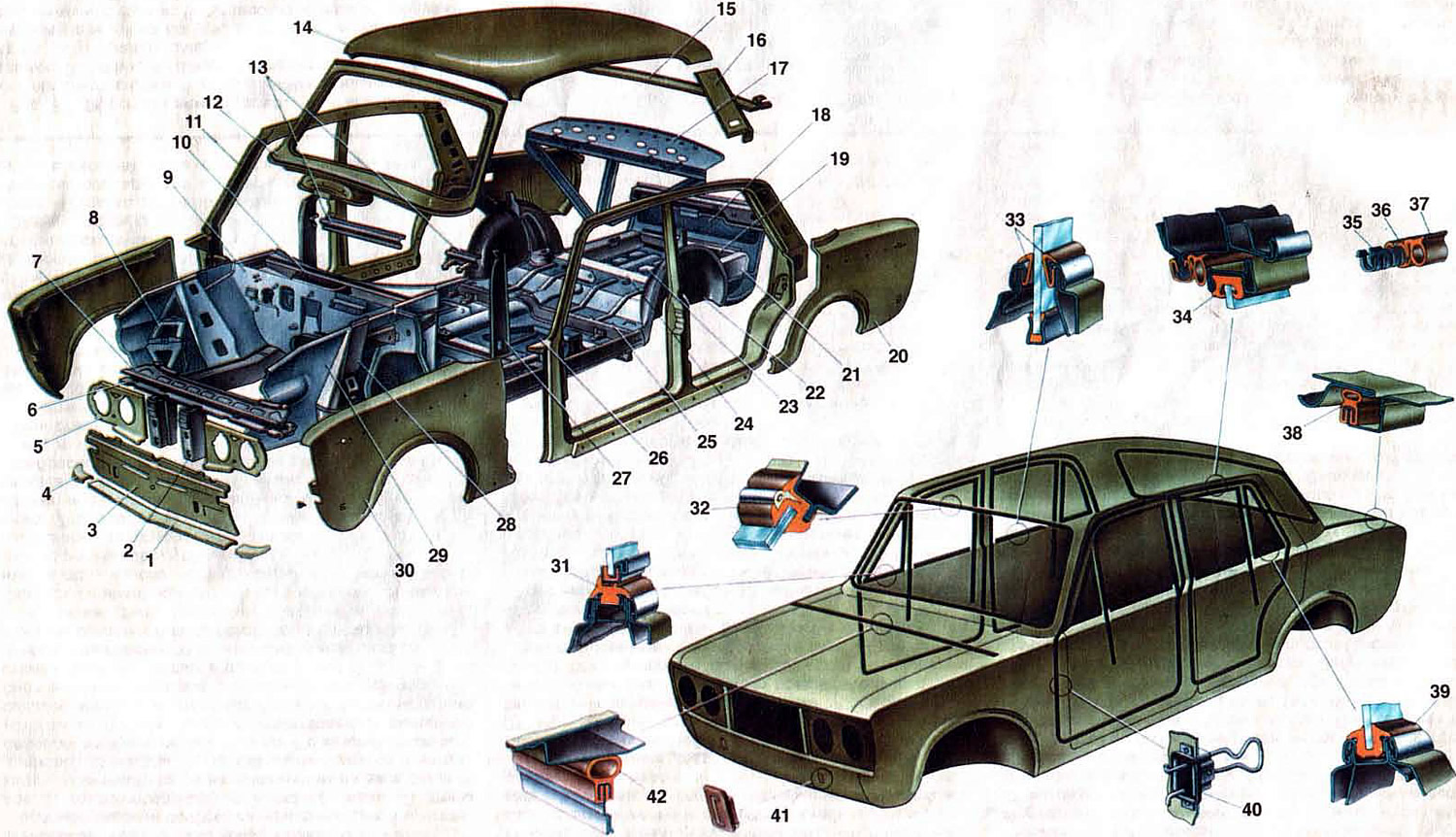
Fig. 32. Body.
1. Front central mudguard; 2. Front pillar; 3. Lower front panel; 4. Right mudguard of the front bumper; 5. Headlight housing; 6. Upper front cross member; 7. Upper cross member reinforcement; 8. Battery platform; 9. Front shield; 10. Air duct box; 11. Sidewall; 12. Windscreen frame; 13. Lower crossbar of the instrument panel; 14. Cover panel; 15. Rear window frame panel; 16. Roof side panel; 17. Rear partition frame with shelf; 18. Tail panel; 19. Lower rear cross member; 20. Rear wing; 21. Rear floor side member; 22. Rear wheel arch; 23. Trunk floor; 24. Trunk floor crossbar; 25. Rear floor cross member; 26. Front floor; 27. Front strut reinforcement; 28. Mudguard stand; 29. Mudguard; 30. Front wing; 31. Swivel glass seal; 32. Windscreen and rear window seal; 33. Lower door glass seal; 34. Seal for sliding glass; 35. Door seal frame; 36. Seal edge; 37. Door opening seal; 38. Trunk lid seal; 39. Seal for fixed door glass; 40. Door opening limiter gasket; 41. Bumper bracket seal; 42. Hood seal.
1. Front central mudguard; 2. Front pillar; 3. Lower front panel; 4. Right mudguard of the front bumper; 5. Headlight housing; 6. Upper front cross member; 7. Upper cross member reinforcement; 8. Battery platform; 9. Front shield; 10. Air duct box; 11. Sidewall; 12. Windscreen frame; 13. Lower crossbar of the instrument panel; 14. Cover panel; 15. Rear window frame panel; 16. Roof side panel; 17. Rear partition frame with shelf; 18. Tail panel; 19. Lower rear cross member; 20. Rear wing; 21. Rear floor side member; 22. Rear wheel arch; 23. Trunk floor; 24. Trunk floor crossbar; 25. Rear floor cross member; 26. Front floor; 27. Front strut reinforcement; 28. Mudguard stand; 29. Mudguard; 30. Front wing; 31. Swivel glass seal; 32. Windscreen and rear window seal; 33. Lower door glass seal; 34. Seal for sliding glass; 35. Door seal frame; 36. Seal edge; 37. Door opening seal; 38. Trunk lid seal; 39. Seal for fixed door glass; 40. Door opening limiter gasket; 41. Bumper bracket seal; 42. Hood seal.
The car body is a sedan type, metal, all-welded, load-bearing structure, four-door. The door hinges are located in the front. The door locks and latches are of a safe type. The door windows have two panes: the front doors have one swivel pane. The front and rear windows have panoramic glass. The windshield is three-layered, polished; rear - polished, tempered. All glass is of the safety type. The protruding parts of the interior are made safe (handles, levers, sun visors and other parts).
Body frame
All parts and components of the frame are mainly connected to each other by contact spot welding; heavily loaded parts are additionally welded using arc welding. Roof panel 14 is welded to side panels 16 using gas welding
The body frame consists of the following main units: the front of the body, the floor with reinforcements and the rear panel, the side panels, the rear fenders, the roof with the frames of the windshield and rear windows, the front fenders with reinforcements.
The front end consists of a vertical front end shield 9, an air intake box 10, mudguards 29 of the front fenders with struts 28 of the front suspension, front side members, upper and lower front end cross members, struts 2 of the front end, headlight covers 5, lower panel 3 of the front end and mudguards 1 and 4. A platform 8 for the storage battery is welded to the right mudguard 29 of the front fender.
The body floor with reinforcements and the rear panel includes the front and rear floor panels, the luggage compartment floor 23, the spare wheel and fuel tank floors, the rear panel 18. The front and rear floor side members, the luggage compartment floor side members 21, the central pillar connectors, the cross members 19, 24, 25, the crossbar bracket, the inner arches 22 of the rear wheels and other parts are welded to the floor panels.
Sidewall 11 consists of a one-piece stamped panel, an outer rear wheel arch, a central pillar and reinforcements located along the sidewall contour. The right and left sidewalls are connected to each other by a crossbar 13 of the instrument panel and a rear shelf with diagonals.
The rear wings 20 are welded to the sidewalls 11, the rear panel 18, to the spare wheel or fuel tank floor. Reinforcers are welded to the rear wings. The right wing has a fuel tank filler neck niche cover. The fixed hinge of the cover is attached to the wing with two screws. In the closed and open positions, the cover is fixed with a servo spring, fixed to the hinge of the cover.
The roof consists of panel 14, side roof panels 16, welded together by gas welding, and roof reinforcements. The windshield frame 12 and the rear window frame are welded to the roof panel.
The front fenders are welded to the front panel 3, to the mudguards 29, to the headlight housings 5 and to the front side pillars 11.
Body attachments
The doors, hood, and trunk lid are hung on the welded body. All these units consist of outer and inner panels made of 0.7 mm thick steel and connected to each other by bending the flanges of the outer panels with subsequent spot welding. To increase the rigidity of the hood and trunk lid, their outer and inner panels are additionally connected to each other with glue, which hardens when the paintwork of the body dries. The hood is hung along the front edge of the body on hinges. The hood is fastened to the hinges with bolts. Enlarged holes in the hinges for bolts allow adjustment of the hood position in the body opening. The trunk lid has hinges with a torsion mechanism, which facilitates opening and holding the lid in the open position. Enlarged holes in the hinges allow adjustment of the trunk lid position.
Upper parts of doors (window openings) are made of steel profiled frames that are welded to the inner door panels. The door hinges allow the door position in the opening to be adjusted vertically to ensure uniform gaps with the body along the upper and lower edges. To prevent the doors from hitting the body pillars with their front end when opening, they have opening limiters made of spring wire.
Bumpers with two buffers and side linings are installed on VAZ-21 cars, they are attached to the body using two brackets with four bolts. The brackets are sealed with rubber seals.
Body sealing
Sealing is achieved by various rubber seals, sealing mastics, rubber plugs for process holes and careful adjustment of mating parts.
The air intake box is sealed from smoky air entering the passenger compartment from the engine compartment by a rubber seal 42 installed on the upper flange of the box. The seal is secured by the elasticity of a perforated metal frame placed in the lower part of the seal.
The trunk lid in the opening is sealed with seal 38, made of sponge rubber and installed on the flanges of the drainage channels along the contour of the opening. The design of the seal is similar to seal 42.
The seals 37 of the door openings are made of sponge rubber with a branch to which a plastic edging 36 with a metal frame 35 is sewn, ensuring the fastening of the seal on the flanges of the door openings. Non-drying mastic 51-G-7 is applied under the seal at the corners of the central pillars and door hinges.
The windshield and rear window glass are sealed with rubber seals 32, which do not require the use of sealing mastics. The lower seals 33 of the door drop-down windows are made of plastic, the profile of which ensures easy and reliable installation. To reduce friction, pile is glued to the seals of the drop-down windows. When water seeps under the seal 33, it flows down the door and then pours out through the drain holes.
[Information copied from the portal VAZBOOK.RU]