




Open large image in new tab »
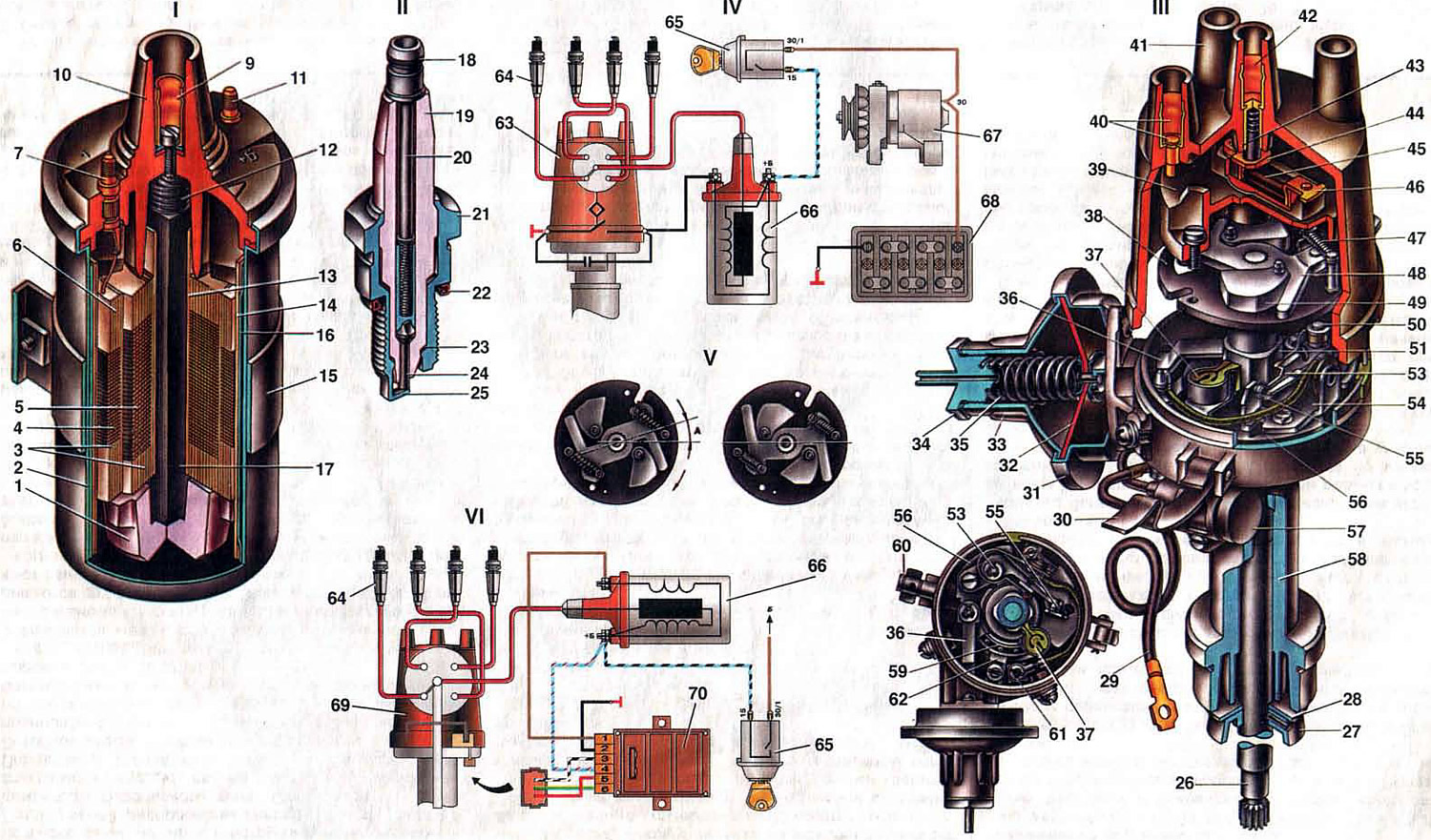
Fig. 31. Ignition system.
1. Insulator: 2. Ignition coil housing; 3. Insulating paper of windings; 4. Primary winding; 5. Secondary winding; 6. Primary winding insulating tube; 7. Primary winding end terminal; 8. Contact screw; 9. High voltage terminal; 10. Lid; 11. Terminal "+B" of the output of the beginning of the primary and end of the secondary windings; 12. Central terminal spring; 13. Secondary winding frame; 14. External insulation of the primary winding; 15. Mounting bracket; 16. External magnetic circuit; 17. Core; 18. Contact nut; 19. Spark plug insulator; 20. Rod; 21. Spark plug body; 22. Sealing ring; 23. Heat dissipating washer; 24. Central electrode; 25. Spark plug side electrode; 26. Distributor shaft; 27. Oil-deflecting clutch of the shaft; 28. Washer; 29. Current supply wire to the distributor; 30. Lid locking spring; 31. Vacuum regulator housing; 32. Diaphragm; 33. Vacuum regulator cover; 34. Nut; 35. Vacuum regulator spring; 36. Vacuum regulator rod; 37. Cam oil wick (filc); 38. Ignition timing regulator support plate; 39. Ignition distributor rotor; 40. Side electrode with terminal; 41. Distributor cap; 42. Central electrode with terminal; 43, Central electrode carbon; 44. Rotor central contact; 45. 5-6 kOhm resistor for suppressing radio interference; 46. External rotor contact; 47. Ignition timing regulator spring; 48. Centrifugal regulator plate; 49. Ignition timing adjuster weight; 50. Insulating bushing; 51. Breaker cam; 52. Lever insulating block; 53. Breaker lever; 54. Rack with breaker contacts; 55. Breaker contacts; 56. Movable breaker plate; 57. Capacitor 0.20-0.25 μF; 58. Ignition distributor housing; 59. Bearing of the movable plate of the breaker; 60. Oiler body; 61. Terminal clamp screw; 62. Bearing retaining plate; 63. Ignition distributor; 64. Spark plugs; 65. Ignition switch; 66. Ignition coil; 67. Generator; 68. Battery; 69. Ignition distributor sensor; 70. Switch; A. Ignition timing angle; B. To power sources; I. Ignition coil; II. Spark plug; III. Ignition distributor; IV. Scheme of the classic ignition system; V. Scheme of operation of centrifugal ignition advance regulator. VI. Scheme of contactless ignition system.
1. Insulator: 2. Ignition coil housing; 3. Insulating paper of windings; 4. Primary winding; 5. Secondary winding; 6. Primary winding insulating tube; 7. Primary winding end terminal; 8. Contact screw; 9. High voltage terminal; 10. Lid; 11. Terminal "+B" of the output of the beginning of the primary and end of the secondary windings; 12. Central terminal spring; 13. Secondary winding frame; 14. External insulation of the primary winding; 15. Mounting bracket; 16. External magnetic circuit; 17. Core; 18. Contact nut; 19. Spark plug insulator; 20. Rod; 21. Spark plug body; 22. Sealing ring; 23. Heat dissipating washer; 24. Central electrode; 25. Spark plug side electrode; 26. Distributor shaft; 27. Oil-deflecting clutch of the shaft; 28. Washer; 29. Current supply wire to the distributor; 30. Lid locking spring; 31. Vacuum regulator housing; 32. Diaphragm; 33. Vacuum regulator cover; 34. Nut; 35. Vacuum regulator spring; 36. Vacuum regulator rod; 37. Cam oil wick (filc); 38. Ignition timing regulator support plate; 39. Ignition distributor rotor; 40. Side electrode with terminal; 41. Distributor cap; 42. Central electrode with terminal; 43, Central electrode carbon; 44. Rotor central contact; 45. 5-6 kOhm resistor for suppressing radio interference; 46. External rotor contact; 47. Ignition timing regulator spring; 48. Centrifugal regulator plate; 49. Ignition timing adjuster weight; 50. Insulating bushing; 51. Breaker cam; 52. Lever insulating block; 53. Breaker lever; 54. Rack with breaker contacts; 55. Breaker contacts; 56. Movable breaker plate; 57. Capacitor 0.20-0.25 μF; 58. Ignition distributor housing; 59. Bearing of the movable plate of the breaker; 60. Oiler body; 61. Terminal clamp screw; 62. Bearing retaining plate; 63. Ignition distributor; 64. Spark plugs; 65. Ignition switch; 66. Ignition coil; 67. Generator; 68. Battery; 69. Ignition distributor sensor; 70. Switch; A. Ignition timing angle; B. To power sources; I. Ignition coil; II. Spark plug; III. Ignition distributor; IV. Scheme of the classic ignition system; V. Scheme of operation of centrifugal ignition advance regulator. VI. Scheme of contactless ignition system.
On VAZ-2103, VAZ-2106 cars, the classic ignition system is mainly used (scheme IV). On VAZ-21065, a contactless ignition system can be installed (scheme VI).
Ignition coil. The classic ignition system uses B-117A ignition coils, while the contactless system uses 27.3705, which differ in winding data and some parts. The coil is a transformer with two windings: primary 4 and secondary 5, and serves to convert low-voltage current (12 V) into high-voltage current (11-20 kV) to break through the air gap between the spark plug electrodes.
Spark plugs a-17DV type for the classic ignition system and A-17DV-10 for the contactless system, or similar spark plugs of foreign manufacture are installed. The design of the spark plugs is non-separable, traditional. The gap between the spark plug electrodes is 0.5-0.6 mm for A-17DV and 0.7-0.8 mm for A-17DV-10.
Ignition switch mounted on the steering shaft bracket, consists of a housing with a lock and anti-theft device and a contact part. The principle of operation of the device is that after removing the key from the lock, set to position III (Parking), the locking rod of the lock extends, enters the groove of the steering shaft and locks it.
Electronic switchboard is used in a contactless ignition system to interrupt the current in the primary circuit of the ignition coil based on signals from a contactless sensor. Interchangeable switches of various brands can be used: 3620.3734, HIM-52, BAT10.2 or PZE4020. The current pulse value is 8-9 A. Automatic current shutdown through the ignition coil is provided after 2-5 seconds with the engine not running but the ignition on.
Distributor 30.3706 is used to interrupt the current in the low voltage circuit of the ignition coil and distribute high voltage pulses to the spark plugs. The ignition distributor is installed in the left front part of the engine and is driven by helical toothed gear 27 (see fig. 4).
The breaker consists of a cam 51 with four projections and a rack 54 with contacts that the cam opens during rotation. A support plate 38 of the centrifugal ignition advance regulator with weights 49 is soldered to the upper end of the cam sleeve. A vacuum regulator is attached to the side of the distributor housing, consisting of a housing 31 with a cover 33, between which a flexible diaphragm 32 is clamped. A rod 36 is attached to the diaphragm, connected to a movable plate 56 of the breaker.
The distributor consists of a rotor 39 and electrodes installed in a plastic cover 41. The central 44 and outer 46 rotor contacts are riveted to the rotor, between which a noise-suppressing resistor 45 is located in a recess. A spring-loaded carbon electrode 43 rests against the central rotor contact.
Ignition Distribution Sensor 37.3706 is used in a contactless ignition system. It differs from the ignition distributor 30.3706 only in that instead of a breaker, a contactless sensor is installed on the movable plate, and a cylindrical steel screen with four slots is attached to the support plate 38 from below.
The contactless sensor operates on the basis of the Hall effect and consists of a semiconductor plate with an integrated microcircuit and a permanent magnet. There is a gap between them, through which a steel screen passes. When the screen body is in the gap, the magnetic lines of force are closed through the screen and do not act on the plate. If there is a screen slit in the gap, then a magnetic field acts on the semiconductor plate and the potential difference is removed from it. The microcircuit built into the sensor converts this potential difference into voltage pulses.
Operation of the ignition system
When the engine is running, the interrupter interrupts the current in the primary winding of the ignition coil. At this moment, the magnetic field in the ignition coil is sharply compressed and, crossing the winding turns, induces an EMF of about 12-24 kV in it. The high-voltage current goes to the central terminal of the ignition distributor, then through the rotor contacts to the side electrode and further to the spark plug, creating a spark discharge between its electrodes.
Capacitor 57 serves to quench the self-induction EMF in the primary winding of the ignition coil and to reduce sparking between the breaker contacts. If there were no capacitor, the EMF in the secondary winding would not exceed 4000-5000 V.
To obtain maximum engine power, it is necessary to ignite the combustible mixture a little earlier than the piston reaches TDC, so that combustion ends when the crankshaft rotates 10-15° after TDC. Each crankshaft speed requires its own ignition advance angle. So, at 750-800 rpm, the initial ignition advance angle is 3-5°. As the rotation speed increases, the ignition advance angle should increase, and this task is performed by a centrifugal ignition advance regulator.
When the rotation speed increases, the weights 49, under the action of centrifugal forces, diverge and rotate the support plate 38 together with the cam 51 of the breaker by an angle A in the direction of rotation of the shaft. The projections of the cam open the contacts of the breaker earlier and the ignition advance increases.
The vacuum regulator changes the ignition timing depending on the engine load. At low loads, the residual gas content in the combustible mixture is high, the mixture burns more slowly, it must be ignited earlier and vice versa. The regulator diaphragm is affected by the vacuum taken from the area above the throttle valve of the first chamber of the carburetor. At small openings of the throttle valve (low load) under the action of vacuum, the diaphragm 32 is pulled back and by means of rod 36 turns the movable plate 52 of the breaker against the direction of rotation of the shaft. The ignition advance increases. As the throttle valve opens further, (increase in load) the vacuum decreases and the spring pushes the diaphragm back to its original position.
The contactless ignition system works the same way as the classic one, only instead of a breaker, the current in the primary winding circuit of the ignition coil is interrupted by a switch based on signals from a contactless sensor in the ignition distributor sensor.