




Open large image in new tab »
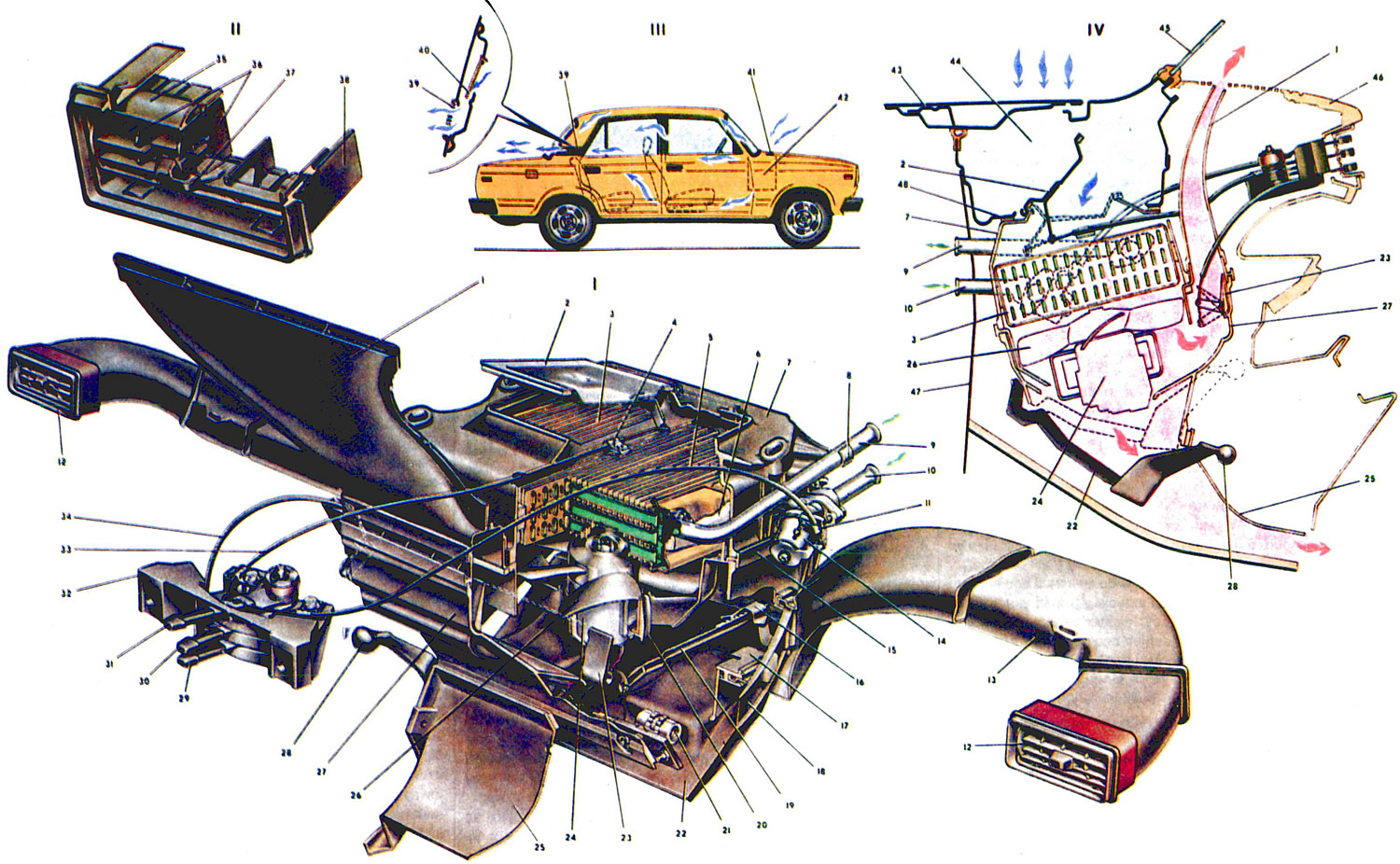
Fig. 35: 1. Windshield heating duct. 2. Air intake cover. 3. Heater radiator. 4. Air intake cover rod casing fastening bracket. 5. Flexible rod of heater valve. 6. Radiator gasket. 7. Radiator casing. 8. Heater pipe fastening bracket. 9. Outlet pipe. 10. Inlet pipe. 11. Rod casing fastening bracket of valve rod. 12. Side window heating nozzles. 13. Right side window heating duct. 14. Heater valve. 15. Fan guide casing. 16. Rod clamp. 17. Side window heating flap housing. 18. Windshield heating air duct flap. 19. Rod of flap. 20. Electric fan fastening bracket. 21. Resistor. 22. Air distribution cover. 23. Windshield heating air duct flap. 24. Electric motor. 25. Interior ventilation air duct. 26. Impeller. 27. Fan casing. 28. Air distribution cover lever. 29. Windshield and side window heating air duct flap control handle. 30. Air intake cover control handle. 31. Heater tap control handle. 32. Control lever bracket. 33. Air intake cover flexible rod. 34. Windshield heating air duct flap flexible rod. 35. Nozzle guides. 36. Nozzle blades. 37. Nozzle control lever. 38. Nozzle housing. 39. Decorative grille. 40. Valve. 41. Hood grille. 42. Heater installation location. 43. Hood. 44. Air intake box. 45. Windshield. 46. Instrument panel. 47. Front shield. 48. Heater sealing gasket. I - Heater. II - Side window heating nozzle. III - Exhaust ventilation operation diagram. IV - Heater operation diagram.
The passenger compartment is heated by air heated in the heater radiator, which is included in the engine cooling system parallel to the main radiator. The air intake box is sealed from smoky air from the engine compartment by a rubber seal pressed against the inner panel of the hood.
Air enters through grille 41 of hood 43 of the car into air intake box 44, located under the hood in the rear part of the front of the body. The deflector then sharply changes the direction of air movement, separates it from rainwater and then air enters radiator 3 of the heater through hatch of casing 7.
The plastic casing 7 of the radiator is secured with four nuts from below to the front shield reinforcement through the sealing gasket 48. In the upper part of the casing there is a cover 2 of the air intake, which regulates the amount of air entering the radiator 3. The right radiator tank is divided into two parts inside by a rubber gasket. The outlet pipe 9 and the tap 14 with the inlet pipe 10 are bolted to the tank. The ends of these pipes are connected by rubber hoses to the engine cooling system. The outlet of the pipes into the engine compartment is sealed with a rubber seal, which is attached to the front shield with two bolts.
The air that has passed through the heater radiator enters the guide casing 15 and the fan casing 27. The guide casing 15 is installed between the radiator and fan casings. It is fastened to the radiator casing with spring clips. In the center of the plastic guide casing, an electric motor 24 with a fan impeller 26 is installed on two elastic cushions with the help of spring clips 20. An additional resistor 21 (resistor) is fastened to the inner wall of the fan casing 27. Its connection or disconnection to the electric motor circuit is performed with a three-position switch on the instrument panel. The additional resistor provides low and high fan rotation speeds.
From the fan casing 27, air rises through the guide casing window into the air duct 1 in the upper part of the instrument panel for heating the windshield, through the air ducts 13 through the nozzles 12 located on the left and right sides of the instrument panel for heating the front door windows, through the air duct 25 of the internal ventilation into the lower part of the cabin to the passengers' feet.
At the bottom of the fan casing 27, an air distribution cover 22 is hingedly mounted on brackets; when it is opened by lever 28, air is directed to the passengers' feet through the internal ventilation air duct.
The heater is controlled by handles 29, 30 and 31 on the instrument panel, levers 37 for controlling the side nozzles 12, lever 28 of the air distribution cover 22 and the fan motor switch.
Handles 29, 30 and 31 are placed on the ends of the levers and fixed with projections stamped on the ends of the levers. The control handle levers are located on the axis installed in bracket 32, which is secured with two bolts to the instrument panel crossbar. On both sides of each lever, friction rubber washers are installed on the axis, between which fixed steel washers are placed on the axle flat. All parts on the axis are pressed with a rubber cushion.
The upper handle 31 of the heater tap control is connected by a flexible rod 5 to the tap lever and regulates the amount of coolant supplied from the cooling system to the heater radiator.
Handle 30 is connected by flexible rod 33 to the lever of cover 2 of the air intake and regulates the amount of fresh air entering the heater.
The handle 29 for controlling the flaps of the air ducts 1 and 13 for heating the windshield and side windows is connected by a flexible rod 34 to the outer lever of the flap 23. The flap regulates the amount of air supplied to the windshield and the front door windows. The inner lever of the flap 23 is made integral with the flap and is connected by a rod 19 through a clamp 16 to the lever of the flap 18 of the right air duct 13 for heating the side window. The tightness of the flap's fit to the housing 17 is ensured by a polyurethane foam gasket. The flap of the left air duct has a similar design. By rearranging the clamp along the rod 19, it is possible to achieve complete closure of the flap. When the flap 23 of the air duct 1 is fully open, the flaps 18 for heating the side windows must be closed. Flexible rod 34 is connected to damper lever 23 by means of a loop at the end. The other end of the rod is connected to handle lever 29 through an opening in the lever. The ends of the flexible rod casing are clamped with clamps using screws. Flexible rods 5 and 34 are connected in a similar manner. When fastening the clamps to the tap, radiator casing and guide casing, the ends of the rod casings should protrude from under the clamps by 5-7 mm. Fastening of the clamps to bracket 32 of the heater control levers is performed with the tap and air intake cover closed and with the windshield air duct damper fully open in such a way that the control levers do not reach the end of the grooves in the bracket by 5 mm.
To make it easier to remember the position of the control handles, there are triangle symbols on the left side of the instrument panel. The tops of the triangles indicate the position of the handles, in which the valve, air intake cover and windshield heating air duct flap are closed.
Air is supplied to the side windows from air ducts 13 through left and right nozzles 12, all parts of which are made of plastic. Housing 38 is inserted into the air duct in a rubber seal and fixed to the flange of the air duct with four spring protrusions. Nozzles with guides are pivotally installed in the openings of the housing, along which the lever 37 moves, movably connected to three guide blades 36. The direction of the air flow is changed by lever 37, in the vertical direction by turning the nozzle in the openings, in the horizontal direction by turning the blades.
The connections of air ducts 1 and 13 with the fan casing are sealed with polyurethane foam gaskets.
Ventilation of the vehicle interior can be carried out as follows:
- through the door windows with the windows down;
- through the upper nozzles on the instrument panel insert with the handles 29 and 30 in the right position;
- through nozzles 12 on the instrument panel with the right position of the handle 30 and the left position of the handle 29;
- with lids 2 and 22 open, into the lower part of the passenger compartment.
The car has an exhaust ventilation system that sucks air out of the passenger compartment. Air from the passenger compartment passes under the upholstery of the inner side roof panel, presses the rubber valve 40 and exits through the decorative grilles 39 on the side roof panels. Valves 40 prevent air from entering the passenger compartment during a side wind.
At low vehicle speeds, the amount of fresh air can be increased by turning on one of the fan speeds.
Depending on the ambient temperature, various options for ventilation and heating of the passenger compartment are possible.
In hot and warm weather, the door windows are lowered for ventilation. For additional air flow, the lid 2 of the air intake is opened (with the handle pulled to the right 30), and lower the air distribution cover 22 with the lever 28. The air direction can be adjusted with the nozzles 12 of the air ducts 13. The amount of supply air can be increased by turning on the electric fan.
In cool weather, for ventilation and to prevent fogging of the windshield and side windows, direct the air flow to the windows using handle 29 and levers 37 of the air duct nozzles 13. To obtain slightly warmed air, it is necessary to open valve 14 of the heater by moving handle 31 slightly to the right.
In cold weather, the heater valve and air intake cover are opened to provide heating and prevent the windows from freezing. The air distribution cover is opened to direct warm air to the lower part of the passenger compartment to the passengers' feet.
In very cold weather, the air temperature in the passenger compartment can be increased by turning on the electric fan and setting the air intake flap to the partially open position.
If you need to quickly warm up the windshield, close the air distribution cover and move handle 29 to the right. Warm air will be directed only to the windshield.
At an ambient temperature of minus 25°C, a fully switched-on heater provides an average temperature in the cabin of plus 25°C, and in the driver's and passenger's footwell area of plus 30°C.
It is prohibited to turn on the electric fan when the air intake cover is closed and the heater valve is open.