




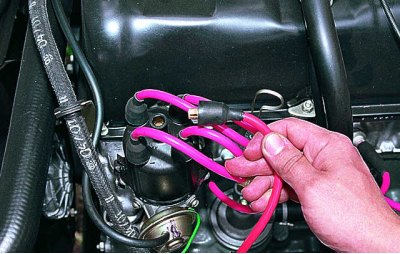
We take out the central high-voltage wire (connected to the ignition coil) from the distributor cap.
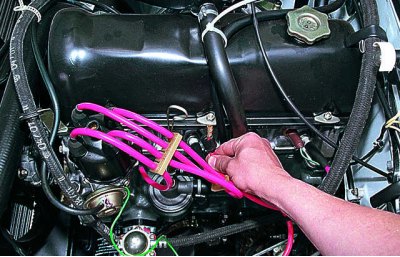
We bring its tip at a distance of about 1 millimeter to the exposed contact of the "ground" (for example to a bolt or stud on the engine).
Holding the wire in this position, ask the assistant to turn the engine crankshaft with the starter.
If there is no spark, we check in order: the gap between the breaker contacts (see Adjusting the angle of the closed state of the breaker contacts).
[The original source is located on the website VAZbook.ru]
The presence of voltage on the low-voltage contact of the distributor when the ignition is turned on can be checked with a tester or a test lamp.
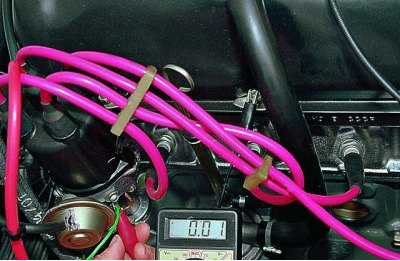
The tester (voltmeter) should show the periodic occurrence of voltage when turning the crankshaft, and the control lamp should light up and go out (see Checking the ignition timing).
We replace the ignition coil with a known good one.
If there is a spark, we install the central wire in place and repeat the experiment with any of the spark plug wires.
If there is no spark between the spark plug wire and the ground, it is possible that condensation has settled on the inner wall of the distributor cap; damage to the carbon of the central electrode; runner resistor failure,...
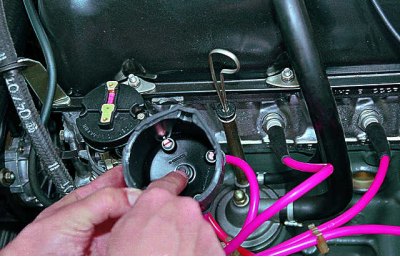
...as well as oxidation of the distributor cap and rotor electrodes.
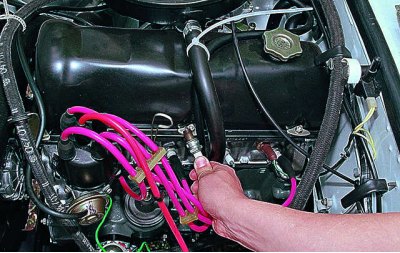
If there is a spark on the spark plug wire, we check the condition of the spark plugs and the ignition timing (see relevant sections).