




Caution: Since the vehicles described in this book use a high-energy ignition system, do not disconnect the high-tension wires or check the ignition circuits for spark while the engine is running, as this may result in personal injury and may cause the high-tension insulation to burn out and the ignition system to fail.
Do not disconnect the wires from the battery terminals while the engine is running, as this may damage the switch.
After servicing or repairing the vehicle, before starting the engine, make sure that the high-voltage wires are securely connected to the coil and spark plugs.
Contactless sensor
The performance of the contactless sensor located in the spark timing sensor can be checked using an indicator assembled according to the circuit shown in Figure 152. The indicator uses resistors of the MLT type, 1 W; capacitor C1 is of type KLS1, and C2 is of type K53-14. The indicator lamp HL1 is an automobile lamp A12, 3 W.
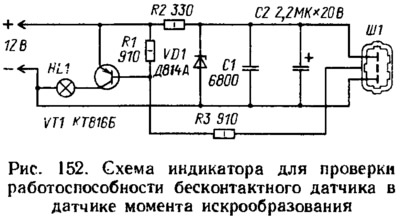
Instead of the KT816B transistor, you can use a KT814B transistor. The indicator wires are soldered to a three-terminal block W1 of the same type that is attached to the spark moment sensor on the car.
To check the contactless sensor, connect the indicator to the spark timing sensor instead of the ignition system wiring harness and turn the engine with the starter and a special key for the bolt on the crankshaft. If the HL1 lamp blinks when the crankshaft rotates, then the contactless sensor is working properly.
The serviceability of the contactless sensor can also be checked using a voltmeter according to the diagram shown in figure 154. The procedure for checking is described in the next section. This method is more accurate, as it allows you to check the magnitude of the voltage pulses emitted by the sensor using a voltmeter.
Switch
The operability of the switch can also be checked using a lamp of the A12 type, 3 W. To check, it is necessary to disconnect the brown wire from the ignition coil, coming from the terminal "1" of the switch, and connect the tip of the wire to the test lamp. The other output of the lamp is connected to the terminal of the ignition coil and the engine is turned by the starter. If the lamp blinks when the engine crankshaft is turned, then the switch sends current pulses to the ignition coil.
The described method allows only a rough estimate of the switch's performance - whether it produces current pulses or not. Pulse parameters (size and duration, shape) cannot be checked by this method. And they can seriously affect the engine operation, especially at high crankshaft speed. Therefore, the following test of the switch on the stand using an oscilloscope and a rectangular pulse generator is more accurate.
Ignition coil and high tension wires
The performance of these elements can be checked using a high-voltage arrester. The simplest arrester consists of two pointed metal rods, the gap between which can be adjusted. The rods are fixed to a plate made of electrically insulating material (plastic. ceramics).
To check, disconnect the high-voltage wires from the spark plugs and connect them to the spark gap electrodes. Set the air gap between the spark gap electrodes to 7-10 mm. If, when the engine is rotated by the starter, uninterrupted sparking is observed between the spark gap electrodes, then the ignition coil and high-voltage wires are in good condition.