




Contents: Ignition distributor sensor ↓ Switch ↓ Ignition switch ↓ Ignition coil ↓ Operation of the ignition system ↓
Open large image in new tab »
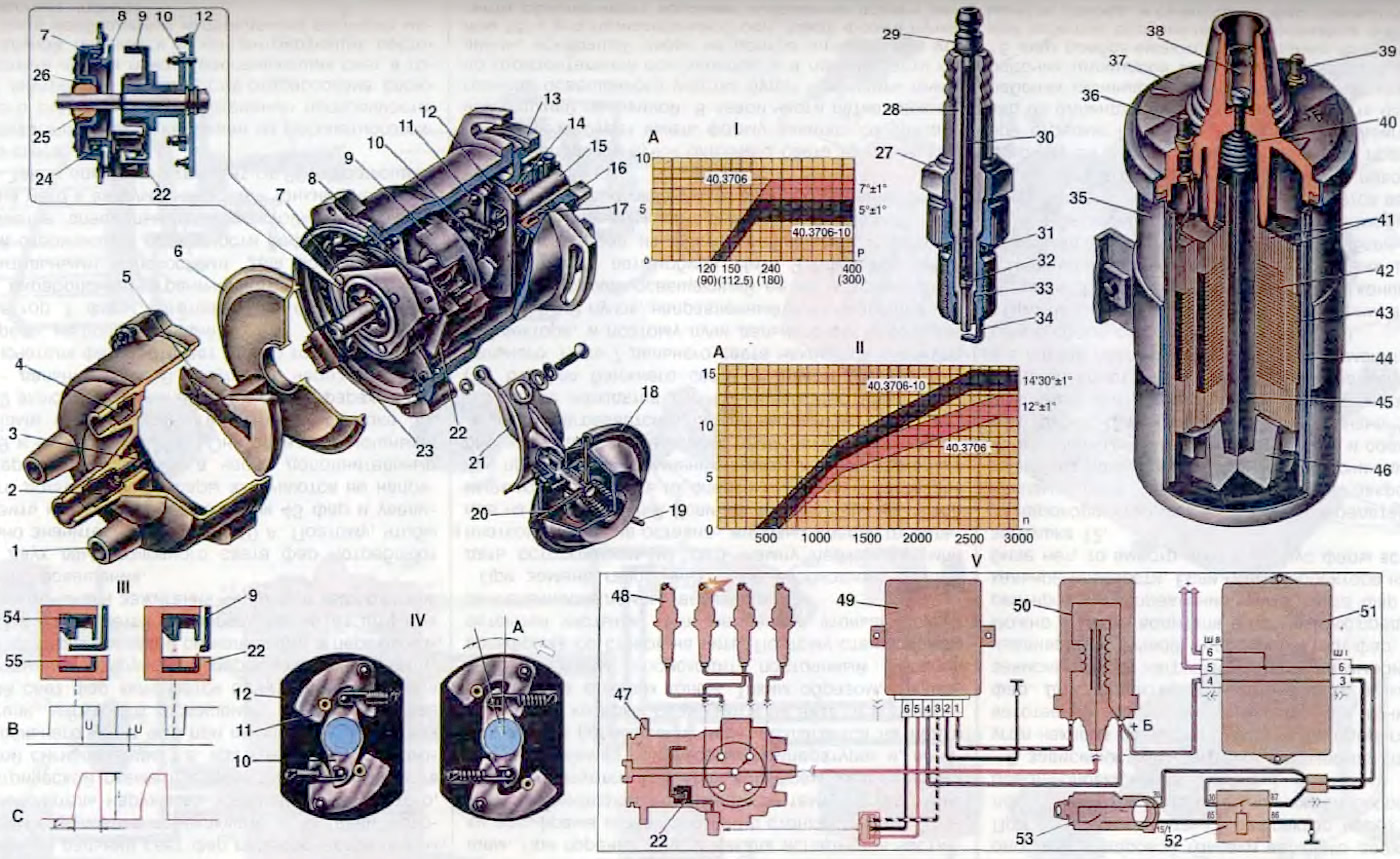
Figure 32. Ignition system: 1. Ignition distributor sensor cover; 2. Terminal for the wire from the ignition coil; 3. Central carbon electrode; 4. Side electrode with terminal; 5. Rotor with central and outer contacts and with a noise suppression resistor; 6. Protective screen; 7. Front roller bearing holder; 8. Sensor support plate; 9. Screen; 10. Driven plate of the centrifugal regulator; 11. Weight; 12. Leading plate: 13. Ignition distributor sensor housing: 14. Oil seal; 15. Ignition distributor sensor shaft; 16. Coupling; 17. Bushing of the rear end of the roller; 18. Vacuum regulator housing; 19. Nipple for vacuum supply; 20. Vacuum regulator diaphragm; 21. Vacuum regulator rod. 22. Contactless sensor; 23. Connector block: 24. Sensor support plate bearing; 25. Front end bushing of the roller; 26. Felt ring; 27. Spark plug body; 28. Isolator; 29. Contact bushing; 30. Contact rod; 31. Sealing ring; 32. Central electrode; 33. Heat dissipating washer; 34. Side electrode; 35. Ignition coil housing; 36. Terminal "K" of the primary winding end output; 37. Lid; 38. High voltage central terminal; 39. Terminal "B" of the output of the beginning of the primary and end of the secondary windings; 40. Contact spring of the central terminal; 41. Insulating paper of windings; 42 Secondary winding; 43. Primary winding; 44. External magnetic circuit. 45. Core (internal magnetic circuit); 46. Isolator; 47. Ignition distributor sensor; 48. Spark plugs; 49. Switch; 50. Ignition coil; 51. Mounting block; 52. Ignition relay; 53. Ignition switch; 54. Permanent magnet; 55. Semiconductor plate with integrated circuit; I. Characteristics of the vacuum ignition advance regulator: A - ignition advance angle, deg; P - vacuum hPa (mmHg); II. Characteristics of the centrifugal ignition advance regulator; A - ignition timing angle, degrees; n - rotation speed of the ignition distributor shaft, min⁻¹; III. Sensor operation diagram: B - voltage pulses at the sensor output; C - current pulses in the primary winding of the ignition coil; tn - current accumulation time; IV. Scheme of operation of the centrifugal ignition advance regulator: A - ignition advance angle, deg.; V. Ignition system diagram.
The contactless ignition system used in VAZ-2108 and VAZ-2109 vehicles consists of the following units: ignition distributor sensor, switch, spark plugs, ignition coil, ignition switch and high-voltage wires.
Ignition distributor sensor
Type 40 3706 is used on engines 2108 and 21083 or 40.3706-10 on engines 21081 and serves to issue low-voltage control pulses to the commutator and to distribute high-voltage pulses to the spark plugs. These sensors-distributors are four-spark with vacuum and centrifugal ignition advance regulators and with a contactless microelectronic sensor of control pulses. They differ only in the characteristics of the vacuum and centrifugal ignition advance regulators.
The ignition distributor sensor is mounted on the auxiliary unit housing and is driven directly from the rear end of the camshaft via clutch 16. The shaft rotates in two metal-ceramic bushings 17 and 25. Bushing 17 is lubricated with oil from the engine lubrication system, and bushing 25 is surrounded by a felt ring 26 impregnated with oil, which is sufficient for the entire service life. The shaft contains the components of the centrifugal ignition advance regulator: leading plate 12 with weights 11 and driven plate 10. The leading plate is secured to the shaft, and the driven plate, together with screen 9, forms a single unit with the bushing placed on the shaft. The bushing can rotate on the shaft within a small range.
The contactless sensor 22 is fixed on the plate 8 and operates on the basis of the Hall effect, which consists in the occurrence of a transverse electric field in the plate of the semiconductor with current when a magnetic field acts on it. The sensor consists of a semiconductor plate with an integrated microcircuit 55 and a permanent magnet 54 with a magnetic circuit. Between the plate and the magnet there is a gap in which there is a steel screen 9 with four slits.
When the screen body passes through the sensor gap (see picture), then the magnetic lines of force are closed through the screen and do not act on the plate. Therefore, the potential difference in the plate does not arise. If there is a screen slit in the gap, then a magnetic field acts on the semiconductor plate and the potential difference is removed from it.
The integrated microcircuit built into the sensor converts the potential difference arising on the plate into negative polarity voltage pulses. Thus, when the screen body is in the sensor gap, there is a voltage of U 4max 0 at its output, approximately 3 V less than the supply voltage. If a screen slit passes through the sensor gap, the voltage of U 4min 0 at the sensor output is close to zero (no more than 0.4 V).
Switch
Electronic switch 49 is used to interrupt the current in the primary circuit of the ignition coil according to the signals of the contactless sensor. Interchangeable switches of different brands can be used: 3620.3734, HIM-52, BAT10.2, RT1903 or PZE4020. A special powerful high-voltage transistor is used to interrupt the current.
The switch circuit has a device for automatically regulating the period t 4h 0 of current accumulation I 41 0 in the ignition coil, depending on the speed of rotation of the crankshaft. The value of the current pulses I 41 0 is 8-9 A. In addition, automatic current cut-off through the ignition coil is provided when the engine is not running, but the ignition is turned on. After 2-5 seconds after the engine stops, the output transistor is locked without creating a spark on the spark plugs.
Spark plugs used are domestic types A-17DV-10 or FE65R made in Slovenia, or similar. These plugs have a built-in interference suppression resistor of 4-10 kOhm. The design of the plugs is traditional. The gap between the electrodes of the plug is 0.7-0.8 mm.
Ignition switch
The ignition switch is fixed to the steering shaft bracket and is used together with the ignition relay type 113.3747-10, which is fixed under the instrument panel. The switch has a lock against restarting the starter with the engine running and an anti-theft device. The principle of operation of this device is that after removing the key in position III (Parking), a locking rod extends from the housing, enters the groove on the steering shaft and locks it.
Ignition coil
Ignition coil type 27.3705 with open magnetic circuit, sealed, oil-filled. It is designed to convert low-voltage current (12 V) into high-voltage current (20-25 kV) to break down the air gap between the spark plug electrodes. It is a transformer with two windings: primary 43 and secondary 42.
Operation of the ignition system
When the engine is running, the contactless sensor produces pulses. In voltage to the plug "6" of the switch, and it converts them into pulses. From the current in the primary winding of the ignition coil. At the moment of current interruption, the magnetic field in the ignition coil is sharply compressed and, crossing the turns of the winding, induces an EMF of about 22-25 kV in it. The high-voltage current goes to the central terminal 2 of the ignition distributor sensor, then through the contacts of the rotor 5 to the side electrode 6 and further to the spark plug, creating a spark discharge between its electrodes.
To obtain maximum engine power, it is necessary to ignite the combustible mixture a little earlier than the piston reaches TDC, and each engine crankshaft speed requires its own ignition advance angle. Thus, at 750-800 rpm, the initial (installation) the ignition advance angle is 1°±1° for 2108 engines, 6°±1° for 21081 and 4°±1° for 21083. As the rotation speed increases, the ignition advance angle should increase, and this task is performed by a centrifugal ignition advance regulator.
When the rotation speed increases, the weights 11 move apart under the action of centrifugal forces and rotate the plate 10 together with the screen 9 by an angle A in the direction of rotation of the roller. Now the screen slot passes through the sensor gap by an angle A earlier, and it gives out a pulse earlier, i.e. the ignition advance increases.
The vacuum regulator changes the ignition timing depending on the engine load. When the load is high (carburetor throttle valves are fully open), the residual gas content of the combustible mixture is low and it burns faster, so ignition should occur later. Conversely, at low load (throttle valves are closed) the amount of residual gases in the working mixture is increased, and the working mixture burns more slowly, so ignition must occur earlier.
The vacuum regulator diaphragm 20 is subjected to a vacuum transmitted from the area above the throttle valve of the first chamber of the carburetor. When the valve opens slightly, the vacuum causes the diaphragm 20 to pull back and, with the help of the rod 21, turn the support plate 8 of the sensor against the direction of rotation of the shaft. The ignition advance increases. As the throttle valve opens further, (increase in load) the vacuum decreases and the spring presses the diaphragm back to its original position. The sensor support plate rotates in the direction of the shaft rotation and the ignition advance decreases.