




Contents: Distributor ↓ Ignition coil ↓ Spark plugs ↓ Ignition switch ↓ Elements for suppressing radio…↓
Distributor
Before installing the ignition distributor on the stand, check the condition of the breaker contacts, whether the lever with the movable contact is jammed, as well as the contact pressing force, which should be 500-600 gf. Check the wear of the breaker lever pad. In case of wear, set the required gap between the breaker contacts.
If the contacts of the breaker are dirty, burnt or eroded, then clean them with a file. Sandpaper and other abrasive materials cannot be used for this purpose. After cleaning, wipe the contacts of the breaker with chamois soaked in gasoline. Then pull the lever to evaporate the gasoline, and wipe the contacts again with dry chamois. Instead of chamois, you can use any material that does not leave fibers.
The contacts must touch with their entire surface. If this does not happen, then, by bending the rack bracket, adjust the position of the fixed contact. Do not bend the lever with the movable contact. Wipe the distributor cap from dirt and oil. Slightly lifting the distributor cap, check whether the rotor contact is opposite the cap electrode at the moment the breaker contacts open.
Checking the work
The ignition distributor is installed on a test bench for checking electrical devices and connected to an electric motor whose rotation speed is adjustable. Connections are made to the ignition coil and to the storage battery. The four terminals of the cover are connected to spark gaps on the bench, the gap between the electrodes of which is adjustable.
A gap of 5 mm is set between the discharger electrodes, the stand's electric motor is turned on and the distributor shaft is rotated clockwise for several minutes at a frequency of 2000 rpm.
Then the gap between the electrodes is increased to 10 mm and they monitor whether there are any internal discharges in the ignition distributor, which are detected by the sound or by the weakening and interruption of sparking on the spark gap of the test bench.
During operation, the ignition distributor should not produce significant noise at any shaft rotation speed.
Removal the characteristics of the centrifugal ignition advance regulator
Install the ignition advance regulator on the stand and make electrical connections in accordance with the stand instructions. Turn on the stand's electric motor and rotate the distributor shaft at a frequency of 300-400 rpm for P125 distributors and 150-200 rpm for 30.3706-01 distributors. Read off the graduated disk to determine the degree value, which results in one of four sparks.
By increasing the rotation speed and taking readings at each increase of 200-300 rpm, the number of degrees of ignition advance relative to the initial value is determined depending on the rotation speed of the ignition distributor shaft. The resulting characteristic is compared with the characteristic in Fig. 166. If the characteristics do not match, then new weight springs are selected or the distributor is replaced.
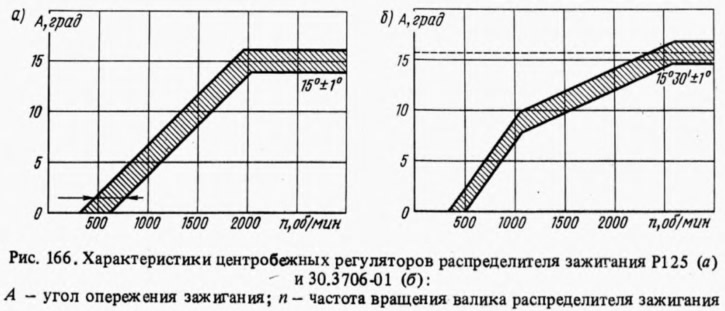
Checking the angle of the closed state of contacts
The ignition distributor is installed on the test bench and the cover is removed. The connections are made in accordance with the instructions for the bench. The electric motor of the bench is turned on and the rotation frequency of the ignition distributor shaft is increased to 1000 rpm. The value of the angle of the closed state of the contacts is measured on the bench scale, which should be (55±3)°. After checking the angle of the closed state of the contacts, the angles between the moments of opening of the contacts on the cylinders relative to the first (asynchronism), which should not differ from the nominal values by more than 1°.
Insulation resistance testing
The insulation resistance between the various terminals and the ground must be checked with a megohmmeter. The resistance between the low-voltage terminal of the breaker and the ground is measured with the breaker contacts open. The insulation resistance at (25±5)°C must be at least 10 mOhm.
Checking the capacitor
The capacitance of the capacitor, measured in the frequency range between 50 and 1000 Hz, should be within 0.20-0.25 μF.
Removal the vacuum regulator characteristic
Install the ignition distributor on the stand and make connections in accordance with the stand instructions. Turn on the electric motor of the stand and rotate the ignition distributor shaft at a frequency of 1000 rpm. Set the conditional "zero" for the moment of sparking in any of the cylinders on the graduated disk.
Smoothly increasing the vacuum, every 20 mm Hg note the number of degrees of ignition advance relative to the initial value. The resulting characteristic is compared with the characteristic in Fig. 167. Adjust the characteristic of the vacuum regulator by selecting adjusting washers between the spring and the plug of the vacuum regulator. When taking the characteristic, it is necessary to pay attention to the clarity of the return to the initial position of the movable plate of the breaker after removing the vacuum.
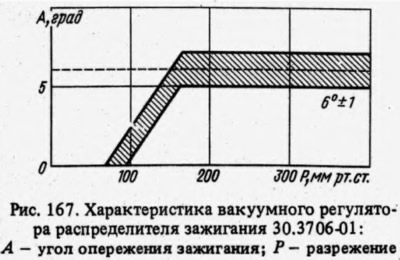
Ignition coil
The ignition coil is checked for ohmic resistance of the windings, which at 20°C should be 3.07-3.5 Ohm for the primary winding and 5400-9200 Ohm for the secondary winding. Then the reliability of the insulation to the "ground" is checked. The ignition coil must withstand an alternating current voltage of 1500 V, supplied for 1 min between one end of the primary winding and the housing. The insulation resistance to the "ground" must be greater than or equal to 50 MOhm.
Spark plugs
If misfires are observed, especially in one or more cylinders, it is necessary to check the condition of the spark plugs. Before testing, spark plugs with carbon deposits or contaminated ones are cleaned on a special installation with a jet of sand and blown with compressed air. If the carbon deposits are light brown, then it can be left in place, since they appear on a serviceable engine and do not interfere with the operation of the ignition system.
After cleaning, inspect the spark plugs and adjust the gap between the electrodes. If the spark plug insulator has chips, cracks, or the weld on the side electrode is damaged, replace the spark plug. The gap (0.5-0.6 mm) between the spark plug electrodes is checked with a round wire probe from the tool kit supplied with the car. It is impossible to check the gap with a flat probe, since this does not take into account the notch on the side electrode that is formed during operation of the spark plug. The gap is adjusted by bending only the side electrode of the spark plug. The central electrode is not bent, since this can cause breakage of the ceramic insulator.
Leak test
Screw the spark plug into the corresponding socket on the stand, and then create a pressure of 20 kgf/cm² in the stand chamber. Drop a few drops of oil or kerosene onto the spark plug. If the seal is broken, air bubbles will usually come out between the insulator and the metal body of the spark plug.
Electrical test
Having adjusted the gap between the spark plug electrodes (0.5-0.6 mm), screw it into the socket on the stand and tighten it with a torque wrench to a torque of 3.2-4 kgf·m. The tightness is ensured by the elastic gasket of the socket nipple. Adjust the gap between the spark gap electrodes to 12 mm, which corresponds to a voltage of 18 kV, and then use the pump to create a pressure of 6 kgf/cm². Install the tip of the high-voltage wire on the spark plug and press the switch button. The following may be observed.
1. A full spark between the spark plug electrodes is visible in the stand's eyepiece. In this case, the spark plug is considered to be in good working order. Several sparks on the spark gap are allowed.
2. Sparking occurs between the electrodes of the spark gap. In this case, you should reduce the pressure in the device and check at what pressure sparking occurs between the spark plug electrodes. If at a pressure of 5 kgf/cm², then the spark plug is considered normal, and if at a pressure of 4 kgf/cm² and below, then it is defective.
If there is no spark formation on the spark plug and on the spark gap, it must be assumed that there are cracks on the spark plug insulator and that the discharge occurs internally between the mass and the electrodes. Such a spark plug is considered defective.
Ignition switch
The ignition switch is checked for operation of the anti-theft device and correct contact closure in different key positions (Table 27). Voltage from the battery and generator is supplied to contacts "30" and "30/1". Contacts "16" of the switch are not used. The free plug "INT" is intended for connecting a radio receiver. Since 1986, a contact part has been installed that does not have contact "16".
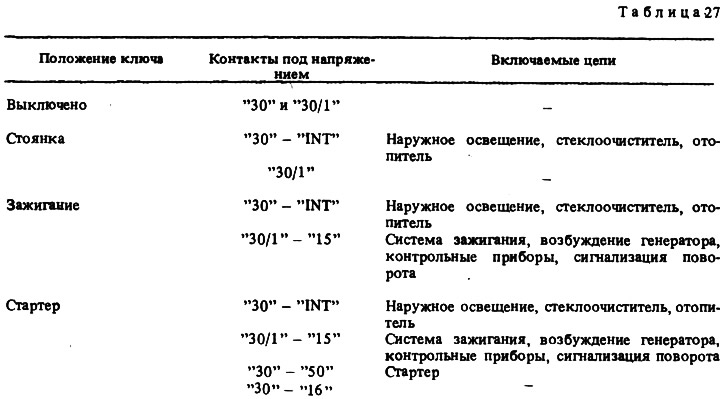
The anti-theft device locking rod must extend when the key is turned to the Park position and removed from the lock. The rod must retract when the key is turned from the Park position to the Off position.
When installing the contact part into the switch housing, it must be positioned so that the "15" and "30" plugs are on the side of the locking rod. Then the wide projection of the contact part will fit into the wide groove of the switch housing.
Elements for suppressing radio interference
These elements include high-voltage wires with a resistance of (2000±200) Ohm/m distributed along their length and a noise-suppressing resistor in the ignition distributor rotor with a resistance of 5000–6000 Ohm,
The functionality of these elements is checked with an ohmmeter.
(The information is published on the website www.VAZbook.ru)