




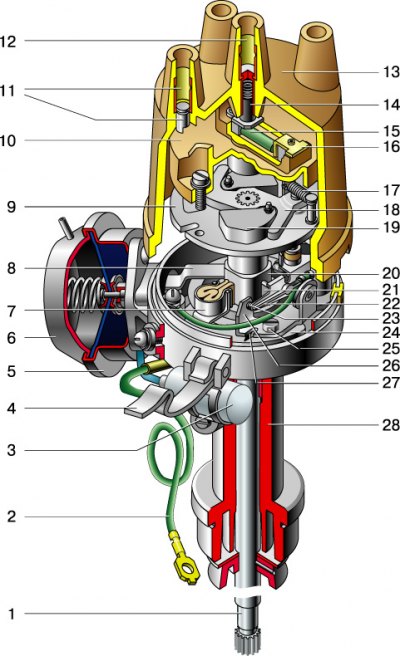
1 – roller; 2 – wire for supplying current to the distributor; 3 – capacitor; 4 – lid locking spring; 5 – vacuum regulator housing; 6 – membrane; 7 – felt; 8 – vacuum regulator rod; 9 – ignition timing regulator support plate; 10 – distributor rotor; 11 – side electrode with terminal; 12 – central electrode with terminal; 13 – distributor cap; 14 – central electrode carbon; 15 – resistor; 16 – outer rotor contact; 17 – centrifugal ignition timing regulator spring; 18 – leading plate of the centrifugal regulator; 19 – ignition timing adjuster weight; 20 – breaker cam; 21 – lever insulating block; 22 – breaker lever with movable contact; 23 – breaker contacts; 24 – movable breaker plate; 25 – contact group fastening screw; 26 – rack with fixed contact of breaker; 27 – groove; 28 – ignition distributor housing.
The ignition distributor converts the direct current of the low-voltage circuit into pulsed current and distributes high-voltage current pulses to the spark plugs. It is structurally combined with the breaker and ignition advance regulators.
The distributor is installed in the front part of the cylinder block on the left side.
The distributor housing is cast from an aluminum alloy. Two plain bearings are pressed into the housing tailstock, in which the shaft rotates. The breaker cam is made on the upper part of the shaft, and a centrifugal regulator and rotor (runner) are mounted. When the shaft rotates, the centrifugal regulator weights diverge under the action of centrifugal forces and turn the tetrahedral breaker cam by a certain angle in the direction of shaft rotation. In this case, the contacts open with some lead, the greater the higher the engine speed. The angle of rotation is limited by the size of the groove in the rotor support plate.
The breaker consists of a stand with a fixed contact and a movable contact with a textolite stop, which is pressed by a flat spring to the square cam of the distributor shaft. When the cam rotates, the contacts close and open. The cam is lubricated with a felt pad soaked in motor oil.
Attention! When operating the vehicle, it is necessary to systematically check and adjust the gap between the breaker contacts (see Adjusting the angle of the closed state of the breaker contacts).
The plate on which the interrupter mechanism is mounted is mounted on a ball bearing, allowing it to rotate around the shaft axis. The plate is connected by a rod to the diaphragm of the vacuum ignition advance regulator. Vacuum (supplied through a hose from the carburetor throttle body) acts on the diaphragm of the vacuum regulator, and the rod rotates the breaker mechanism together with the movable plate relative to the square cam, thereby ensuring the optimum ignition timing depending on the engine load.
To reduce sparking between the breaker contacts, a capacitor is connected in parallel to them. It is fixed on the outside of the distributor housing.
The distributor housing is closed from above by a cover with sockets for high-voltage wires. A spring-loaded piece of carbon is mounted in its central electrode from the inside of the cover. The rotor with a contact plate (runner) distributes high-voltage current to the spark plugs in accordance with the order of operation of the cylinders (1–3–4–2). The distributor shaft rotates clockwise (seen from above).
When adjusting the ignition timing, turning the distributor clockwise decreases the timing, and counterclockwise increases it.