
English Русский
Български
Беларускі
Український
Српски
Hrvatski
Română
Polski
Slovenský
Magyar
| Articles | Contacts | Sitemap |   
Repair and maintenance Lada Repair and maintenance Mazda Repair and maintenance Mitsubishi Repair and maintenance Toyota Repair and maintenance Land Rover Repair and maintenance Hyundai Repair and maintenance Nissan
VAZbook.ru


Main     1111   2101   2105   2106   2107   2109   2110   2115   2121  
VAZ-2108 (1984-2003) VAZ-2109 (1984-1997) VAZ-21099 (1990-2004)
  • Main
  • «Sputnik»
  • VAZ-2109
  • Electrical equipment
  • Engine electrics
  • Operation of the contactless ignition system

Operation of the contactless ignition system (VAZ-2109)

            0

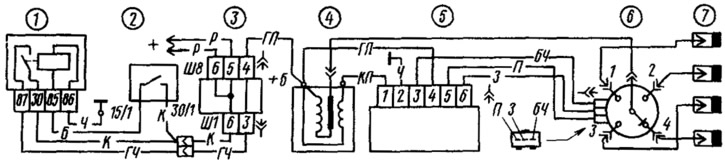
When the ignition is turned on, contacts "30" and "87" of relay 1 are closed (figure 110) ignition and the supply voltage is supplied to terminal "4" of switch 5 and the contactless sensor in the ignition distributor sensor 6. The camshaft rotates the shaft of the ignition distributor sensor and the contactless sensor produces voltage pulses (see figure 108, II) to terminal "6" of the switch. In turn, the switch converts them into current pulses in the primary winding of ignition coil 4.

Figure 110. Contactless ignition system diagram:

Figure 110. Contactless ignition system diagram:
1 - ignition relay; 2 - ignition switch; 3 - mounting block; 4 - ignition coil; 5 - switch; 6 - ignition distributor sensor; 7 - spark plugs.


The current flowing through the primary winding of the ignition coil creates a magnetic field around the winding turns. At the moment of current interruption, the magnetic field decreases sharply and, crossing the turns of the secondary winding, induces an EMF of about 22...25 kV in it. The high-voltage current goes to the spark plugs and closes along the path: secondary winding of the ignition coil, high-voltage wire, central terminal of the cover, central and outer contacts of the rotor, side electrode of the ignition distributor cover, spark plug, "ground". Then, through parallel circuits, the current passes through the battery, generator, all switched-on consumers, to contacts "87" and "30" of the ignition relay, to terminal "+B" and to the secondary winding of the ignition coil.


High voltage supplied to the central electrode of the spark plug breaks the air gap between the electrodes, and a spark jumps between them, igniting the working mixture in the engine cylinder.

To obtain maximum power and efficiency of the engine, it is necessary to ignite the working mixture a little earlier than the piston reaches TDC, so that combustion ends when the crankshaft turns 10...15° after TDC. In order for the fuel to burn in a timely manner, each engine speed requires its own ignition advance angle. When the crankshaft speed decreases, the ignition advance angle should decrease, and when it increases, it should increase.

At high rotation speed, weights 1 (figure 111) under the action of centrifugal forces they rotate relative to their axes, rest against the driven plate 3 and, overcoming the tension of the springs, rotate it together with the screen 9 (see figure 107) in the direction of rotation of the ignition distributor sensor shaft by angle "A" (figure 111, b). Now the screen slot at angle "A" passes through the sensor gap earlier and it gives out a pulse earlier, i.e. the ignition advance increases. When the rotation speed decreases, the centrifugal forces decrease, and the springs turn the driven plate 3 together with the screen against the direction of rotation of the shaft, i.e. the ignition advance decreases.
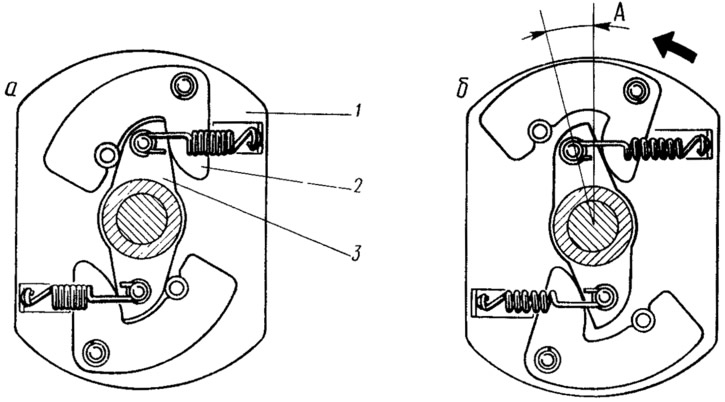
Figure 111. Operation diagram of the centrifugal ignition advance regulator at low crankshaft…

Figure 111. Operation diagram of the centrifugal ignition advance regulator at low crankshaft rotation speed (a) and at high speed (b):
1 - leading plate of the centrifugal regulator; 2 - weights; 3 - driven plate of the centrifugal regulator.


When the engine load changes, the residual gas content in the engine cylinders changes. At high loads, when the carburetor throttle valves are fully open, the residual gas content in the working mixture is low, so the mixture burns faster and ignition should occur later. When the engine load decreases, (throttle cover) the amount of residual gases increases, the working mixture burns longer and ignition must occur earlier. The ignition advance angle is adjusted depending on the engine load by the vacuum ignition advance regulator.

At aperture 20 (see figure 107) This regulator operates under vacuum, transmitted from the area above the throttle valve of the primary chamber of the carburetor. When the throttle valve is closed (engine idle), the hole from which the vacuum comes is higher than the edge of the throttle valve, above which there is no vacuum, so the vacuum regulator does not work.

When the throttle valve opens slightly, a vacuum appears in the hole area, which is transmitted to the vacuum regulator. Diaphragm 20 bends and, with the help of rod 21, turns the sensor support plate against the direction of rotation of the ignition distributor sensor shaft. The ignition advance increases. As the throttle valve opens further, (increase in load) the vacuum decreases and the spring presses the diaphragm back to its original position. The sensor support plate rotates in the direction of the shaft rotation, and the ignition advance decreases.

(The article is copied from the website: «www.VazBook.ru»)


This article is available at russian, bulgarian, belarusian, ukrainian, serbian, croatian, romanian, polish, slovak, hungarian
The text was reviewed by the specialist: Grigory Vologodtsev

Share with friends:

Previous articles
VAZ-2109: Engine electrics
Next articles

Ignition system device
Main faults of the starter and how to fix them
Starter Maintenance
Starter operation
Starter device
Operation of the digital ignition system
Maintenance of the ignition system
Setting the ignition timing
Main faults of contactless ignition system and ways to eliminate them
Features of troubleshooting in a digital ignition system

More articles from other manuals on VAZ cars:
➠ The structure and operation of the ignition system VAZ-2101 (1970-1983)
➠ Contactless ignition system diagram VAZ-21051 (1979-2010)
➠ Contactless ignition system diagram VAZ-2106 (1976-2006)
➠ Contactless ignition system VAZ-2121 (1977-1994)
➠ Ignition system VAZ-1111 (1988-1996)
Link in different formats to this page


Visitor comments

No comments yet


How much will 25 + 40 ?


VAZ-21099 (1990-2004) 
  • General information
  • Specifications
  • User manual
  • Maintenance
  • Car care
  • Troubleshooting
  • Power unit
  • Engine repair
  • Cooling and lubrication system
  • Power and exhaust system
  • Transmission
  • Car gearbox
  • Clutch and drive shafts
  • Chassis
  • Car suspension
  • Steering
  • Brake system
  • Body
  • Exterior
  • Interior
  • Doors and locks
  • Electrical equipment
  • Equipment and devices
  • Lighting and signaling
  • Engine electrics
  • Ignition system


VAZ-2109 (1984-1997) 
  • General information
  • Vehicle operation
  • Vehicle device
  • Power unit
  • Engine repair
  • Cooling and lubrication system
  • Supply system
  • Transmission
  • Clutch
  • Gearbox and drive
  • Chassis
  • Car suspension
  • Steering
  • Brake system
  • Body
  • Body elements
  • Electrical equipment
  • Engine electrics
  • Equipment and devices


VAZ-2108 (1984-2003) 
  • General information
  • Introduction to guide
  • Power unit
  • Engine repair
  • Cooling and lubrication system
  • Power and exhaust system
  • Transmission
  • Clutch and drive shafts
  • Car gearbox
  • Chassis
  • Front suspension
  • Rear suspension
  • Steering
  • Brake system
  • Body
  • Exterior
  • Interior
  • Doors and glass
  • Electrical equipment
  • Equipment and devices
  • Engine electrics
  • Ignition system


VAZbook.ru © 2017 · Mobile version · Contact with administration · Sitemap: EN BG BY UA RS HR RO PL SK HU · Site search · News and articles VAZ-1111 · VAZ-11113 · VAZ-2101 · VAZ-21011 · VAZ-2104 · VAZ-2105 · VAZ-21051 · VAZ-2106 · VAZ-21061 · VAZ-2107 · VAZ-21099 · VAZ-2109 · VAZ-2108 · VAZ-2110 · VAZ-2112 · VAZ-2114 · VAZ-2115 · VAZ-2121 · VAZ-21213 · VAZ-21214 ·
The site stores technical data using cookies to improve the service.