




Coolant
Every 10,000 km check the mileage and, if necessary, restore the coolant level in the expansion tank.
When the car leaves the factory, the cooling system is filled with a special liquid TOSOL A-40M. This liquid is an ethylene glycol mixture that does not freeze at temperatures down to minus 40°C, has anti-corrosion, anti-foaming properties, prevents scale formation and does not require replacement for three years. Therefore, maintenance of the cooling system during the specified period consists only of periodically checking the liquid level in the expansion tank. The liquid level should always be 3-4 cm above the "Ml N" mark (Fig. 35). Check only on a cold engine. If the liquid level is below the "MIN" mark, add the same liquid to the expansion tank.
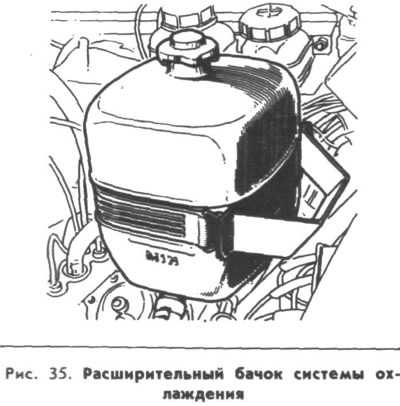
In cases where the fluid level is constantly dropping and you have to top it up frequently, check the tightness of the cooling system and fix the problem.
In extreme cases, you can add clean water to the cooling system. In this case, follow the following procedure:
- cool the engine;
- remove the plugs from the radiator and expansion tank;
- pour water into the radiator; pour water until it starts to spill out of the neck;
- put the radiator cap back in place;
- add enough water to the expansion tank so that its level becomes 3-4 cm above the "MIN" mark;
- put the tank cap back in place.
In cold weather, after adding water to the cooling system, warm up the engine before driving to ensure fluids are moving.
The original source is published on the website VAZBOOK.ru
Please note that when adding water to the system, the freezing point of the mixture increases, so make the necessary repairs to the system and fill it with the appropriate fluid as soon as possible.
Every three years or every 60,000 km mileage (whichever comes first) flush the cooling system and replace the coolant with new one. To remove the liquid from the cooling system, unscrew the plug 2 (Fig. 36) of the drain hole of the lower radiator tank and the plug 3 of the drain hole on the left side of the cylinder block. In this case, set the heater tap control lever to the extreme right position. Remove the remaining liquid from the expansion tank by disconnecting the fastening and raising the tank to the appropriate height.
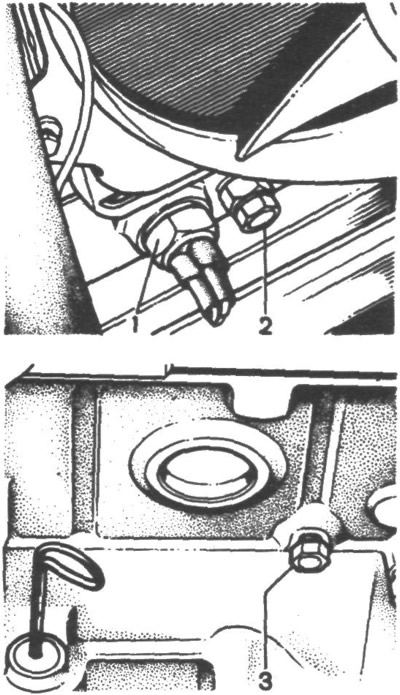
Fig. 36. Cooling system drain holes:
1 - thermal switch; 2 - plug in the lower radiator tank; 3 - plug in the cylinder block.
If plug 2 is missing from the lower radiator tank, then to drain the coolant, disconnect the wires and unscrew the thermal switch 1.
Flush the cooling system as follows:
- fill the system with clean water, start the engine, let it run until the lower radiator tank warms up and, with the engine idling, drain the water through the drain holes;
- stop the engine, cool it down, fill the system again with clean water and repeat the above operation.
After flushing, fill the system with coolant. If there is no special coolant, it is permissible to use clean water, if possible, soft water at an ambient temperature above 0°C, to avoid intensive scale deposits that lead to engine overheating under normal vehicle operating conditions. If using hard water, flush the cooling system twice a year using special substances for descaling.
If the vehicle is equipped with an aluminum radiator with plastic tanks, the use of water is not permitted.