




The suspension strut consists of a housing in which a hydraulic telescopic shock absorber, a cylindrical spring and an upper support are installed. A bracket for attaching the steering knuckle, a steering arm and a lower support cup of the spring are welded to the outside of the strut housing.
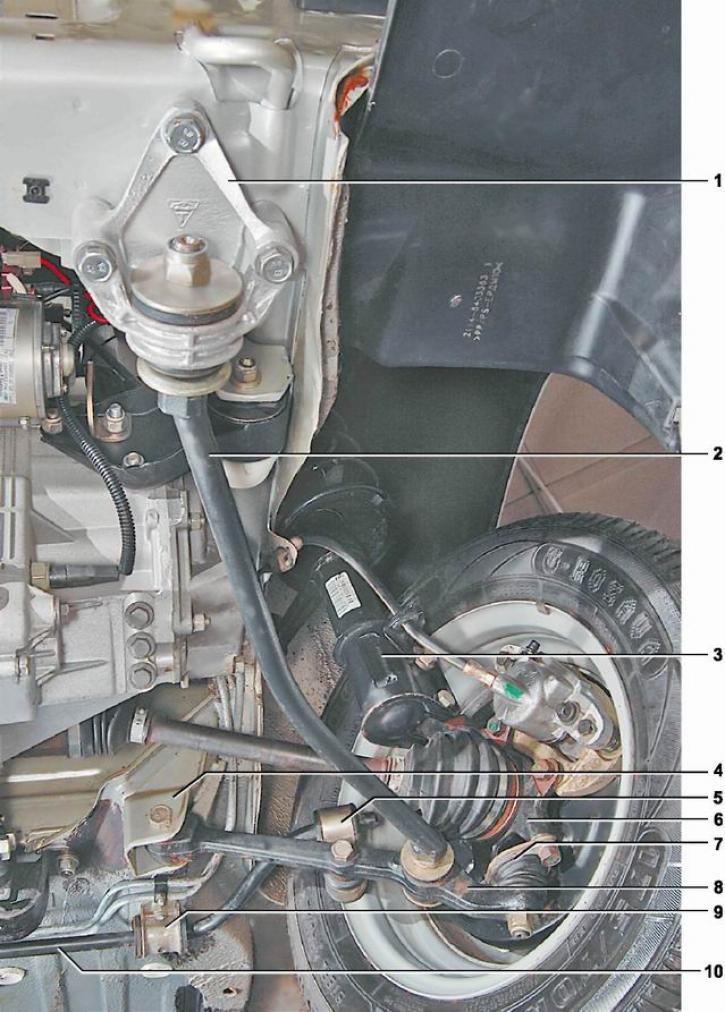
Front suspension: 1 - brace bracket; 2 - longitudinal stretch; 3 - telescopic stand; 4 - transverse arm bracket; 5 - stabilizer strut; 6 - steering knuckle; 7 - ball joint; 8 - transverse lever; 9 - stabilizer bar mounting bracket; 10 - stabilizer bar
The lower coil of the cylindrical spring rests on the lower support cup, and the upper coil rests on the upper support cup, which is fixed to the shock absorber rod. Also mounted on the shock absorber rod is the upper support of the strut, consisting of a housing, a rubber cushion and a bearing. The support housing is attached to the car body with three studs with nuts. The bearing allows the shock absorber rod to rotate in the support when the strut rotates, and the rubber buffer prevents the transmission of vibrations to the car body.
The shock absorber rod is protected from dirt and dust by a corrugated casing. When the suspension breaks through, the rod travel is limited by a compression travel buffer.
The pivot arm of the rack is connected to the steering rod via a ball pin. Changing the length of the rod using its coupling allows you to adjust the toe-in of the front wheels.
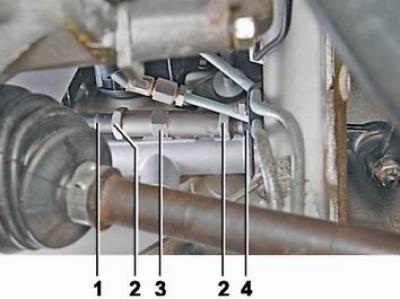
Steering rod coupling: 1 - steering rod; 2 - lock nut; 3 - coupling sleeve; 4 - steering rod end
The steering knuckle is attached to the strut bracket with two bolts and nuts. The upper hole of the bracket is oval, and the bolt installed in it has an eccentric belt and an eccentric washer. When this bolt is rotated, the steering knuckle shifts relative to the strut, turning on the lower mounting bolt, as on an axis. Due to this, the angle between the strut and the knuckle changes, which, in turn, allows you to adjust the camber of the front wheel.
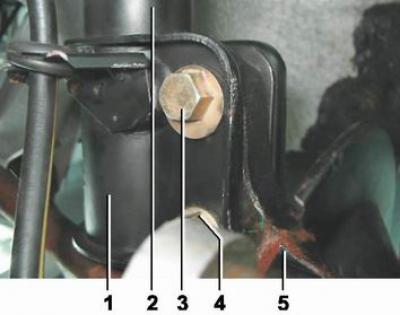
Fastening the steering knuckle to the strut: 1 - steering knuckle mounting bracket; 2 - rack body; 3 - bolt (eccentric) upper mount of the steering knuckle; 4 - lower mounting bolt of the steering knuckle; 5 - steering knuckle
A double-row ball bearing is pressed into the hole of the steering knuckle and secured with two retaining rings. The wheel hub is pressed into the inner ring of the bearing.
At the bottom, the steering knuckle is connected to the transverse suspension arm by means of a ball joint. The transverse arm is held from moving by a brace, which is attached with its rear end through a rubber-metal hinge to the arm, and with its front end through a cushion to a bracket fixed to the car body. By changing the number of washers in the front and rear brace mounts, it is possible to change the position of the arm, thereby adjusting the angle of the longitudinal inclination of the wheel rotation axis.
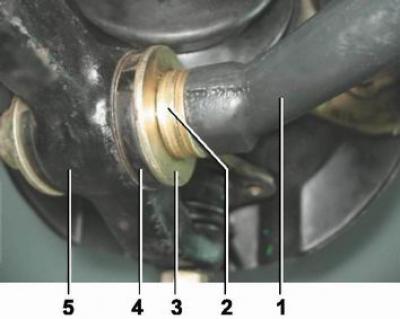
Fastening the longitudinal tensioner to the transverse arm: 1 - rear end of longitudinal stretch; 2 - adjusting washers; 3 - thrust washer; 4 - rubber-metal hinge; 5 - transverse suspension arm
The ends of the anti-roll bar are connected to the transverse levers of the front suspension of the car by means of struts. The central part of the anti-roll bar is fixed to the body with brackets through rubber cushions. The movement of one of the levers is transmitted to the other through the anti-roll bar. This allows for partial synchronization of the work of both sides of the suspension and thus reduces the rocking of the car on uneven roads and rolls in turns.
After repairing any suspension or steering components, be sure to check the front wheel alignment angles. A high-quality check and adjustment of the front wheel alignment angles can only be performed at a service facility that has a special stand for performing adjustment work.