




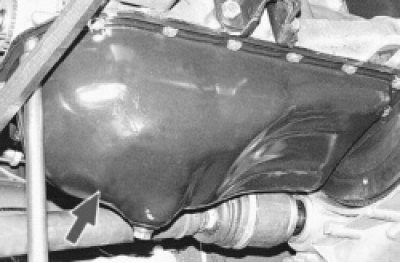
2. Look under the front of the car to see if the engine oil pan is punctured or leaking.
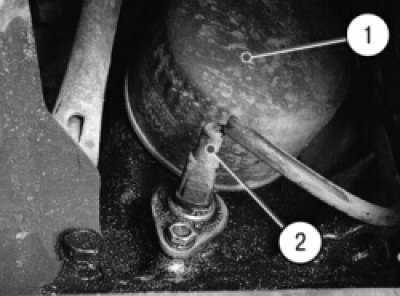
3. Pay special attention to the oil filter. Oil may leak from under the rubber gasket of the filter 1 if it is damaged or the filter is not secured properly. If oil leaks from under the oil filter, sometimes it is enough to turn it a little clockwise. Check the reliability of the contact of the wiring block on the oil level sensor 2 in the engine crankcase.
(Original source is on the resource: vazbook)
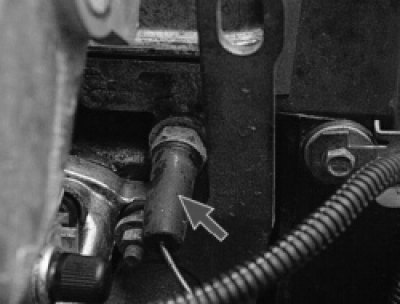
4. Check the reliability of the fastening of the wiring block on the emergency oil pressure drop sensor.
Warning! Be careful - you can get burned by hot engine parts, so wear gloves and long sleeves when working.
5. Remove the dipstick, wipe it with a clean cloth and reinsert it. Remove the dipstick again and check the oil level. The level should be between the "MIN" and "MAX" marks.
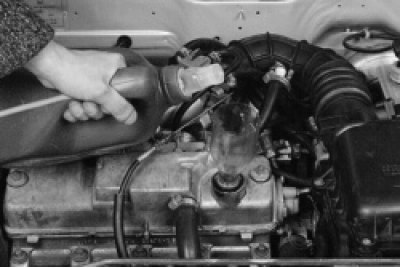
6. If the oil level is below the "MIN" mark, add oil to the norm, for this you can use a funnel from the neck of a plastic bottle. Start the engine.
If the low oil level warning light in the engine crankcase continues to light on the on-board monitoring system indicator, then the sensor itself is faulty or the fault should be looked for in the sensor's electrical circuit. When the engine oil level is normal, the low oil pressure warning light should go out - you can continue driving.
If the lamp still lights up, check the oil pressure sensor for proper operation. To do this, unscrew the standard oil pressure sensor and install a mechanical pressure gauge in its place. If the pressure at normal idle speed is more than 0.06 MPa (0.65 kgf/cm²) and increases with increasing speed, the sensor or its electrical circuit is faulty.
If after eliminating all visible causes the oil pressure in the engine is insufficient (the oil pressure warning light is on), engine diagnostics and repair is required (see section "Engine").
Warning! Do not attempt to drive to a garage - the engine will fail. Tow the car to a repair shop with the engine inoperative.