
English Русский
Български
Беларускі
Український
Српски
Hrvatski
Română
Polski
Slovenský
Magyar
| Articles | Contacts | Sitemap |   
Repair and maintenance Lada Repair and maintenance Mazda Repair and maintenance Mitsubishi Repair and maintenance Toyota Repair and maintenance Land Rover Repair and maintenance Hyundai Repair and maintenance Nissan
VAZbook.ru


Main     1111   2101   2105   2106   2107   2109   2110   2115   2121  
VAZ-2114 (2004-2013) VAZ-2115 (1997-2012)
  • Main
  • «Samara-2»
  • VAZ-2115
  • General information
  • Vehicle malfunctions
  • Checking the electrical equipment of the car

Checking the electrical equipment of the car (VAZ-2115)

            0

Contents: Check on the car ↓ Checking the regulator removed from…↓
1. Check if the alternator drive belt is broken. If the belt is intact, check its tension. Press…


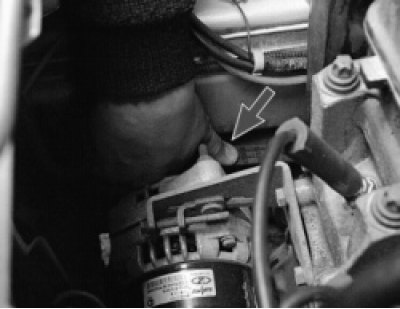
1. Check if the alternator drive belt is broken. If the belt is intact, check its tension. Press the belt with your thumb from above and see how much it bends.

Normal tension is provided with a belt deflection of 10-15 mm. If the belt is poorly tensioned, loosen the tightening of the nuts of the lower and upper generator mounts and, turning the adjusting bolt clockwise (shown by arrow), move the generator away from the engine. Tighten the generator mounting nuts.
2. If the belt tension is correct, check whether the corresponding fuse has blown. See the fuse…


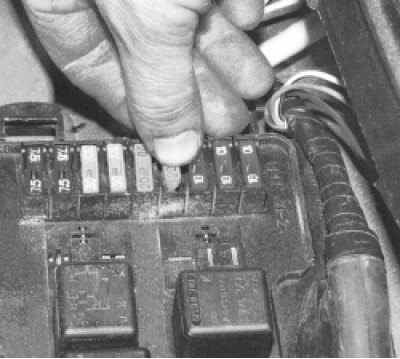
2. If the belt tension is correct, check whether the corresponding fuse has blown. See the fuse location and ratings. "Electrical equipment faults", in the vehicle repair manual, a separate electrical diagram, on the fuse box body and on the fuses themselves.


If the fuse is blown, replace it, start the engine and check if the battery charge lamp goes out. If the lamp goes out, you can continue driving.

Warning! Do not install fuses with a higher rated current - this may cause damage to electrical equipment and even fire.

3. If the battery charging lamp does not go out, check the wire going from the generator to the…


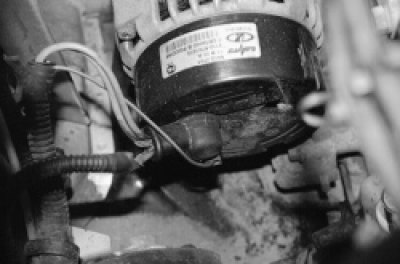
3. If the battery charging lamp does not go out, check the wire going from the generator to the positive terminal of the battery. There are two wires connected to it: the thicker one connects the battery to the starter, the thin one to the generator. The wire may be torn, broken inside the insulation, or have oxidized or unreliable contacts. Fix the problem and start the engine. If charging current appears, you can continue driving.

If after the measures taken the charging lamp continues to light with the engine running, then the possible cause of the malfunction lies in the generator itself. There may be several reasons, it is better to eliminate them in a car service or garage, and you can only hope that the energy reserve in the battery is enough to get to them.

To reduce current consumption when driving a car with a faulty generator, if possible, turn off the radio, unnecessary lighting devices, heater fan, glass heater, etc.


Experienced car enthusiasts can be recommended to check the generator voltage regulator. The voltage regulator's job is to continuously and automatically change the excitation current of the generator so that the generator voltage is maintained within the specified limits when the rotation speed and generator load change.

Check on the car


To check, you need a DC voltmeter with a scale of up to 15-30 V and an accuracy class of at least 1.0. After 15 minutes of engine operation at medium speed with the headlights on, measure the voltage between terminal "30" and the generator "ground". The voltage should be within 13.6-14.6 V. If systematic undercharging or overcharging of the battery is observed and the regulated voltage does not fit within the specified limits, the voltage regulator must be replaced.
Checking the regulator removed from the generator


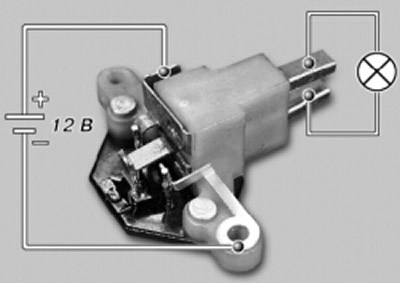
Checking the regulator removed from the generator


Connect a 12 V test lamp to the brushes. Apply 12 V "+" to the terminal and "-" to the brush holder "ground" - the test lamp should light.
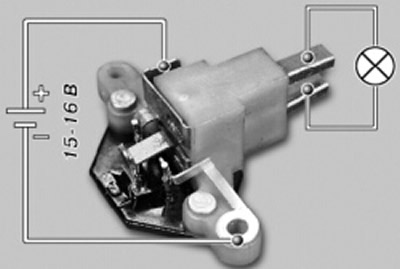
Then apply a voltage of 15-16 V - the lamp should go out. If the lamp lights up in both cases, then…


Then apply a voltage of 15-16 V - the lamp should go out. If the lamp lights up in both cases, then there is a breakdown in the regulator; if it does not light in both cases, then either there is a break in the regulator, or there is no contact between the brushes and the terminals of the voltage regulator.


This article is available at russian, bulgarian, belarusian, ukrainian, serbian, croatian, romanian, polish, slovak, hungarian
The text was reviewed by the specialist: Grigory Vologodtsev

Share with friends:

Previous articles
VAZ-2115: Vehicle malfunctions
Next articles

The battery is not recharging
Checking the cooling system
Car engine overheating
Checking the lubrication system
The engine oil pressure has dropped
Vehicle electrical equipment faults
Extraneous knocking noises in the engine
Extraneous knocks in the suspension and transmission
Vibration and shock on the steering wheel
Brake problems

More articles from other manuals on VAZ cars:
➠ Checking the operation of electrical equipment elements VAZ-21099 (1990-2004)
➠ Additional electrical equipment and sound signal VAZ-1111 (1988-1996)
➠ Electrical equipment wiring diagram VAZ-2101 (1970-1983)
➠ Electrical equipment diagrams for VAZ-2104 and VAZ-2105 cars VAZ-2105 (1979-2010)
➠ Electrical equipment diagrams for VAZ-2106 and VAZ-2103 cars VAZ-2106 (1976-2006)
Link in different formats to this page


Visitor comments

No comments yet


How much will 36 + 36 ?


VAZ-2114 (2004-2013) 
  • General information
  • Operation and maintenance
  • Power unit
  • Engine repair
  • Cooling system
  • Supply system
  • Control system
  • Exhaust system
  • Transmission
  • Clutch
  • Car gearbox
  • Front wheel drives
  • Chassis
  • Wheels and tires
  • Front suspension
  • Rear suspension
  • Steering
  • Brake system
  • Body
  • Exterior
  • Interior
  • Doors and glass
  • Tailgate
  • Ventilation and heating
  • Electrical equipment
  • Equipment and devices
  • Headlights and lighting
  • Engine electrics
  • Electrical circuits


VAZ-2115 (1997-2012) 
  • General information
  • Vehicle device
  • Operation manual
  • Vehicle malfunctions
  • Car care
  • Power unit
  • Engine repair
  • Cooling system
  • Supply system
  • Control system
  • Exhaust system
  • Transmission
  • Clutch
  • Car gearbox
  • Front wheel drives
  • Chassis
  • Front suspension
  • Rear suspension
  • Steering
  • Brake system
  • Body
  • Exterior
  • Interior
  • Doors, covers and windows
  • Electrical equipment
  • Equipment and devices
  • Headlights and lighting
  • Engine electrics
  • Anti-theft system


VAZbook.ru © 2017 · Mobile version · Contact with administration · Sitemap: EN BG BY UA RS HR RO PL SK HU · Site search · News and articles VAZ-1111 · VAZ-11113 · VAZ-2101 · VAZ-21011 · VAZ-2104 · VAZ-2105 · VAZ-21051 · VAZ-2106 · VAZ-21061 · VAZ-2107 · VAZ-21099 · VAZ-2109 · VAZ-2108 · VAZ-2110 · VAZ-2112 · VAZ-2114 · VAZ-2115 · VAZ-2121 · VAZ-21213 · VAZ-21214 ·
The site stores technical data using cookies to improve the service.