




Open large image in new tab »
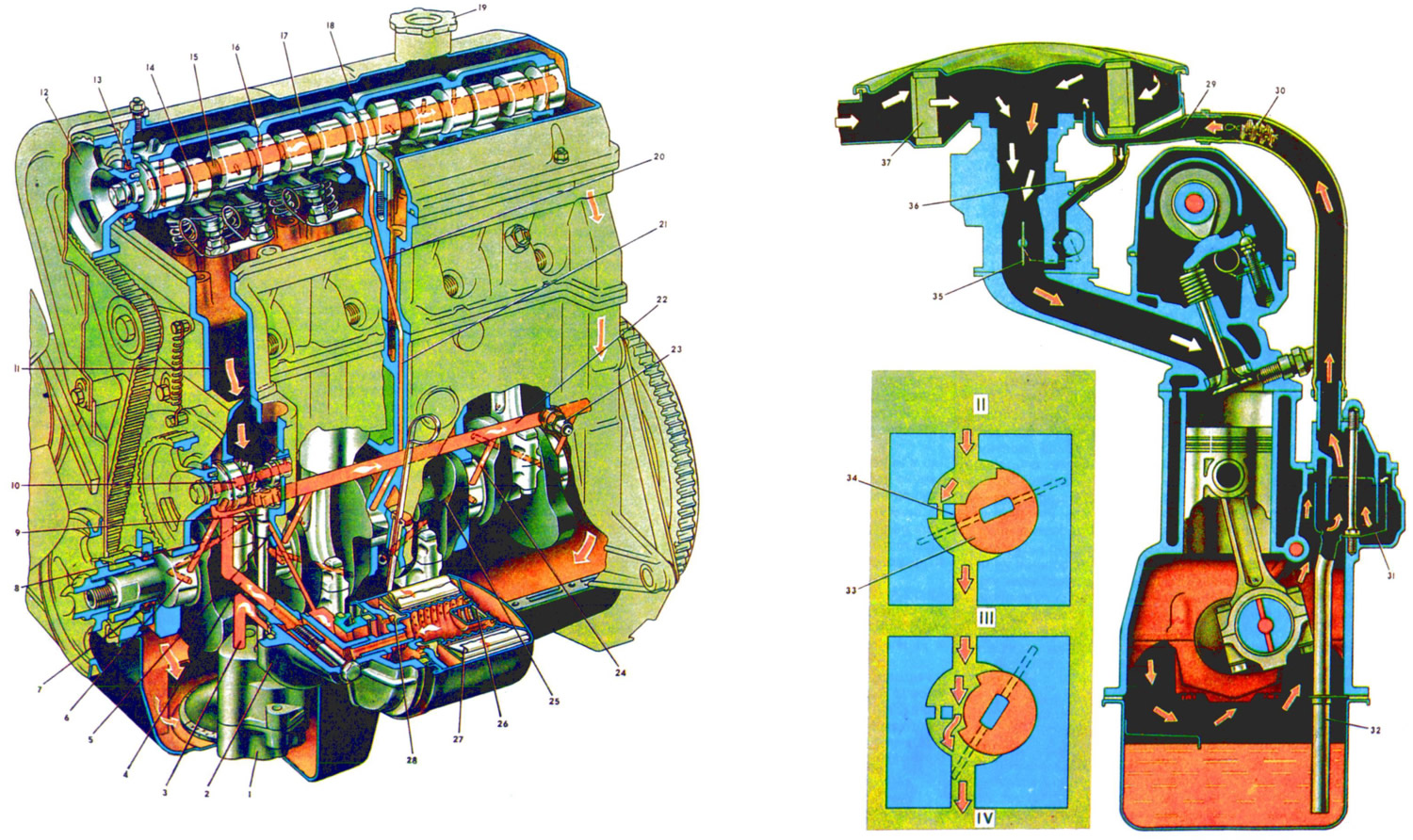
Fig. 6: 1. Oil pump. 2. Oil filter bracket. 3. Oil supply channel from the pump to the filter. 4. Horizontal channel in the cylinder block for supplying oil from the filter to the oil line. 5. Channel in the cylinder block for supplying oil to the oil pump and distributor drive gear. 6. Channel in the crankshaft journal. 7. Front crankshaft oil seal. 8. Oil supply channel from the oil line to the main bearing and to the accessory drive shaft. 9. Oil pump and distributor drive gear sleeve. 10. Accessory drive shaft. 11. Oil drain cavity into the engine crankcase. 12. Camshaft pulley. 13. Camshaft oil seal. 14. Channel in the camshaft cam. 15. The main channel in the camshaft. 16. The channel in the support journal of the camshaft. 17. The bearing housing of the camshaft. 18. The annular groove on the middle support journal. 19. The oil filler cap. 20. An inclined channel in the cylinder head for supplying oil to the valve timing mechanism. 21. A vertical channel in the cylinder block for supplying oil to the valve timing mechanism. 22. The main channel in the cylinder block. 23. The sensor of the oil pressure warning lamp. 24. The channel for supplying oil to the main bearing of the crankshaft. 25. The channel for supplying oil from the main bearing to the connecting rod. 26. The bypass valve of the oil filter. 27. The paper filter element of the oil filter. 28. The anti-drainback valve. 29. Crankcase ventilation exhaust manifold. 30. Flame arrester. 31. Oil separator. 32. Drain pipe. 33. Spool valve on the primary throttle valve shaft of the carburetor. 34. Calibrated hole. 35. Throttle valve. 36. Hose for removing crankcase gases into the rear throttle space of the carburetor. 37. Air filter element. I - Engine crankcase ventilation diagram. II - Spool valve device operation diagram. III - At low crankshaft speed. IV - At high crankshaft speed.
The engine lubrication system, by supplying oil to the rubbing surfaces, ensures:
- reducing friction and increasing the mechanical efficiency of the engine;
- reduction of wear of rubbing parts;
- cooling of engine parts and removal of wear products from the mating surfaces of engine parts.
Lubrication of rubbing parts along with the selection of materials and the type of treatment of their surfaces effectively increases the durability of the engine. The lubrication system also ensures the purification of circulating oil from mechanical and other harmful impurities when it passes through an oil filter with a paper filter element.
The engine oil has a complex of additives that provide high lubricating properties of the oil, resistance to oxidation and the ability to operate in a wide range of temperatures.
The oil reserve required for normal engine operation is located directly in the engine crankcase. Oil is added to the engine crankcase through the oil filler neck, hermetically sealed with cover 19. Used oil is drained from the system through an opening closed with a threaded plug. The capacity of the lubrication system is 3.75 l. The oil level is controlled by the marks on the level indicator.
The oil pressure on a warm engine at medium crankshaft speed is 0.35-0.45 MPa (3.5-4.5 kgf/cm²).
The engine lubrication system is combined: under pressure and splashing. Under pressure, the main and connecting rod bearings, camshaft supports, gear bushing and shaft of the oil pump drive and ignition distributor are lubricated.
The oil flowing out of the gaps and splashed by the moving parts lubricates the cylinder walls, pistons with piston rings, piston pins in the piston bosses, the timing chain, the valve drive lever supports, and also the valve stems in their guide bushings.
The lubrication system includes: oil pump 1, a suction pipe with a filter mesh attached to the pump body; full flow oil filter mounted on the left front side of the engine; oil pressure reducing valve built into the intake manifold; sensor 23 of the oil pressure indicator lamp.
The oil pressure indicator lamp sensor is connected to the oil pressure indicator lamp on the instrument panel, which lights up when the oil pressure drops to 0.02-0.06 MPa (0.4-0.8 kgf/cm²). When the engine is running with a properly functioning lubrication system, the lamp should go out (if the engine is not overheated).
The oil circulation during engine operation occurs as follows. Oil pump 1, driven by a pair of gear wheels with spiral teeth, sucks oil from the crankcase through the filter mesh of the intake pipe and feeds it through channel 3 into the full-flow filter. Filtered oil enters longitudinal main channel 22 along channel 4, passing along the block on the left side, and from there through channels 24 drilled in the partitions of the cylinder block, it is fed to the main bearings of the crankshaft. Oil is fed to the central support of the camshaft through channels 20, 21 drilled in the cylinder block, in the cylinder head and in the housing 17 of the camshaft bearings. In the cylinder head gasket there is a copper-rimmed hole through which oil passes from channel 21 of the block to channel 20 of the cylinder head.
Each shell of the first, second, fourth and fifth main bearings has two holes through which oil gets into the annular grooves on the inner surface of the shells. From the grooves, part of the oil goes to lubricate the main bearings, and the other part goes through channels 6, drilled in the journals and cheeks of the crankshaft, to the connecting rod bearings, and from them through the holes in the lower heads of the connecting rods, a stream of oil gets onto the cylinder mirror at the moment the bearing hole coincides with the channel in the connecting rod journal.
Oil for lubricating the third (central) the main bearing oil comes from the channel through two holes in the liners. There are no annular grooves in the liners of this main bearing and there is no oil drain from it to the connecting rod bearing.
The oil that has passed to the central support of the camshaft through the annular groove 18 in the support journal enters the main channel 15 of the camshaft, and from the channel through openings 14 and 16 in the cams and support journals to the working surfaces of the cams, levers and shaft supports.
Oil from the first bearing of the shaft 10 of the oil pump and ignition distributor drive goes through a channel drilled in the shaft itself to the second bearing. Oil is supplied to the bushing 9 of the gear of the oil pump and ignition distributor drive through a separate channel 5 from the cavity in front of the oil filter. The remaining parts are lubricated by splashing and gravity.
The oil collected under the cylinder head cover flows into the engine crankcase through special cavities 11 for draining and ventilation in the head and cylinder block.
In order to provide the necessary oil pressure in the line during engine operation in any mode, and also to compensate for the oil consumption that increases with engine wear, the oil pump has excess capacity. And to prevent the oil pressure from increasing beyond the permissible level, a pressure-reducing valve is installed in the system, which bypasses excess oil into the oil receiver.
Oil pump (see engine cross section drawing) gear type, installed inside the crankcase and secured to the cylinder block with two bolts. The pump drive gear is fixed to the shaft, and the gear wheel rotates freely on the axis pressed into the pump body. Oil enters the pump through the oil inlet pipe, passing through the filter mesh. A pressure-reducing valve is built into the body of the oil inlet pipe. When the pressure in the lubrication system increases above the permissible level, the oil pushes the pressure-reducing valve and excess oil is bypassed from the pressure cavity into the cavity of the oil receiver. The pressure at which the pressure-reducing valve operates is provided by a spring of the corresponding elasticity, installed at the factory. This pressure is not adjustable.
Oil filter Oil filter full-flow, non-separable. Until 1986, the engines were equipped with oil filter 2101 (shown in the picture), which, due to its larger dimensions than the 2105 filter, was installed using bracket 2. Later, filter 2105 was installed on all the engines described. Due to its smaller dimensions, it can be installed on all VAZ engines. The filter is screwed onto the fitting and pressed against the annular flange of the bracket or cylinder block. The tightness of the connection is ensured by a rubber gasket installed between the filter cover and the block flange. Oil enters the filter through channel 3 and, having passed filter element 27, exits into the main channel 22 of the block through the central hole and the fastening fitting.
The filter has an anti-drain valve 28, which prevents oil from draining from the system when the engine is stopped, and a bypass valve 26, which is activated when the filter element is clogged and bypasses oil in addition to the filter into the main channel 22. Oil filtration is performed by a paper element 27.
When changing the engine oil, the filter must be replaced to ensure effective oil filtration.
Engine crankcase ventilation system
During engine operation, some exhaust gases penetrate into the crankcase through the gaps where the piston rings are installed and the gaps between the valve stems and guide bushings. When the engine is started, gasoline vapors also condense in the cylinders, which, getting into the crankcase, dilute the oil and worsen its lubricating properties. Water vapors present in the exhaust gases, condensing in the crankcase, foam the oil and lead to the formation of thick and sticky emulsions, and in combination with sulfur dioxide, form acids that corrode the working surfaces of engine parts and accelerate their wear.
To remove gases and gasoline vapors from the crankcase, which increases the service life of the oil and increases the durability of the engine, forced ventilation of the crankcase is used, carried out by sucking gases from the crankcase into the engine intake pipe. In addition, crankcase ventilation does not allow the pressure in the crankcase to increase due to the penetration of exhaust gases into it. And since the ventilation system is closed, it excludes the ingress of crankcase gases into the car interior and reduces the emission of toxic substances into the atmosphere.
Crankcase gases are sucked off through a hose placed on the branch pipe of the oil separator cover 31, into the exhaust manifold 29, located under the air filter. From there, the gases can be sucked off in two ways: 1) upwards into the space behind the filter element of the air filter and then through the carburetor into the engine intake pipe; 2) through hose 36 into the valve device of the carburetor and further into the throttle space of the carburetor.
The slide valve device regulates the gas suction mode at different crankshaft speeds. It consists of a slide valve 33 located on the primary chamber throttle axis and a calibrated hole 34 in the carburetor body.
At low crankshaft speed (with closed throttle valves) the vacuum at the carburetor inlet is insignificant and the bulk of the gases are sucked out through hose 36 and then through calibrated opening 34 of the spool valve into the carburetor's throttle space. Calibrated opening 34 limits the amount of gases sucked out, and the ventilation system has little effect on the vacuum behind the throttle valve.
As the crankshaft speed increases when the throttle valve 35 opens, the valve 33 rotates and opens an additional path for gases along the valve groove, and the gases are sucked out both through the hose 36 and through the air filter. The total amount of gases sucked out increases.
Finally, at high crankshaft speed (throttle valves are fully open) the bulk of the crankcase gases is sucked into the air filter into the space behind the filter element.
To prevent flame from getting into the engine crankcase when "firing" into the carburetor, a flame arrester 30 is installed in the exhaust hose. Crankcase gases pass through an oil separator 31 into the exhaust hose, and the oil separated from the gases flows down a tube 32 into the oil crankcase. The housing of the oil separator 31 is installed in the cylinder block boss and is closed with a cover.