




Carburetor Idle System Diagram
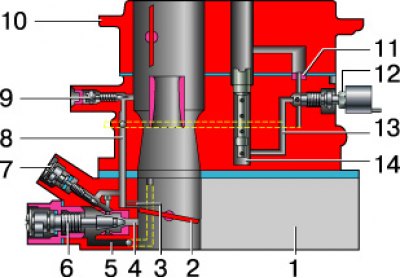
1 – throttle body; 2 – first chamber throttle valve; 3 – transition mode holes; 4 – hole adjusted by the mixture quantity screw; 5 – air supply channel; 6 – mixture quantity adjustment screw; 7 – mixture composition (quality) adjustment screw; 8 – emulsion channel of the idle system; 9 – Additional air adjustment screw*; 10 – carburetor body cover; 11 - idling system air jet; 12 – idle fuel jet housing with shut-off valve; 13 – idle system fuel channel; 14 – emulsion well.
* Installed on carburetor parts.
We adjust the idle system to ensure stable engine speed at idle with a minimum content of carbon monoxide (CO) and hydrocarbons (CH) in the exhaust gases. We recommend that this operation be carried out at the "CO-CH" adjustment points.
To adjust the idle speed, the carburetor has a quantity screw, which decreases or increases the amount of mixture entering the engine, and a quality screw, which determines the composition of the mixture (see Description of the design).
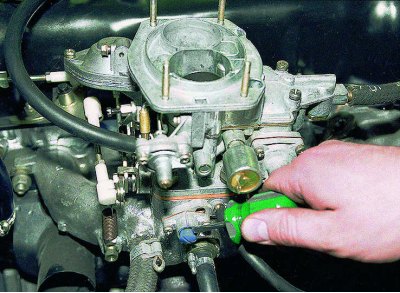
At the factory, these screws are fitted with plastic stop bushings.
They do not allow to violate factory settings. The mixture quantity screw with the limiting sleeve can be turned no more than 90°, and the quality - 50°, which allows, without a gas analyzer, only to adjust the idle speed. If it is not possible to adjust the idle speed with the sleeves, we break them with a screwdriver and repeat the operation.
We carry out the adjustment using a gas analyzer on an engine warmed up to operating temperature with adjusted ignition and valve drive clearances (see relevant sections), with the air damper fully open.
Using the quantity screw, set the crankshaft speed to 820–900 min⁻¹ on the tachometer.
(The original source is published on the website: vazbook)
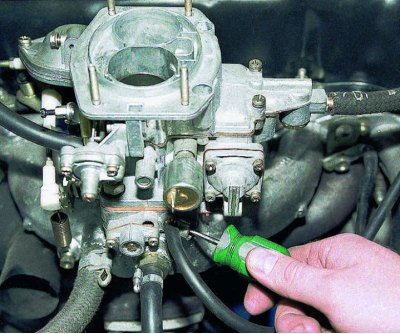
Use the quality screw to achieve a CO concentration in the exhaust gases within 0.5–1.2% at the given position of the quantity screw.
Use the quantity screw to restore the crankshaft speed to 820–900 min⁻¹. If necessary, use the quality screw to restore the CO concentration to 0.5–1.2%.