




1. The following can be attributed to the ignition system malfunctions that cause engine operation interruptions or engine shutdown:
- current leakage through cracks or burnouts in the rotor or distributor cap. What is usually done with such parts? They are replaced with new ones;
- burning of the contacts of the ignition distributor cap or rotor. Such contacts are cleaned with a velvet file or a special abrasive plate for cleaning contacts, washed with gasoline and blown with compressed air;
- damage to the spark plug or spark plugs. Characteristic signs: dark insulator skirt, lower spark plug body temperature. If you remove the wire from the "suspected" spark plug while the engine is running, the latter will "not feel" anything. Spark plugs that have failed are usually replaced with new ones. It happens that, having replaced one or two spark plugs, you do not get any noticeable results;
- burnt runner resistor. The thing is that you won't notice anything visually. A burnt resistor doesn't give itself away. If you're on the go and don't have a new runner at hand, a piece of wire wrapped around the runner spacer plate or bent into a bracket inserted in place of the resistor can temporarily act as a resistor. Such manipulations don't always ensure success;
- failure of the distributor capacitor. To verify this, remove the distributor cap, disconnect the capacitor wire and turn the crankshaft (using the starting handle or a special key for turning the crankshaft for a car VAZ-2105 and VAZ-2107) until the contacts are completely closed. After completing these preparatory operations, turn on the ignition, bring the central high-voltage wire to a distance of 4-5 mm to the capacitor wire. Manually open the breaker contacts 3-4 times (this way you will charge the capacitor if it is working properly) and then connect the tip of the capacitor wire to the "ground". If the capacitor is working properly, a click will be heard, i.e. the capacitor will discharge. The absence of a click is a reason to replace the capacitor;
- installation fault - ignition timing;
- changing the gaps between the breaker contacts;
- wear of the bushing or weakening of the spring of the movable contact of the breaker, large beating of the distributor shaft or wear of the shaft bushing. Performing these operations requires a certain skill, so it is advisable to contact specialists.
2. Violation of thermal clearances between the levers and camshaft cams significantly affects the smooth operation of the engine. With increased clearances, the mating parts wear out much more intensively. With very small clearances, the valves are cramped, they are clamped and express their "protest" by popping or shooting from the muffler and carburetor, just like with a "knocked down" ignition. Small clearances (less than 0.15 mm) can cause a lot of trouble, since burning of valve plates or deformation of stems cannot be ruled out.
3. One of the most likely culprits of unstable engine operation is the carburetor. All of its numerous parts and units, mechanisms and systems can be the reasons for the engine to run intermittently. If the jets or channels of the carburetor are clogged, the timely and precisely dosed supply of fuel, air and combustible mixture is immediately disrupted. As a result, starting a cold engine becomes difficult, power is lost. Engine operation, especially at high crankshaft speed, becomes unstable. If the jets of the idle system are clogged (Fig. 44), this will immediately affect the start of a hot engine and its operation at idle.
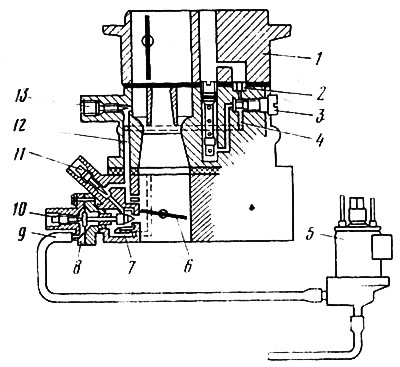
Fig. 44. Carburetor idle system diagram:
1 - carburetor body cover; 2 — idling system air jet; 3 — idle system fuel jet, 4 — idle system fuel channel; 5 - pneumatic valve; 5 primary chamber throttle valve; 7 — air supply channel; 8 — forced idle economizer; 9 - hose connecting the economizer to the pneumatic valve; 10 — mixture quantity adjustment screw; 11 — mixture quality adjustment screw; 12 — emulsion channel of the idle system; 13 — adjusting screw for factory carburetor adjustment.
Sometimes the contamination of the jets and channels is so old that compressed air is not enough. Prompt intervention is required. This is delicate work. Millimeter holes have to be soaked in acetone, cleaned with sharp wooden sticks, and then washed in gasoline. Patience and accuracy are required. But this should be done when there is no other way out. Most jets are removable and can be replaced with new ones, especially since special repair kits for carburetors are available, which include jets. If new jets are available, special care must be taken to install exactly the jet that is required. The jets of the primary (p. k.) and secondary (s. k.) chambers of the carburetor have calibrated holes, the values of which are given in Table 3.
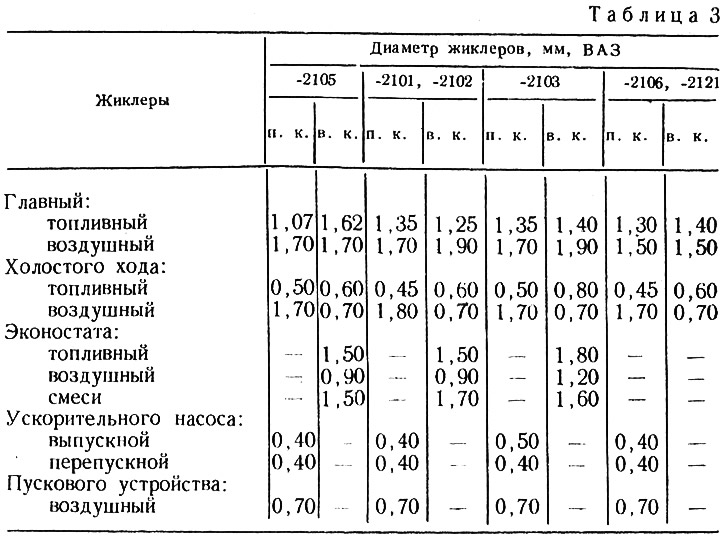
The nozzles and sprayer bodies have numbers indicating the hole diameter in hundredths of a millimeter. Thus, 150 means that the nozzle diameter is 1.5 mm. The sprayer body also has markings corresponding to the nominal diameter of the channel section through which the emulsion exits the main dosing system.
The presence of water in the carburetor has approximately the same effect as clogged jets. The presence of water is especially unpleasant in winter. Regardless of the season, water must be removed not only from the carburetor, but also from the fuel tank, since all the troubles come from it. To rid the carburetor of water, it must be removed and blown out well with compressed air. As for the fuel tank, you can leave it in place, remembering that water is heavier than gasoline and will always be at the very bottom.
Another reason for unstable engine operation at idle is air suction through such places as the connection of the carburetor with the pipeline, the cylinder head with the intake manifold, through the hose going to the brake booster in VAZ-2103, -2105, -2106, -2121, -2107 cars. This defect can occur only in two cases: either the fastening of the parts has become loose, or the gaskets (hose) are deformed. First of all, it is necessary to tighten the bolts, nuts and clamp in the specified connections. If these actions do not achieve anything, you will have to change the gaskets or the hose depending on where the air is being sucked in.
Quite often, the cause of unstable engine operation at idle is a faulty electromagnetic valve. Sometimes, debris gets into the idle channel near the valve. To remove them, some car enthusiasts use a simple but effective method: they slightly unscrew the electromagnetic valve and screw it back in.
All these operations are performed with the engine running (at a crankshaft speed of 2000–2500 rpm).
Speaking about the electromagnetic valve, it is advisable for car enthusiasts to turn to the accumulated experience of restoring the valve on their own, if there is no possibility to purchase it.
Often the valve fails to work due to oxidation of the casing where it fits into the contact plate. Repair consists of removing oxidation products and nothing more, so it is understandable that car enthusiasts want to restore the valve's functionality. Using a sharp screwdriver, carefully flare the casing from the plug side, remove the coil, clean the oxidized areas with sandpaper, and then return the coil to its place.
[The text is taken from the online resource: VazBook.ru]
The casing is rolled again and filled with BF-2 glue.
Sometimes, when idling, the engine of VAZ-2105 and -2107 cars suddenly starts to spontaneously increase the crankshaft speed, then drops it, or even refuses to work at all. This is usually caused by a malfunction of the pneumatic valve 5 (see fig. 44) forced idle economizer (FIE).
If this happens without a new valve, disconnect hose 9, which goes from the valve to the carburetor, and plug it.