




Check the front wheel alignment angles at a service station, where the optical stand will ensure high accuracy of this operation. Below is a method for checking and adjusting only the wheel alignment, which can be done independently, but with less accuracy, after meeting the following requirements:
- the air pressure in the tires is normal;
- radial and axial runout of tires does not exceed 3 mm;
- axial clearance in front wheel bearings no more than 0.15 mm;
- the clearance in the engagement of the worm and the steering roller ensures free play of the steering wheel of no more than 5°;
- there is no gap between the pendulum arm axis and the bushings;
- shock absorber rods do not jam;
- the ball joints of the steering rods have no clearance;
- the rubber of the front suspension arm joints has no breaks or extreme deformations;
- the ball joints of the front suspension do not have excessive play.
Check the wheel alignment on a fully fueled and equipped vehicle with a load of 3200 N (320 kgf). Place the vehicle on a level, level surface and set the front wheels in a position corresponding to straight-line movement (the bipod is in a neutral position). The steering wheel spoke must be horizontal. If the spoke is in a different position, remove the steering wheel and move it so that the spoke is horizontal. The tightening torque of the steering wheel mounting nut is 50 N·m (5 kgf·m).
To stabilize the position of the suspension units, "squeeze" them by applying a force of approximately 400–500 N (40–50 kgf) from top to bottom 2–3 times, first on the rear bumper and then on the front one.
To determine the camber, measure the distance "A" (Fig. 52) between the wheel rim and the square. Then move the car so that the wheels turn 180°, and measure the distance "B". When the wheels are installed correctly, the dimension "B" should be 1-5 mm larger than the dimension "A". The camber is adjusted by changing the number of spacers between the lower arm axle and the cross member.
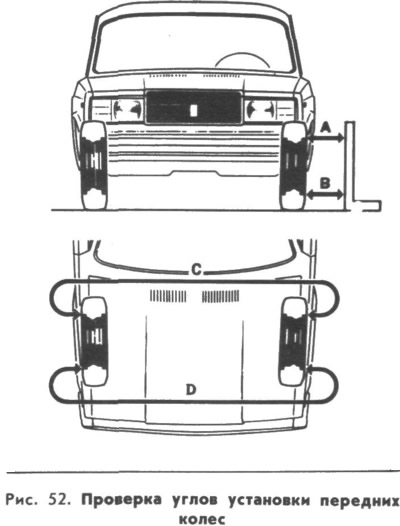
Check and adjust the wheel alignment only after checking and adjusting their camber. To determine the wheel alignment, measure the distance "C" between the corresponding points on the rims of the front wheels. Then move the car so that the wheels turn 180°, and measure the distance "O". When the wheels are installed correctly, the dimension "C" should be 2-4 mm larger than the dimension "D".
The article is taken from an online resource (VAZBOOK)
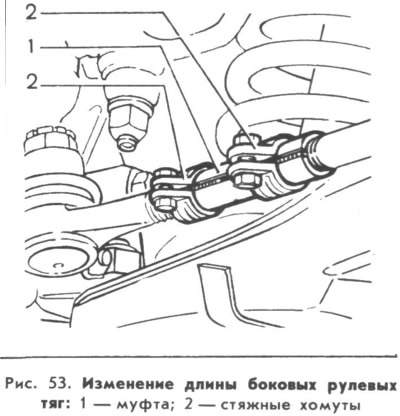
Wheel alignment is adjusted by changing the length of the side steering rods. To do this, loosen the clamping clamps 2 (Fig. 53) and turn the adjusting sleeves 1 by the same amount in opposite directions, changing the length of the side rods. After completing the adjustment, tighten the clamps 2 to a torque of 19 N·m (1.9 kgf·m) so that their slots are in the horizontal plane and the ends do not touch after tightening.
Wheel alignment can be checked approximately on an unloaded vehicle. Wheel alignment should be within the range B-A=-1÷+3 mm, and wheel alignment C-D=4±1 mm.