




Contents: Angle of longitudinal inclination of…↓ Front wheel camber angle ↓ Front wheel alignment ↓ Checking and adjusting clearances in…↓ Replacing grease in front wheel hub…↓ Wheel balancing ↓
Checking and adjusting the front wheel alignment angles is performed on special stands in accordance with the stand instructions.
Attention! Checking the wheel alignment angles is mandatory if replacement or repair of suspension parts is carried out, which may lead to a change in the wheel alignment angles.
The new car (before the first maintenance) the wheel alignment angles have the following values:
- longitudinal angle of inclination of the axis of rotation - 4°+1°–1°30;
- camber — 0°30+40–30;
- toe-in – 1-7 mm.
After the first maintenance (after 2000-3000 km of running) and during further operation of the vehicle, the wheel alignment angles should be:
- longitudinal angle of inclination of the axis of rotation – 4°±30' (3°30'±30')*;
- camber – 0°30'±20' (0°5'±20')*;
- toe-in – 2-4 mm (3-5 mm)*.
The difference in the longitudinal angles of inclination of the steering axes of the right and left wheels must not exceed 0°30'.
Before adjusting the wheel alignment angles, check:
- tire pressure;
- axial clearance in front wheel hub bearings;
- shock absorber serviceability (no rod jamming);
- radial and axial runout of tires;
- clearance in the upper ball joints of the suspension;
- free play of the steering wheel.
Correct any detected faults and make the necessary adjustments.
Wheel alignment can be checked and adjusted both on a loaded vehicle and on an unloaded vehicle, but checking the angles on a loaded vehicle gives more accurate results. Therefore, in critical cases, it is recommended to check and adjust the angles on a vehicle under a static load of 3136 N (320 kgf), which corresponds approximately to the weight of four people and a load of 40 kg in the trunk.
The car is loaded either with special weights suspended from the bottom of the body, or with ballast (280 kg) placed on the seat cushions and in the trunk (40 kg). The front seats should be in the middle position of their longitudinal travel. The load in the trunk is distributed evenly. The lack of fuel is compensated by the load placed on the right side of the trunk area.
After installing the car on the stand, immediately before checking the corners, apply a force of 392-490 N (40-50 kgf) 2-3 times to the car suspension, directed from top to bottom, first to the rear bumper, and then to the front one. In this case, the car wheels should be parallel to the longitudinal axis of the car.
The order of checking and adjusting the wheel alignment angles is as follows:
- longitudinal tilt angle of the pivot axis;
- camber angle;
- convergence.
* The values of angles without load are given in brackets; without brackets – with load.
Angle of longitudinal inclination of the axis
If, when checking, the angle value does not correspond to the data given above, change the number of adjusting washers 27 (see Fig. Front suspension), installed between the lower arm axis and the cross member.
To adjust the longitudinal tilt angle of the steering axis, loosen the nuts securing the lever axis to the crossmember and change the number of adjusting washers under the bolts to obtain the correct longitudinal tilt angle of the steering axis, using the table below.
Changing the camber angle and longitudinal tilt of the steering axis when changing the number of washers in the packs
The number of washers added to or removed from the bag | Wheel alignment | Longitudinal angle of inclination of the wheel pivot axis | |||
Front bolt | Rear bolt | Thickness of washers, mm | |||
0,5 | 0,8 | 0,5 | 0,8 | ||
1 | 1 | - (7'–9') | - (11'–14') | 0 | 0 |
-1 | -1 | (7'–9') | (11'–14') | 0 | 0 |
1 | 0 | 0 | 0 | - (18'–20') | - (29'–32') |
-1 | 0 | 0 | 0 | (18'–20') | (29'–32') |
0 | 1 | - (7'–9') | - (11'–14') | (18'–20') | (29'–32') |
0 | -1 | (7'–9') | (11'–14') | - (18'–20') | - (29'–32') |
-1 | 1 | - (7'–9') | - (11'–14') | (36'–40') | (58'–64') |
1 | -1 | (7'–9') | (11'–14') | - (36'–40') | - (58'–64') |
Tighten the nuts with a torque wrench and check the caster angle of the steering axis.
Attention! When adjusting the front wheel alignment angles, it is permissible to use U-shaped adjusting shims, which must be installed with the slot facing down.
Front wheel camber angle
If the camber angle differs from the norm, adjust it by changing the number of adjusting washers 27 (see Fig. Front suspension), installed between the lever axis and the cross member, following the table.
To increase the camber angle, remove the same number of washers from both bolts, and to decrease it, add them.
Front wheel alignment
1. If the toe-in value differs from the norm, loosen the side tie rod clamps and use key 67.7813.9504 to turn both couplings by the same amount in opposite directions; in this way the couplings are screwed on or unscrewed and change the length of the side rods.
2. Once the adjustment is complete, install the clamps with the slot horizontally (towards the rear of the car) with an upward or downward deviation of no more than 60° and tighten them in this position. When the nuts are tightened, the edges of the slots of the clamping clamps should not touch.
Checking and adjusting clearances in the front wheel hub bearings
Front Wheel Hub Bearing Adjustment Diagram
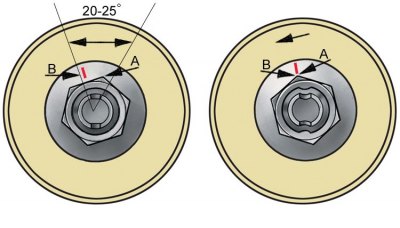
A – nut edge; B – mark on the washer
1. To check the clearance, lift the front of the car, support it on stands and remove the front wheels.
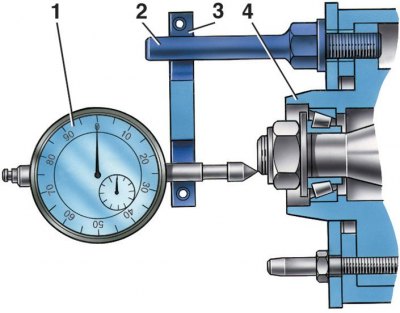
2. Install the 02.7834.9505 device under the wheel mounting bolt. Press the indicator leg 1 against the end of the repeat knuckle axis, with the arrow in the zero position, and, moving the hub 4 along the steering knuckle axis, measure the amount of movement (gap) using the indicator (2 – bolt; 3 – bracket).
3. If the gap is more than 0.15 mm, adjust it in the following order:
- unscrew the adjusting nut from the steering knuckle journal;
- install a new or used nut, but on another vehicle, and tighten it to 19.6 N·m (0.7 kgf·m);
- make a mark B on the washer (see fig. Front wheel hub bearing adjustment diagram), then loosen the nut by 20–25° so that edge A does not quite reach mark B;
- lock the nut in this position by pressing the grooves on the nut neck into the slots on the end of the steering knuckle axle.
4. After adjustment, the bearing clearance should be within 0.02–0.08 mm.
5. When adjusting the clearance, it should be taken into account that the direction of the thread on the left pivot pin is right, and on the right pivot pin it is left.
Replacing grease in front wheel hub bearings
1. Loosen the wheel mounting bolts.
2. Raise the front of the car and support it on stands, remove the bolts and remove the wheels.
3. After bending back the petals of the locking plates, unscrew the brake caliper mounting bolts; remove the caliper and set it aside without disconnecting the fluid supply hose to prevent air and dirt from entering the brake hydraulic system; the support should not hang on the pipelines.
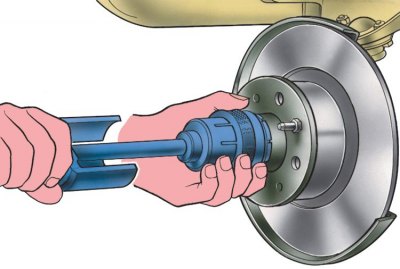
4. Remove the front wheel hub cap using puller 67.7801.9514.
5. Unscrew the adjusting nut and remove the washer.
6. Using the A.40005/1/9B puller, press off the hub, complete with the brake disc, outer bearing and seal; carefully, so as not to damage the seal, remove the hub from the steering knuckle.
7. Wash the inside of the hub and bearings with kerosene.
8. Before installation, fill the bearing separators with LITOL-24 grease. Fill the space between the outer bearing rings, along the inner surface of the hub, evenly with the same grease, in the amount of 40 g. Put 25 g of grease into the hub cap before installing it.
9. Carefully, so as not to damage the seal, install the hub assembly with the brake disc on the steering knuckle, then the inner ring of the outer bearing, the washer and tighten a new or used, but from another car, nut.
10. Adjust the hub bearing clearance as described above.
Wheel balancing
Wheels are balanced on special stands according to the rules described in the instructions attached to the stands. After balancing, the maximum permissible imbalance of the wheel with the tire is 24.5 N·mm (2600 g mm). This imbalance value corresponds to a weight of about 15 g. Wheel imbalance is eliminated by balancing weights, which are held on the rim by special springs. It is not recommended to exceed the weight of the weights in each balancing plane more than 80 g.