
English Русский
Български
Беларускі
Український
Српски
Hrvatski
Română
Polski
Slovenský
Magyar
| Articles | Contacts | Sitemap |   
Repair and maintenance Lada Repair and maintenance Mazda Repair and maintenance Mitsubishi Repair and maintenance Toyota Repair and maintenance Land Rover Repair and maintenance Hyundai Repair and maintenance Nissan
VAZbook.ru


Main     1111   2101   2105   2106   2107   2109   2110   2115   2121  
VAZ-2104 (1984-2012) VAZ-2105 (1979-2010) VAZ-21051 (1979-2010)
  • Main
  • «Zhiguli»
  • VAZ-2105
  • Chassis
  • Suspension and shock absorbers
  • Checking and adjusting the front wheel alignment angles

Checking and adjusting the front wheel alignment angles (VAZ-2105)

            0

Contents: Angle of longitudinal inclination of…↓ Front wheel camber angle ↓ Front wheel alignment ↓
This work is performed on special stands. Be sure to check the wheel alignment angles after replacing or repairing suspension parts that affect these angles, as well as in the event of a strong impact on the suspension units due to careless driving of the car. For a new car (before TO-1), the wheel alignment angles have the following values: camber 0°30'+40'-30', longitudinal angle of inclination of the axis of rotation 4°30'+1°-1°30', toe-in 1-7 mm. After TO-1 (after 2-3 thousand km of mileage) and during further operation of the vehicle, the wheel alignment angles should be: camber 0°30±20' (0°5'±20')*, longitudinal angle of inclination of the steering axis 4°±30' (3°±30')*, toe-in 2-4 mm (3-5 mm)*.

* Data in brackets for a vehicle without load.


The difference in the longitudinal angles of inclination of the steering axes of the right and left wheels must not exceed 30'.

Before adjusting the wheel alignment angles, check the tire pressure, the clearance in the front wheel hub bearings, and the serviceability of the shock absorbers (for absence of rod jamming), radial and axial runout of tires, clearance in the upper ball joints of the suspension, free play of the steering wheel. Eliminate any detected faults by adjusting or repairing the specified units. Checking and adjusting the wheel alignment angles can be carried out on a vehicle both with a full load and without a load, however, checking on an unloaded vehicle gives less accurate results. Therefore, in critical cases, it is recommended to check and set the angles on a vehicle under a static load of 320 kgf, which approximately corresponds to the weight of four people and a load of 40 kg in the trunk.


The car is loaded with special weights that are suspended from the bottom of the body, or ballast (280 kg) distributed over the seat cushions in the trunk (40 kg). The front seats should be in the middle position of their longitudinal travel. The load in the trunk is distributed evenly, and the lack of gasoline is compensated for by a load placed on the right side of the trunk.

After installing the car on the stand, immediately before checking the angles, "squeeze" the car's suspension, for which purpose apply 2-3 times a force of 40-50 kgf, directed from top to bottom, first to the rear, then to the front bumper. In this case, the car's wheels should be directed straight. Observe the following sequence of checking and adjusting the wheel alignment angles: longitudinal tilt angle of the steering axis, camber angle, wheel toe-in.

Angle of longitudinal inclination of the axis of rotation


If, when checking, the angle does not correspond to the data given earlier, change the number of adjusting washers 27 and 28 installed between the lower arm axis and the cross member (see fig. 156), following Table 8. When adjusting the wheel alignment angles, it is permissible to use U-shaped adjusting shims, which should be directed with the slot downwards. After adjustment, tighten the nuts with a torque wrench and check the angle again.
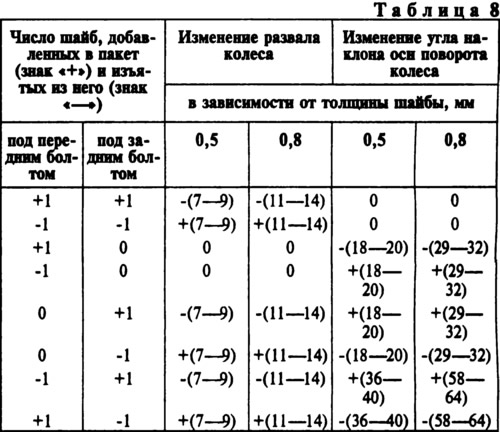
If, when checking, the angle does not correspond to the data given earlier, change the number of…


Front wheel camber angle


If it differs from the norm, adjust it also by changing the number of adjusting washers 27 and 28 (see fig. 156), using Table 8. To increase the camber, remove the same number of washers from both bolts, and to decrease it, add them.

Front wheel alignment


If the wheel alignment is incorrect, loosen the side tie rod clamps 1 (see fig. 183) and key 67.7813.9504 turn both couplings 5 by the same amount in opposite directions. In this case, the couplings are screwed or unscrewed with the rod end and change the length of the rods. After completing the adjustment, install the clamping clamps with the slot horizontally and backwards with an upward or downward deviation of no more than 60° and tighten them in this position. When the nuts are tightened, the edges of the clamp slots should not touch. Key 67.7813.9404 is made similar to pipe wrenches and can be replaced with them.


This article is available at russian, bulgarian, belarusian, ukrainian, serbian, croatian, romanian, polish, slovak, hungarian
The text was reviewed by the specialist: Grigory Vologodtsev

Share with friends:

Previous articles
VAZ-2105: Suspension and shock absorbers
Next articles

Determining the condition of the front suspension parts on a vehicle
Front suspension device
Checking and adjusting the clearance in the front wheel hub bearings
Replacing grease in front wheel hub bearings
Wheel balancing
Removal and installation the front suspension
Disassembly and assembly of front suspension units

More articles from other manuals on VAZ cars:
➠ Checking and adjusting the front wheel alignment angles VAZ-21011 (1974-1983)
➠ Checking and adjusting the front wheel alignment angles VAZ-2107 (1982-2012)
➠ Checking and adjusting the front wheel alignment angles VAZ-2115 (1997-2012)
➠ Checking and adjusting the front wheel alignment angles VAZ-21213 (1994-2006)
➠ Checking and adjusting wheel alignment angles VAZ-1111 (1988-1996)
Link in different formats to this page


Visitor comments

No comments yet


How much will 32 + 21 ?


VAZ-2104 (1984-2012) 
  • General information
  • Operation and maintenance
  • Power unit
  • Engine repair
  • Fuel system (carburetor)
  • Fuel system (injector)
  • Control system
  • Cooling system
  • Exhaust system
  • Transmission
  • Clutch
  • Car gearbox
  • Cardan gear
  • Rear axle
  • Chassis
  • Front suspension
  • Rear suspension
  • Wheels and tires
  • Steering
  • Brake system
  • Body
  • Exterior
  • Interior
  • Doors and glass
  • Ventilation and heating
  • Electrical equipment
  • Equipment and devices
  • Headlights and lighting
  • Engine electrics
  • Electrical circuits


VAZ-2105 (1979-2010) 
  • General information
  • Vehicle description
  • Vehicle device
  • Vehicle operation
  • Maintenance
  • Power unit
  • Engine repair
  • Cooling and lubrication system
  • Supply system
  • Transmission
  • Clutch
  • Car gearbox
  • Cardan gear
  • Rear axle
  • Chassis
  • Suspension and shock absorbers
  • Steering
  • Brake system
  • Body
  • Body elements
  • Electrical equipment
  • Engine electrics
  • Equipment and devices


VAZ-21051 (1979-2010) 
  • General information
  • Introduction to guide
  • User manual
  • Troubleshooting
  • Power unit
  • Engine repair
  • Engine repair VAZ-2103
  • Cooling system
  • Lubrication system
  • Power and exhaust system
  • Fuel injection
  • Transmission
  • Clutch
  • Car gearbox
  • Cardan gear
  • Rear axle
  • Chassis
  • Suspension and shock absorbers
  • Steering
  • Brake system
  • Body
  • Exterior
  • Interior
  • Doors and windows
  • Electrical equipment
  • Equipment and devices
  • Engine electrics
  • Ignition system
  • Electrical circuits


VAZbook.ru © 2017 · Mobile version · Contact with administration · Sitemap: EN BG BY UA RS HR RO PL SK HU · Site search · News and articles VAZ-1111 · VAZ-11113 · VAZ-2101 · VAZ-21011 · VAZ-2104 · VAZ-2105 · VAZ-21051 · VAZ-2106 · VAZ-21061 · VAZ-2107 · VAZ-21099 · VAZ-2109 · VAZ-2108 · VAZ-2110 · VAZ-2112 · VAZ-2114 · VAZ-2115 · VAZ-2121 · VAZ-21213 · VAZ-21214 ·
The site stores technical data using cookies to improve the service.