




Contents: Door opening limiter ↓ Front door lock ↓
They are hung on two hinges and secured with bolts to the front pillars (figure 159). Due to the enlarged holes in the hinges, it is possible to adjust the gap between the door and the body by a small amount. The doors are equipped with cable window lifters, locks with lock switches, door opening limiters 10. The upholstery of 4 doors is made of non-flammable polyurethane foam covered with polyvinyl chloride film (PVC), and is attached with plastic holders in the holes of the inner door panel. The left door has a rear-view mirror.
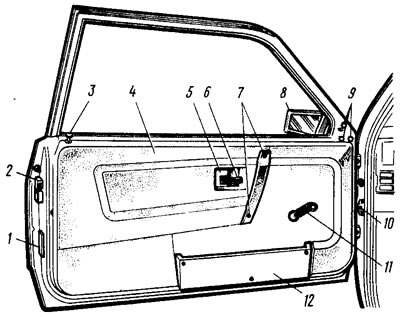
Figure 159. Front door: 1 - reflector; 2 - outer door lock; 3 - lock release button; 4 - door trim; 5 - inner handle lining; 6 - inner door handle; 7 - armrest mounting screws; 8 - outside rear view mirror; 9 - rear view mirror mounting screws; 10 - door opening limiter; 11 - window lift handle; 12 - door trim pocket
Door opening limiter
The flat rod of the limiter is attached to the body pillar with a finger at one end, the other end has a pin that limits the maximum opening. The rod has stampings on both sides. Steel rollers are pressed against the rod on both sides, which are inserted into a cracker made of polyamide. The rollers fix the open position of the door by the stampings of the rod.
Window lifter. Fastened to the inner door panel with nuts to welded bolts. Cable 3 (figure 160) covers two rollers 4. mounted on the upper and lower brackets of the window lifter guide pipe. In the drive housing 6, the cable is wound onto a drum. A spring brake is located on the drive shaft, preventing the glass from lowering spontaneously. The window lifter handle is attached to the splined end of the drive shaft using the handle trim, which, when installed on the handle, enters the annular groove of the shaft. The lowering glass clip is attached to the glass lifting plate with two bolts.
The original source is published on the website (VazBook.ru)
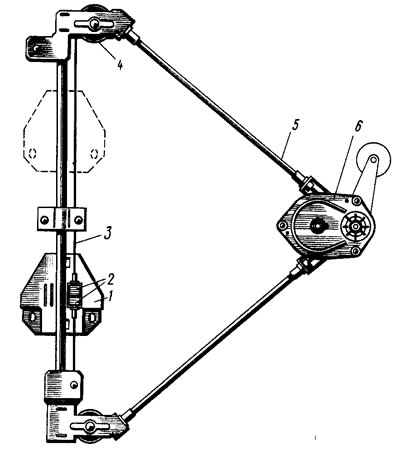
Figure 160. Door window lifter: 1 - mounting plate for the drop glass; 2 - springs for selecting the slack of the cable when it is pulled out; 3 - cable; 4 - roller; 5 - cable sheath; 6 - window lift drive mechanism
Front door lock
Rotary type lock (figure 161); when the door is closed, the ratchet 22 is acted upon by the pin of the lock 21, fixed to the body pillar. The ratchet 22 turns, and the pawl 20, under the action of the spring, locks it by the first or second tooth, ensuring preliminary or complete closing of the door. Incomplete closing of the door can be easily determined by the knock of the pin of the lock in the ratchet or by the existing movement of the door when it is pulled up. The ratchet and the pawl are mounted on the axles of the outer lock. The outer lock together with the inner lock are fastened with two screws to the rear end of the door. The end of the pin 19 of the lock drive enters the inner lock.
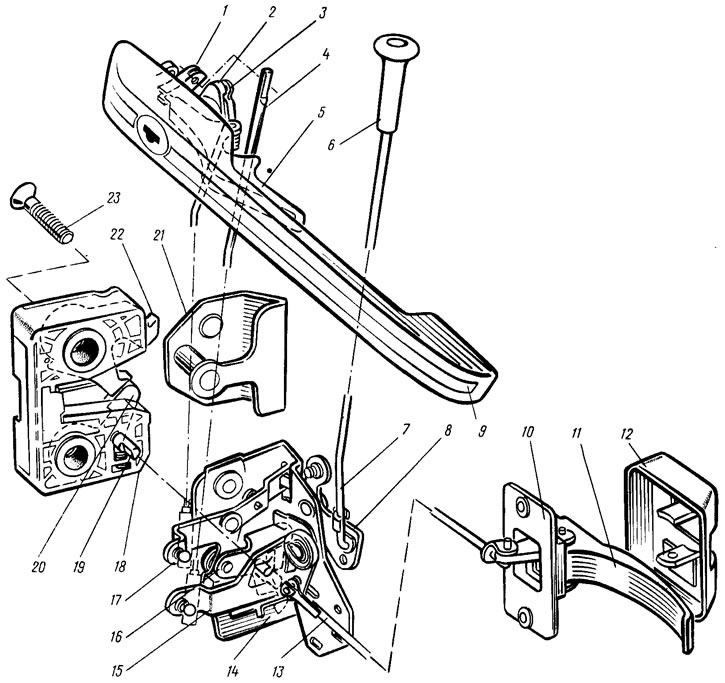
Figure 161. Front right door lock: 1 - leash laying; 2 - leash turn off the lock gel; 3 - shutdown rod; 4 - external drive rod; 5 - key, 6 - lock release button; 7 - power button pull; 8, 17 - release levers; 9 - outer handle; 10 - inner handle bracket; 11 - inner door handle; 12 - inner handle lining; 13 - inner drive rod; 14 - inner lock body; 15 - external drive lever; 16 - intermediate lever; 18 - outer lock housing; 19 - lock drive finger; 20 - dog; 21 - retainer; 22 - ratchet; 23 - lock mounting screw
The outer door handle 9 with the spring-loaded key 5 and the lock switch is attached to the outer door panel through a sealing gasket with two nuts. The leads 1 and 2 of the key and the switch are connected by rods to the lever 15 of the outer drive and the intermediate lever 17 of the lock switch.
When key 5 is pressed, its leash 1 presses on rod 4 and acts on lever 15 of the external drive, which, in turn, presses on the finger of intermediate lever 16. The intermediate lever presses on finger 19 of the lock drive. The finger moves pawl 20 and releases ratchet 22. Under the action of the compressed seal, the door opens.
When the inner door handle 11 is pulled, the rod 13 of the inner drive turns the lever of the inner drive, which with its second shoulder presses on the intermediate lever 16, through the finger 19 releases the pawl and ratchet - the door opens.
To prevent access to the passenger compartment from the outside, the lock is switched off. When the lock switch 6 is pressed, the button rod 7 turns the two-arm lever 8, which acts with its arm on the lever 17. The latter moves the intermediate lever 16 to the side, thereby eliminating the possibility of acting on the finger 19 and the pawl and, therefore, does not allow the ratchet 22 of the lock to be released. The lock can also be switched off by the lock switch. When the switch key is turned, the leash 3 acts directly on the lock switch 17 via the rod.