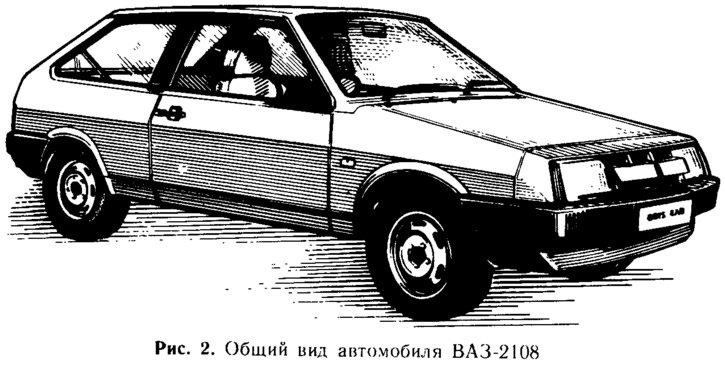
VAZ-2108 is the base model of the family. Passenger car with a closed three-door body. Engine with a displacement of 1.3 liters. Gearbox 4- or 5-speed.
VAZ-21081 - differs from the VAZ-2108 by installing an engine with a displacement of 1.1 liters and using only a 4-speed gearbox.
VAZ-21083 - differs from the VAZ-2108 by installing an engine with a displacement of 1.5 liters and using only a 5-speed gearbox.
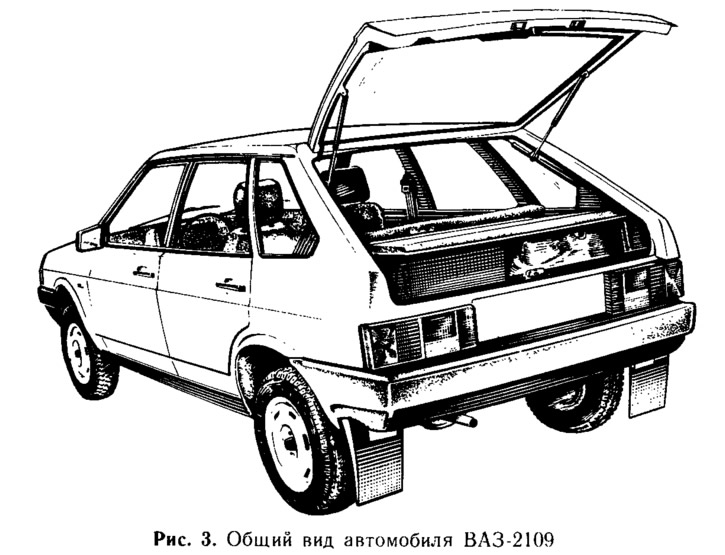
VAZ-2109 - a passenger car with a closed five-door body. Engine with a displacement of 1.3 liters. Transmission.
4- or 5-speed. It differs from the VAZ-2108 mainly in the body structure, which has four side doors.
VAZ-21093 - differs from the VAZ-2109 by installing an engine with a displacement of 1.5 liters and using only a 5-speed gearbox.
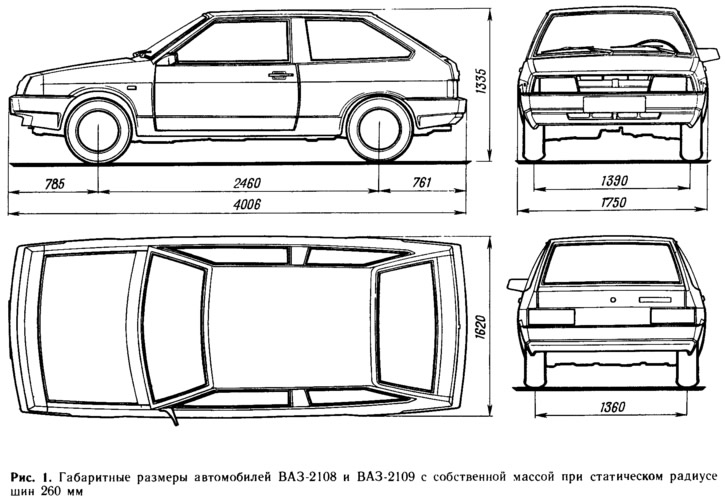
VAZ front-wheel drive cars differ from their predecessors both in design, layout and appearance (pic. 1). They have a wedge-shaped body with curved side windows and large tilt angles of the windshield and rear window. The outer surface of the plastic bumpers and block headlights smoothly merges into the shaping surface of the body. All this gives it a better aerodynamic shape and reduces the drag coefficient. As a result, air resistance losses are reduced.
Body - two-volume, type «hatchback». This is a kind of closed body, which occupies an intermediate position between «sedan» (For example, VAZ-2101) And «station wagon» (VAZ-2102) and differs from the latter in a more inclined and shorter rear door that does not reach the floor of the body. It combines the versatility of a cargo-passenger body with the sweeping lines of a sports car. The luggage compartment is separated from the passenger compartment by a folding plastic shelf installed behind the rear seat. The body is easily transformed into a cargo-passenger version by folding forward the pillows and the back of the rear seat. The tailgate makes it easy to load and unload luggage.
front «anatomical» seats with headrests significantly increase comfort. They, as well as the rear seat, are made of foamed polyurethane with upholstery in knitted material. The stepless adjustment mechanism allows you to smoothly adjust the inclination of their backs. In addition, the front seats can be moved forward and backward, both to select the optimal location and to ensure a comfortable fit for passengers in the rear seat (on VAZ-2108 and its modifications).
All cars are characterized by a transverse engine and torque transmission to the front wheels. This arrangement, in comparison with the rear-wheel drive, allows you to better use the length of the car, reduce its weight, make the interior more comfortable, and simplify the landing of the driver and passengers. All this was possible due to the absence of the gearbox casing, which occupied a significant space in the leg area on rear-wheel drive vehicles, and the reduction of the tunnel on the floor, which housed the driveline to the rear wheels.
The front drive wheels create high vehicle stability against side skidding. The coincidence of the direction of the traction force on these wheels with the direction of their movement provides the car with good handling, maneuverability and maneuverability, especially on slippery and icy roads.
The cars have a new engine, specially designed for a transverse arrangement, for which its length is maximally reduced. Optimization of the combustion process due to the correct selection of valve timing, the shape of the combustion chamber and gas channels made it possible to bring the compression ratio in the engine to 9.9. Combined with a new carburetor and a non-contact ignition system, this improved engine efficiency.
The transmission of cars is simple, compact and reliable. It is a unit consisting of a clutch and a gearbox with a final drive and a differential. The compactness of this unit made it possible to place the power unit across the car and drive the front wheels directly from the gearbox. It is possible to install a five-speed gearbox, which allows the most efficient use of engine power and reduce fuel consumption.
The vehicles have front wheel suspension «rocking candle», also called the MacPherson strut after its inventor. The spring in such a suspension is actually located above the axis of the rotary device and is loaded less than in double-lever type suspensions. The suspension has only one arm—the lower one. Such a suspension has less mass, more wheel travel and is more elastic. The rear suspension is in good agreement with such a front suspension, consisting of two levers swinging in the longitudinal plane, interconnected by a cross member that plays the role of a stabilizer. The elastic element in it, as in the front suspension, are helical springs.
With a transverse engine and MacPherson suspension, rack and pinion steering is well assembled. It does not require intermediate levers, is compact and simple in design.
The braking system has efficient front disc and rear drum brakes. Brake drive - with a vacuum booster, dual-circuit, with diagonal separation of circuits. If one of the circuits fails, the car retains a straight direction of movement and loses no more than 50% of the braking efficiency.
Great attention in the design of cars was given to safety, both active and passive. Active safety is the sum of the factors contributing to the prevention of an accident. In addition to the use of front wheel drive, which in itself increases the safety of driving, there is also a whole range of technical solutions. This includes a dual-circuit diagonal brake drive, a dual-circuit pressure regulator in the rear brake drive, an efficient vacuum brake booster, a large glazing area that creates good visibility for the driver. This also includes cleaners and washers for the windshield and rear windows, exterior and interior rear-view mirrors, glare-free instrument cluster glass, etc.
Passive safety measures, i.e., preventing possible consequences of an accident, include the development of such a power circuit of the body, which helps to preserve the living space of the passenger compartment during impacts. Other elements of passive safety include energy-intensive bumpers made of fine-mesh polyurethane, seat belts, soft lining of the instrument panel and body pillars, safety steering, seat headrests and much more.
In order to reduce the mass of vehicles, which significantly affects its dynamic characteristics and fuel consumption, plastics are widely used in the design of components. Bumpers, various casings, heater parts, interior lining and trunk lining are made of them. The mass of plastic parts reaches 80 kg. The radiator and many parts of the engine and gearbox are made of aluminum alloys, which also made it possible to reduce the weight of the engine and the car as a whole.
Cars have reduced the complexity of maintenance. This is achieved, first, by using «eternal» lubricants in wheel hub bearings, front wheel drive joints, steering and other components. Secondly, due to the use of wear-resistant materials and progressive design solutions, many nodes are made maintenance-free or self-adjusting. Such units, for example, include self-adjusting wheel brakes, non-adjustable wheel hub bearings, «low-maintenance» battery, etc. As a result, it was possible to increase the interservice mileage of cars up to 15 thousand km instead of 10 thousand km for previous cars.
Almost all vehicle components are newly developed and have an original design. Therefore, the degree of unification of cars of the new family with cars of the family VAZ-2101—2107 very insignificant. Only the oil filter is interchangeable (small, type 2105), air filter element (With VAZ-2121), an electric fan of the engine cooling system and a number of smaller components, such as some sensors of control devices, fuses, etc.
Cars are produced in various versions (or configuration), to meet the needs of different categories of buyers. For example, some people need a simpler and cheaper car, others need additional comfort, etc. There are three types of equipment: «standard», «norm» and «luxury». The simplest set is «standard». Then comes «norm», which additionally includes a headlight hydrocorrector, a rear window cleaner and washer, a five-speed gearbox. Basically, all cars are produced in the performance «norm». But some of the VAZ-2108 cars can be performed «standard», and VAZ-21093 - performed «luxury». Of the main features of this configuration can be called: a headlight cleaner and washer, an electronic instrument cluster with additional sensors, a trip computer and improved interior trim.