




Open large image in new tab »
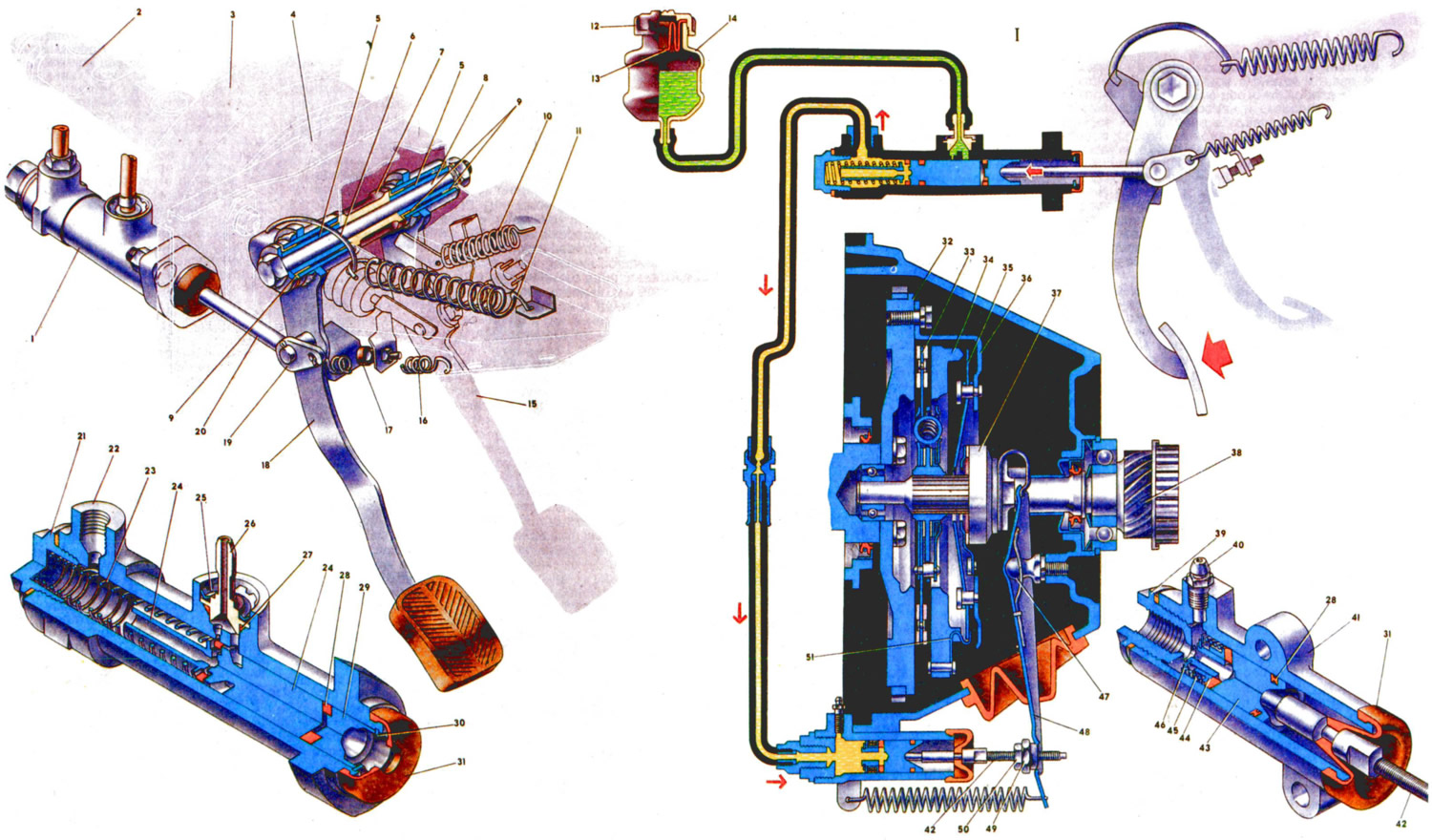
Fig. 15: 1. Clutch release master cylinder. 2. Brake master cylinder. 3. Vacuum booster. 4. Clutch and brake pedal bracket. 5. Inner clutch and brake pedal bushings. 6. Servo spring hook. 7. Spacer sleeve. 8. Clutch and brake pedal shaft. 9. Outer clutch and brake pedal bushings. 10. Brake pedal return spring. 11. Servo spring. 12. Reservoir plug. 13. Plug deflector. 14. Master cylinder reservoir. 15. Brake pedal. 16. Clutch pedal return spring. 17. Clutch pedal limit screw. 18. Clutch pedal. 19. Return spring plate. 20. Push rod. 21. Plug. 22. Master cylinder housing. 23. Piston spring. 24. Master cylinder piston. 25. Lock washer. 26. Fitting. 27. Fitting gasket. 28. Seal. 29. Pusher piston. 30. Retaining ring. 31. Protective cap. 32. Flywheel. 33. Driven disk. 34. Pressure plate. 35. Pressure spring. 36. Clutch housing. 37. Clutch release bearing. 38. Gearbox input shaft. 39. Slave cylinder housing plug. 40. Fitting. 41. Slave cylinder housing. 42. Clutch release fork pusher. 43. Slave cylinder piston. 44. Support plate. 45. Spring. 46. Thrust washer. 47. Ball joint of the clutch release fork. 48. Clutch release fork. 49. Adjusting nut. 50. Lock nut. 51. Pressure spring retainer. I - Schematic diagram of the clutch hydraulic drive.
The clutch is released via a hydraulic drive with a suspended pedal. This type of drive ensures smooth engagement of the clutch, which in turn reduces dynamic loads on transmission parts and increases driving comfort. The hydraulic drive is reliable and durable, and its maintenance labor intensity is reduced to a minimum. The drive includes a servo spring 11, which significantly reduces the clutch release force.
The clutch and brake pedals are suspended from the bracket 4 on one axis 8, made in the form of a bolt. A thrust washer is installed under its head, and a nut with a spring washer is screwed onto its end. External plastic bushings 9 are installed in the pedal hubs, which do not require lubrication during the operation of the car. The pedals rotate on internal metal bushings 5, put on the axis. A distance plastic bushing 7 is installed between the brake pedal and the bracket cheek.
The clutch pedal is pivotally connected to the pusher 20 and the plate 19 of the release spring. They are held on the pin by a cotter pin. The release spring 16 holds the clutch pedal in the initial position, in which the pedal rests against the cap 17 of the pedal travel limiter. The other end of the pusher enters the seat of the piston 29 of the master cylinder. The pedal travel limiter can be used to adjust the gap between the hemispherical end of the pusher and the piston 29.
A bracket is welded to the upper end of the pedal, into the cutout of which a hook 6 fits; the other end of the hook is connected to the servo spring 11. The servo spring tends to turn the upper part of the pedal towards the clutch release, which significantly reduces the force applied to the clutch pedal.
The master cylinder 1 of the clutch release drive is attached to the end plate of the brake and clutch pedal bracket on two studs. The vacuum booster 3 with the master cylinder 2 of the brake drive is also attached to this plate.
A return spring 23 and two pistons 24 and 29 are installed in the cavity of the main cylinder. The spring rests with one end against the plug 21, with the other against the flange of the piston 24 and serves to return the pistons to their original position. Due to the installation of two pistons, the radial loads on the piston 24 are reduced when the pusher 20 acts on the piston 29, and the sealing of the pistons is improved, since the sealing ring 28 is compressed between them.
The master cylinder piston is sealed with a rubber ring, which is located in the piston groove and creates a tight seal in the working cavity of the cylinder. In order to simultaneously improve the piston seal as the pressure in the working cavity increases, an axial channel is made in its tailpiece, connecting with radial holes that go into the groove of the sealing ring. When the pressure in the working cavity of the cylinder increases, under its influence the sealing ring expands along the radius, i.e. fits more tightly to the cylinder mirror. At the same time, the piston sealing ring is a valve through which the cylinder cavity communicates with tank 14. This occurs at the extreme rear position of the master cylinder pistons, when the sealing ring does not block the compensation hole.
All parts of the master cylinder are held in the cavity by a retaining ring 30. A protective cap 31 protects the cylinder cavity from contamination. A pipeline that drains liquid from the master cylinder to the working cylinder and a nipple 26 connected by a hose to the hydraulic drive tank are fixed in the holes of the cylinder body. The nipple 26 in the socket of the body lug is sealed with a rubber gasket 27 and is secured with a lock washer 25.
Working cylinder 24 (see fig. 14) the clutch release drive is secured with two bolts to the clutch housing 13. The upper bolt simultaneously secures the plate of the release spring 25, which returns the clutch release fork to its original position.
The piston 43 is located in the cylinder body (see sheet 15) with two sealing rings. The rear ring 28 is installed in the piston groove, the front one is constantly pressed through the support plate 44 by the spring 45 to the end surface of the piston. The other end of the spring rests against the support washer 46, which is held on the piston tail by a retaining ring.
The working cavity of the cylinder communicates with the groove of the sealing ring through the axial channel and radial holes, which ensures a tighter fit of the ring to the cylinder mirror when the clutch is disengaged, when fluid pressure is created in the working cavity.
A plug is screwed into the housing, into the threaded hole of which the tip of the hose is screwed. A nipple 40 for bleeding the clutch drive is screwed into the lug of the housing. The reservoir 14 of the clutch hydraulic drive is fixed to the bracket of the front shield of the body. It is made of translucent plastic, which makes it easier to check the fluid level in the drive. The plug 12 of the reservoir has a corrugated rubber deflector 13, which protects the cavity of the reservoir from contamination and acts as a fluid damper. In addition, the deflector does not allow direct contact of the fluid with air, which increases its service life. The cavity of the reservoir is connected to the atmosphere through an opening in the plug. When the fluid level in the reservoir decreases, the air pressure above the deflector eliminates the vacuum that occurs in the reservoir. In the lower part of the reservoir there is a nipple on which a hose for supplying fluid to the cavity of the master cylinder is fixed.
Clutch operation
The clutch is of the permanently closed type, i.e. it is permanently engaged unless the driver presses the clutch pedal. In this case, there is a gap of 1.5 - 2 mm between the clutch release bearing and the thrust flange lining. The pressure spring 35, due to its elasticity, presses on the annular projection of the pressure plate 34 and presses it against the driven disk 33, which, moving along the splines of the primary shaft 38, is pressed against the surface of the flywheel. The driven disk 33, clamped between the surfaces of the flywheel and the pressure plate, transmits torque through the transmission elements to the drive wheels of the vehicle. When the clutch is engaged, the leading and driven parts of the clutch rotate as a single unit.
To disengage the clutch, press pedal 18. The force from the pedal is transmitted through the pusher to pistons 29 and 24, which, moving in the cylinder, compress spring 23. The front sealing ring covers the compensation hole, and the cylinder cavity is disconnected from the tank. Under the pressure of the piston, the fluid from the master cylinder through the tube and hose enters the cavity of the working cylinder, creating pressure on piston 43. Under this pressure, the piston moves in the cylinder and through the pusher 42 and the adjusting nut 49 transmits the force to the clutch release fork 48. Turning on the ball joint 47, the fork moves the clutch release bearing sleeve 37. Initially, the gap between the bearing and the friction ring of the thrust flange is selected. This ends the free travel of the clutch pedal, which is 25-35 mm, provided that the clutch drive is correctly adjusted. With further pedal travel, the thrust flange presses on the petals of the pressure spring, which, bending on the support rings, pulls the pressure disk 34 away from the driven disk 33 through the clamps 51, after which the transmission of torque to the primary shaft of the gearbox stops. At this point, shock-free gear shifting or braking is performed.
The full stroke of the clutch pedal is approximately 140 mm. During this stroke, the pressure plate is moved away from the driven plate by 1.4-1.7 mm.
When the clutch pedal is released, the parts of the master and slave cylinders and the pedal itself return to their original position under the action of the return springs. The front sealing ring moves away from the compensation hole, which leads to communication between the cavities of the master cylinder and the tank. The pressure in the drive system is supplied, and the pressure plate, under the action of the elasticity of the pressure spring 35, presses the driven disk to the surface of the flywheel. Due to the elastic wave-like surface, the driven disk initially slips and is clamped gradually, which ensures smooth engagement of the clutch. In this case, the torque is transmitted from the flywheel to the clutch housing 36 and the pressure plate 34, and then due to friction forces - to the driven disk 33. From it through the elastic elements of the damper to the hub of the driven disk and through the splined connection to the primary shaft 38 of the gearbox.
When the torque value changes sharply and torsional vibrations occur, the driven disk 33 together with the damper plates rotates at a certain angle relative to the hub 8 (see sheet 14). In this case, friction occurs between the surfaces of the hub and the friction rings of the damper, and the springs 9 are compressed. The angle of rotation of the driven disk, and therefore the compression stroke of the springs depends on the magnitude of the transmitted torque. The rotation of the driven disk relative to the hub is limited by the abutment of the pins 5 in the horseshoe-shaped cutouts of the hub, after which the action of the elastic element of the damper stops. Due to the elastic element of the damper, the energy of torsional vibrations is absorbed. This reduces the maximum stresses in the transmission parts, protecting them from breakage and premature wear.
When the clutch pedal is released abruptly, the fluid does not have time to fill the space released by the piston 24 (see fig. 15) volume and a vacuum is created in the working cavity of the main cylinder. Under its action, the liquid passes through the hole in the cylinder body, the gap between the rear end of the sealing ring and the piston groove through the radial hole in the piston into the working cavity of the cylinder, which ensures the constant readiness of the drive for effective action.
Precise operation of the clutch is ensured by certain gaps in the clutch drive. Thus, for complete disengagement of the clutch, a gap is required between the pusher 20 and the piston 29 of the master cylinder, which should be within 0.2-0.5 mm, which corresponds to a free travel of the clutch pedal of 0.4-2 mm. If there is no such gap, the piston cannot fully return to its original position, and excess pressure will remain in the working cavity of the cylinder and in its drive when the pedal is released. As a result, the clutch will not fully engage, and its disks will slip. This gap is adjusted by the limiting screw 17 of the pedal travel.
For the same reason, a gap of 2 mm is required between the clutch release bearing and the thrust flange friction ring. Together, these two gaps provide a free travel of the clutch pedal of 25-35 mm. The gap between the clutch release bearing and the thrust flange is adjusted with nut 44.
At the same time, changing the specified gaps towards an increase will lead to the opposite phenomenon of incomplete disengagement of the clutch (the clutch "leads"). These two main faults have their own signs and causes.
When the clutch slips and the torque is not fully transmitted to the drive wheels, the vehicle's driving dynamics are reduced.
This is especially noticeable when the load increases: when overcoming climbs, difficult road sections, and sharp accelerations. At the same time, fuel consumption increases. Due to the slippage of the clutch discs, the friction linings of the driven disc burn. A specific smell is possible.
If the clutch discs slip, first of all, you should check for gaps in the clutch drive: the gap between the pedal pusher and the piston, equal to 0.1-0.5 mm, and the gap between the bearing and the thrust flange ring. The first gap is determined by the value of the free travel of the pedal (0.4-2 mm), the second by the value of the free travel of the slave cylinder pusher, which should be 4-5 mm. The gap is adjusted using the limiting screw 17 of the pedal travel and the adjusting nut 49. When adjusted correctly, the free travel of the clutch pedal should be equal to 25-35 mm.
Additional causes of clutch slippage may include wear, burning or oiling of the clutch discs, as well as damage or seizure of the clutch drive. In these cases, the malfunction is eliminated by replacing or repairing worn or damaged parts.
When the clutch does not fully disengage ("leads"), this is determined by the difficulty in engaging gears, especially reverse gear, when knocking may occur, since this gear is not synchronized. In the case of this malfunction, first of all, check and, if necessary, adjust the clearances in the clutch release drive, as indicated above. In addition, incomplete clutch disengagement occurs when fluid leaks or air gets into the drive, when the disks are warped or damaged, or the hub of the driven disk is jammed on the splines of the primary shaft. In these cases, the malfunction is eliminated by bleeding the clutch drive or replacing damaged or worn parts.