




Warning! Before replacing a fuse, it is necessary to determine and eliminate the cause of its burnout. To avoid failure of electrical equipment components, fuses with an increased rating or homemade ones must not be installed
Sequence of execution
1. Prepare the vehicle for work and disconnect the wire terminal from the negative terminal of the battery (see "Preparing the car for maintenance and repair").
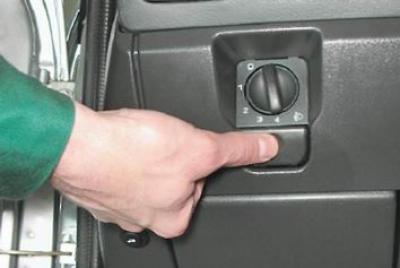
2. By pressing the button located under the headlight hydraulic corrector control handle, open the cover of the mounting block.
3. Using the serial number on the body of the mounting block, we find the fuse of the faulty circuit.
A faulty fuse can be identified by a burnt-out filament.
Recommendation: Sometimes the fuse thread remains intact, while its connection inside the fuse is broken. It is impossible to visually determine such a malfunction. In this case, you can evaluate the condition of the fuse using an ohmmeter.
4. There are tweezers in the fuse and relay mounting block for removing fuses from their sockets. Squeeze the fuse housing with the tweezers and remove the fuse from the block.
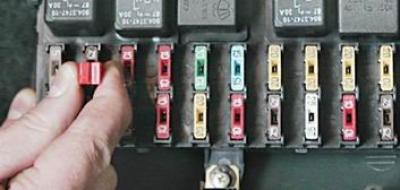
5. Install a new fuse of the appropriate rating.
6. If it is necessary to replace the relay, remove it with your fingers (if the relay fits tightly, you can use pliers).
Advice. You can verify that the relay is faulty by installing another one in its place - one that is known to be working. The relays for headlights, rear window heating, window lifters, and starter are interchangeable.
7. Install a new relay of the same type. In doing so, align its terminals with the slots of the mounting block and press them in until they stop.
8. Close the cover of the mounting block and connect the battery.