




Find out if there are any cracks or traces of contact with road obstacles or the body on the suspension parts, deformation of the levers, braces, stabilizer bar and its struts, parts of the front of the body in the places of attachment of units and parts of the suspension. Deformation of suspension parts and, first of all, braces and parts of the front of the body disrupts the wheel alignment angles and does not allow them to be adjusted.
Check the condition of the rubber-metal hinges, rubber cushions, suspension ball joints, and the condition (settlement) of the upper supports of the telescopic suspension struts. Rubber-metal hinges and rubber cushions are subject to replacement in case of ruptures and one-sided bulging of the rubber, when their end surfaces are cut.
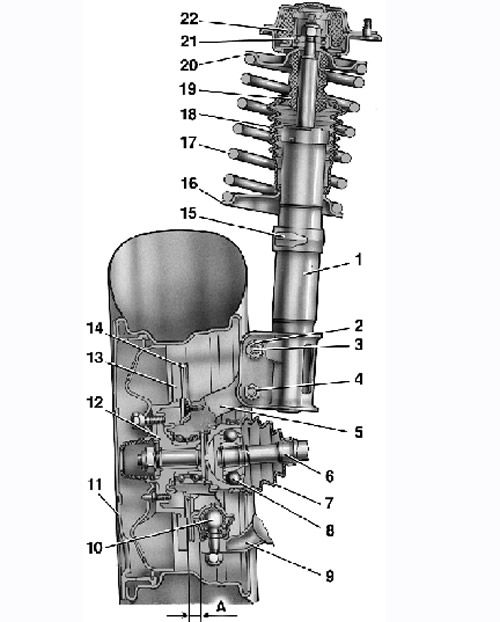
Front suspension assembly: A – control size; 1 – telescopic stand; 2 – nut; 3 – eccentric bolt; 4 – nut; 5 – steering knuckle; 6 – front wheel drive shaft; 7 – hinge protective cover; 8 – outer shaft joint; 9 – lower arm; 10 – ball joint; 11 – decorative wheel disc (cap); 12 – hub; 13 – brake disc; 14 – protective cover; 15 – rotary lever; 16 – lower support cup; 17 – suspension spring; 18 – protective cover for telescopic stand; 19 – compression stroke buffer; 20 – upper support cup; 21 – Upper support bearing; 22 – upper support of the rack
(The original can be seen on the website: VAZbook.ru)
To check the condition of the suspension ball joint, remove the wheel and measure the distance A between the lower arm 9 (see Fig.) and the brake disc 13. If this distance increases by more than 0.8 mm when rocking the suspension, replace the ball joint. For a more precise check of the ball joint, see. "Replacing the ball joint" in the subsection "Front suspension".