




1. Raise and support the front of the vehicle. Remove the wheel.
Warnings! Brake the car with the parking brake and install the anti-rollback stops ("shoes") under the rear wheels. Loosen and tighten the wheel bolts only when the vehicle is on the ground. Bolt tightening torque 65-95 N·m (6.5-9.5 kgf·m).
2. Unscrew the ball joint mounting nut.
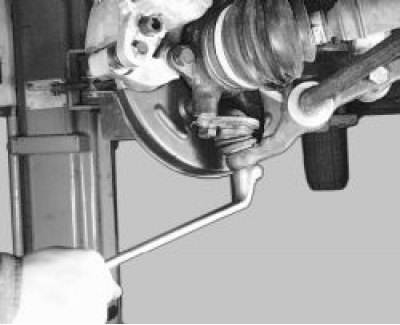
3. Using a puller, press the ball joint pin out of the lever.
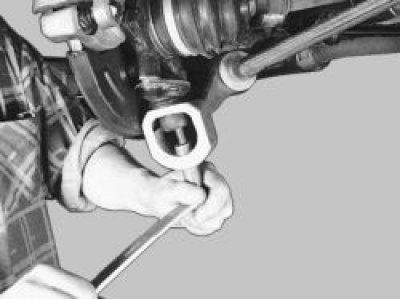
4. Loosen the rear strut mount nut.
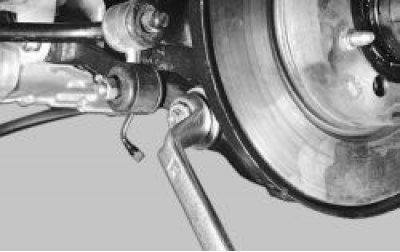
5. Loosen the mounting nut and disconnect the anti-roll bar from the control arm.
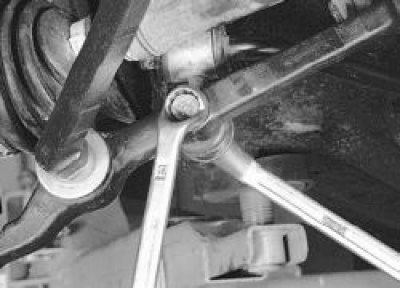
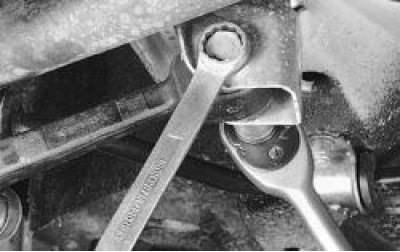
6. Unscrew the nut securing the lever to the body bracket and remove the bolt.
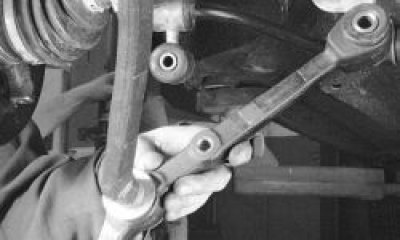
7. Remove the lever from the tension rod.
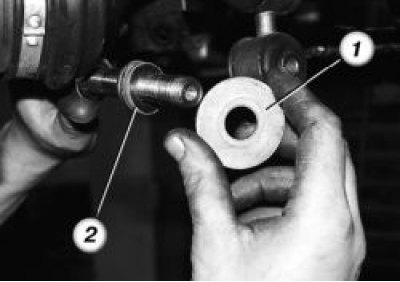
8. Remove the special washer 1 and the pack of adjusting washers 2 from the tensioner, counting their number (if they are installed). Mark the washers so that they can be installed on the same side of the lever later.
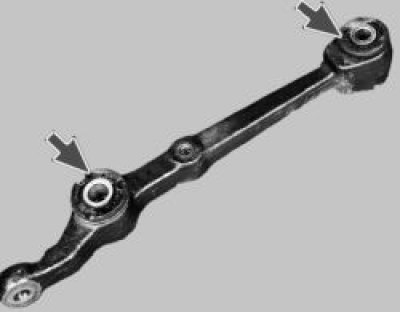
9. Signs of wear of the rubber-metal hinges of the lever are breaks, one-sided bulging of the rubber and peeling of the rubber from the metal bushing. To replace the rubber-metal hinges of the lever, special tools and skills are required. Two options are recommended: either replace the lever assembly with hinges, or, having removed the lever from the car, replace the hinges in a specialized workshop.
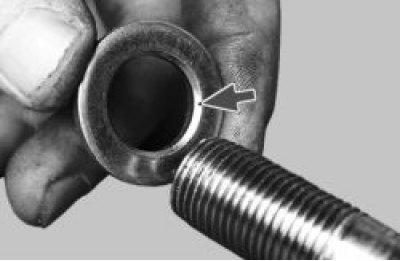
10. Install the new lever in the reverse order of removal. Install the same number of adjusting washers, the chamfers on their internal diameters should be directed towards the thrust shoulder of the tensioner.
Lower the vehicle to the ground and rock it vigorously several times. Tighten with appropriate moments nuts securing the ball joint to the arm and the arm to the body bracket – 80–96 N·m (8.0–9.6 kgf·m), nut securing the tie rod to the arm – 160–180 N·m (16.0–18.0 kgf·m), nut securing the anti-roll bar strut to the arm – 42–52 N·m (4.2–5.2 kgf·m). After running 100 km, tighten these threaded connections again to the required torques.
The information is posted on the portal (VAZBOOK.ru)