




Contents: Ball joints ↓ Rubber-metal hinges ↓ Steering knuckles ↓ Suspension springs ↓ Stabilizer bar ↓
During the check, carefully inspect and make sure that the suspension arms, crossmember, steering knuckles and springs are not deformed and have no cracks. If cracks and deformations are present, replace the specified parts. A more thorough check is carried out using devices.
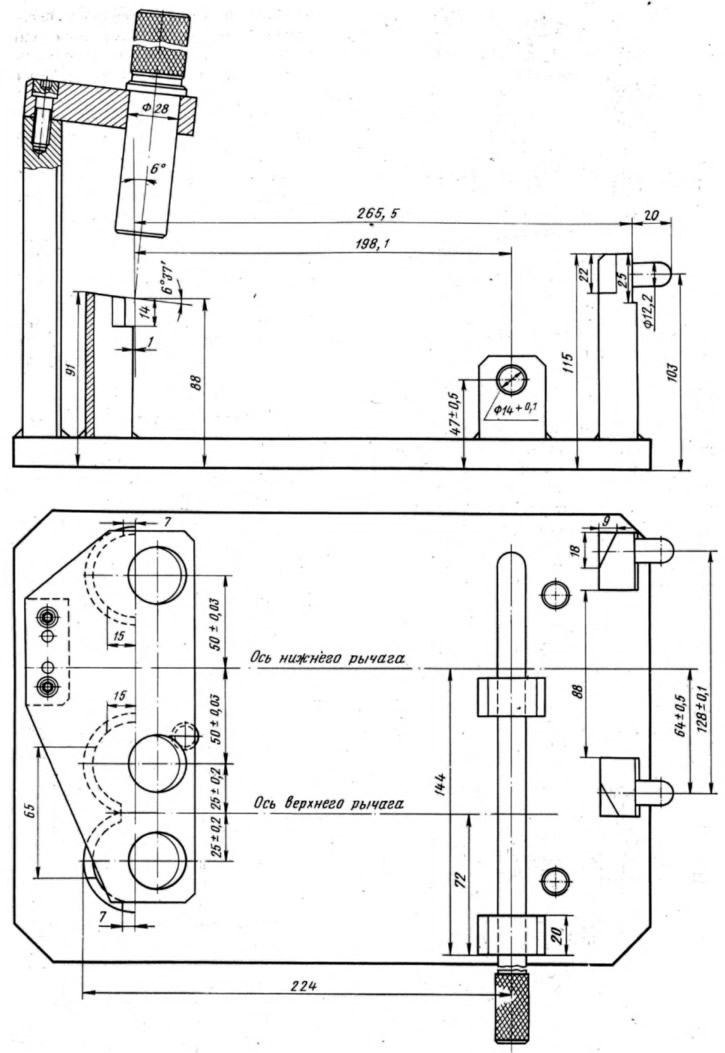
Suspension arms. Their deformation is determined on the device A.95716 (Fig. 111). For this purpose, the lower arm 2 is installed (fig. 112, a) so that the mandrel 1 articulates with the cone of the ball joint pin of the lever, and the installation pins of the device enter the holes 3 of the lever axis. Mandrel 1 for centering should enter the right or central hole of the device, depending on which lever is being checked, the right or the left. A sign of deformation of the lever is the impossibility of inserting the fingers of the device into the holes 3 of the lever axis without force, as well as poor articulation of mandrel 1 with the cone of the ball joint pin.
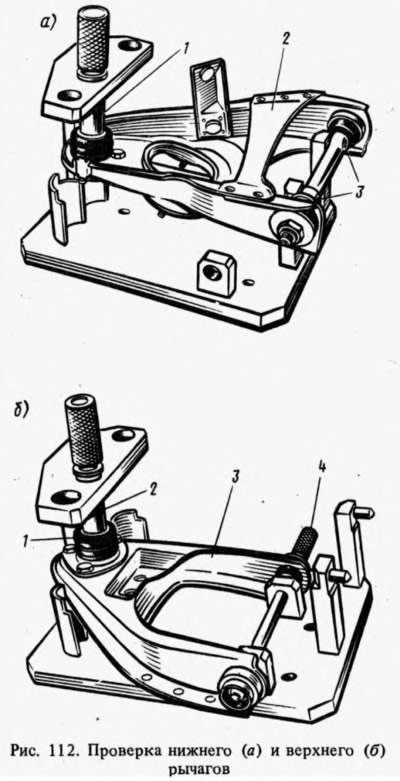
The upper lever 3 (Fig. 112) is installed on the same device in an inverted position so that the mandrel 2 for centering exactly coincides with the tail of the ball joint pin 1, and the pin 4 passes into the holes of the rubber-metal hinges of the lever. The degree of deformation of the lever is determined by the difficulty of inserting pin 4 into the holes of the lever and by the poor articulation of the conical socket of the mandrel 2 with the conical surface of the ball joint pin. Pin 4 should enter the holes of the joint without much effort.
Ball joints
First of all, make sure that the joint mudguards are intact. Tears, cracks, rubber peeling off the metal reinforcement, traces of grease leakage are unacceptable. Then check: is there any wear on the working surfaces of the ball joints, turning the ball pin manually. Free (without resistance) the movement of the pin or its jamming are unacceptable. A more precise check of the condition of the upper ball joint for radial and axial play is carried out on the device 02.8701.9502. For this, the ball joint 1 is installed (fig. 113, a) into the socket of the device and tighten it with a screw. Install indicator 2 in the bracket of the device so that the indicator leg rests against the side surface of the hinge housing, and the indicator arrow is at zero.
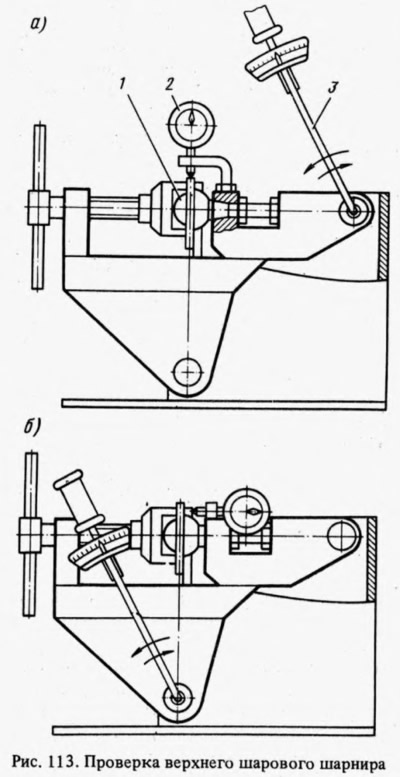
Install torque wrench 3 in the socket of the device and, applying a torque of 20 kgf·m in both directions, determine the total radial clearance in the ball joint using indicator 2. If it exceeds 0.7 mm, replace the joint with a new one.
The axial clearance in the ball joint is checked in a similar manner, having first changed its fastening in the device, as shown in Fig. 113. The axial clearance in the joint is allowed to be no more than 0.7 mm.
Rubber-metal hinges
The signs by which rubber-metal hinges are replaced are described in section. "Determining the technical condition of the front suspension parts on a vehicle".
Steering knuckles
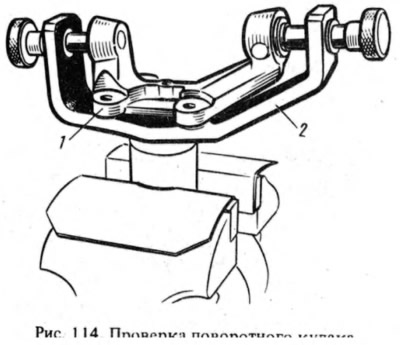
To check, install the steering knuckle 1 (Fig. 114) on the A.96008 gauge (2), clamped in a vice so that its surface under the wheel hub seal coincides with the gauge hole. Insert two side mounting pins of the gauge into the knuckle holes. If some force is required, the knuckle is deformed and must be replaced.
Suspension springs
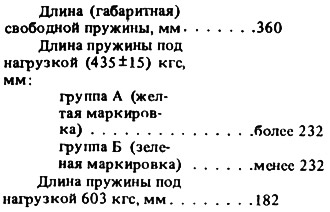
Carefully inspect the springs. If cracks or deformations of the coils are found that may cause malfunction, replace the spring with a new one. After squeezing the spring three times until the coils touch, check its compliance with the following data:
[The original is posted on Internet resource: www.VazBook.ru]
At the same time, the condition of the insulating gaskets is checked. If they are damaged, they are replaced with new ones.
Stabilizer bar
Check whether the rod is deformed and whether its ends are in the same plane. If the deformation is insignificant, the rod is straightened. If the deformation is significant, the rod is replaced. Check the integrity of the cushions in the mounting brackets to the body and to the lower suspension arms. If worn, the cushions are replaced.
Front suspension crossmember. Checking its condition is described in section. "Determining the technical condition of the front suspension parts on a vehicle".