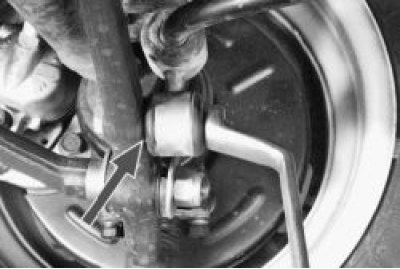
1. Place the vehicle on a ditch or lift and support the front of the vehicle.
Warning! Brake the car with the parking brake and install the anti-rollback stops ("shoes") under the rear wheels.
2. Unscrew one nut securing the stabilizer struts on both sides of the vehicle.
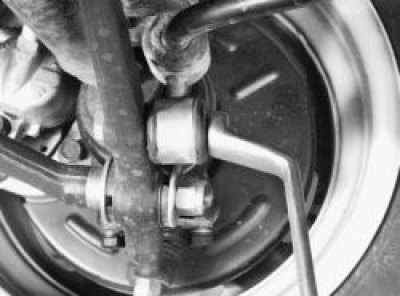
3. Unscrew the two nuts securing the stabilizer bar brackets on the right and left sides of the vehicle.
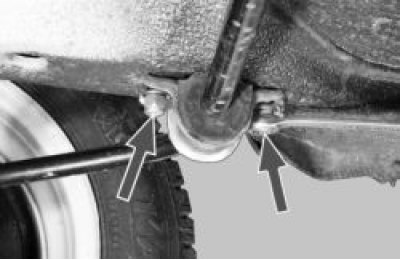
4. Remove the brackets and stabilizer bar together with the struts.
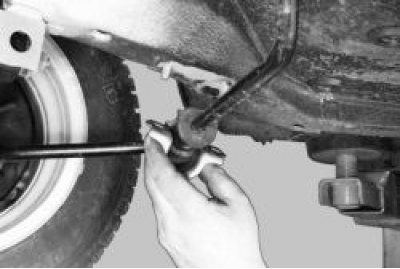
5. If you only need to replace the stabilizer struts or their bushings, unscrew the nuts securing the struts to the levers and knock the struts off the stabilizer bar with a wooden or polymer hammer.
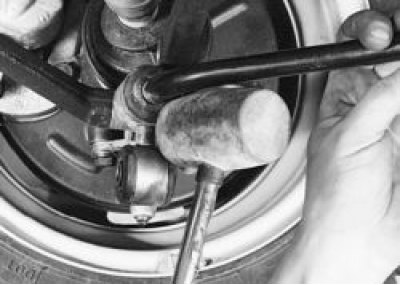
6. Inspect the stabilizer bar. It should not have any deformations, the ends should be in the same plane. If the geometry changes slightly, the bar should be replaced. If the stabilizer pads are worn, torn, have lost their elasticity, or do not fit tightly on the bar, replace them.
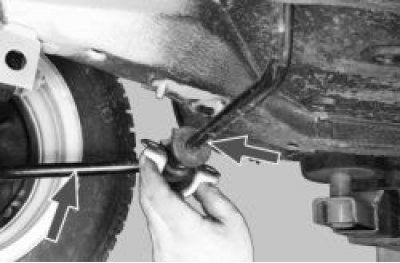
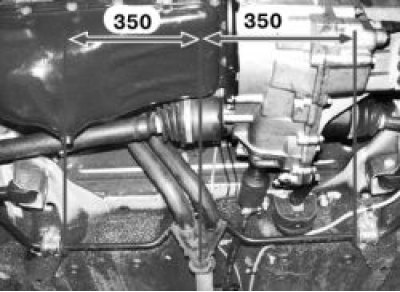
7. If the stabilizer pads need to be replaced, place new pads on the rod at a distance of 350 mm from the center of the rod with the cuts towards the front of the car. Place the struts on the rod.
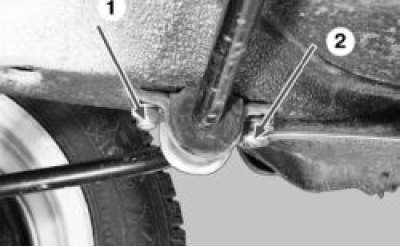
8. Install the rod and tighten the nuts securing the stabilizer cushion brackets until the gap in the cushion cuts is eliminated (if the pillows are split). First, tighten the front nuts 1 (from the cut side), then the back 2.
9. Tighten the strut mounting nuts until the gaps between the struts and the levers are selected. Finally tighten all stabilizer mounting nuts with the suspension loaded (the car is on the ground). Tightening torque of nuts rack mounts 43–53 N·m (4.3–5.3 kgf·m), bracket mounts 13–16 N·m (1.3–1.6 kgf·m).