




The design provides everything to prevent the car from drifting or skidding, but only constant attention to the units that affect stability is a necessary measure to ensure traffic safety. Hydraulic shock absorbers 2 (see fig. 39), anti-roll bar, 4 front suspension coil springs primarily affect the vehicle's stability, damping of rhythmic vibrations and smoothness of the ride.
The same tasks are performed by the rear suspension (Fig. 41) reaction rods 3, 4, 6, shock absorbers 7 and springs 1. To prevent the car from skewing, the forces of all four springs must be equal. It is acceptable if the rear springs are somewhat more powerful than the front ones. All springs are calibrated during their manufacture, marked with green or yellow paint and specially selected during the assembly of the car.
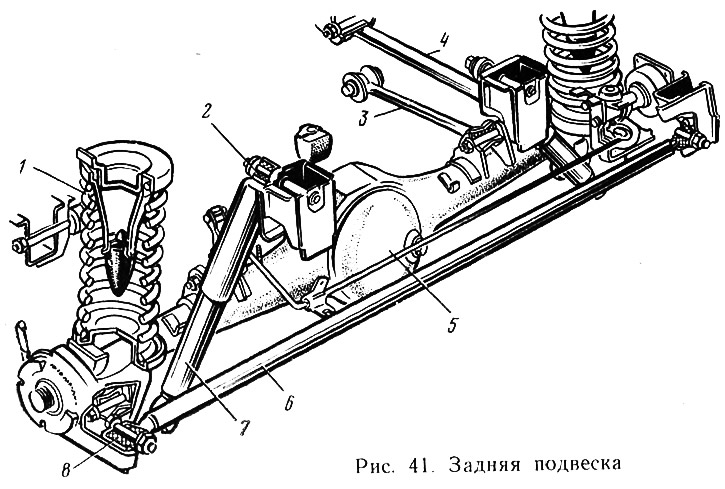
It should be remembered that various rubber and rubber-metal bushings 8 and 2 are used as connecting elements in suspensions. Due to the natural wear of these elastic elements, backlash occurs, as a result of which the units or parts cease to reliably perform their functions.
Imagine the operating conditions of the anti-roll bar or longitudinal reaction rods 3 and 4, which experience compression when transmitting various pushing forces and tension when applying the braking torque, which tends to tear the rear axle 5 away from the body. The transverse rod 6 also operates under similar conditions, which, counteracting the lateral forces that arise on the wheels when turning and driving on uneven roads, keeps the rear axle from shifting across the body. Naturally, the rubber parts wear out first under such loads. They should be given special attention. This should be done during each maintenance.
To tighten loose fasteners, you may need wrenches of sizes 13 mm, 17 and 19 mm. The most convenient way to check for play in the suspension joints is by touch, shaking the part with one hand and feeling for possible play with the other. While under the car (in a viewing ditch or under an overpass), don't forget to also check for fluid leaks from the shock absorbers.
Shock absorbers of both domestic and foreign manufacture are installed on VAZ cars, and if a leaking domestic shock absorber can be repaired, then an imported one is simply replaced with a new one, since its design is non-disassemblable. To check how the shock absorber works, press the wing several times (just find a hard spot on the wing, otherwise you will leave marks on it) and release it. A properly functioning shock absorber will prevent useless vibrations.
It is also necessary to inspect the reaction rods and, if they are found to be twisted or bent, they need to be repaired or replaced with new ones.
As noted above, hinges and ball joints affect driving safety, so there is no need to explain their importance. It is also important that the steering rod hinges and front suspension ball joints installed on VAZ vehicles are of a non-separable design. Assembled and filled with grease at the factory, they should reliably serve for 100 thousand km. The main thing is that the hinges and supports are very effectively sealed. This allows them to always be clean and not lose grease. It is enough for the protective cover to deform slightly, and the hinge will work for 10 thousand km at best.
Hinges and ball joints 6 (see fig. 39) consist of steel ball pins installed in support liners and springs that provide the necessary tension in the connection and eliminate gaps formed due to natural wear of the pins. None of the parts can be replaced. Only the protective cover can be updated if it is deformed. Given such design nuances. only the protective covers are checked by placing the car on an inspection ditch or overpass. Each cover is carefully wiped from dirt and carefully inspected for tears, cracks, warping, etc. The covers should fit tightly around the protruding (cylindrical) part of the ball pin. Of course, the main task of the operation is to check the condition of the protective covers. However, it is equally important to know the condition of the ball joints of the steering rods and steering racks. It is advisable to do this work together. One slightly rotates the steering wheel, and the other checks for play in the joints from below by touch.
(The original is available on the website: vazbook.ru)
To check the condition of the lower ball joints 6 (see fig. 39) it is necessary to remove the wheel and rest the hub 11 on a support with a height of 280-300 mm.
The supports have conical plugs (which, by the way, it is advisable to replace with grease nipples for subsequent use). The plug should be unscrewed after cleaning it from dirt and, having inserted a caliper into the hole, determine the distance from the housing to the end of the ball pin. A size of more than 11.8 mm indicates the need to replace the unit.
It should be remembered that sometimes it is difficult to figure out which of the suspension units is "guilty" of the increased play. In such a situation, check for play with the brake pedal pressed. In this case, only play in the ball joints will be felt on the wheel.
When inspecting the suspension units and parts, make sure that levers 3 and 5 (see fig. 39) suspensions are free of cracks, either from impact or metal fatigue. The serviceability of parts and units of the front and rear suspensions also affects the condition of the tire rubber.
Each car wheel wears differently. There are many factors that influence their different wear: the quality of the rubber and the pressure in the tires, the presence of disc runout and increased play in the suspension joints, the driver's driving style and the intensity of the use of the brakes. Even under the most ideal operating conditions, time takes its toll and there is no escape from rubber wear. However, in all cases, it is advisable for the wheels to wear evenly. This will significantly extend their service life. One way to ensure even wear of the tires is to rearrange the wheels according to a specific pattern provided in the vehicle's operating instructions.
The following tools and devices are required for this operation: a combination wrench for removing wheels, a mounting blade, a jack and special wheel stops. The main thing in this operation is to take all possible precautions, ensuring reliable stability of the car. In order not to move the wheels from place to place in vain, use the following recommendations: take the spare wheel out of the trunk and put it near the right rear wheel; loosen the mounting bolts of this wheel and install a jack in the socket closest to it (remember that the stop in this case should be under the front wheel); place the removed bolts in the inverted wheel cap; remove the wheel and install the spare.
Particular attention should be paid to the tightening of the wheel mounting bolts. Some car enthusiasts stand on the wrench when tightening, jump on it, apparently wanting to permanently attach the wheel to the drum or hub. The tightening torque of the bolts should not exceed 70 N·m. Tightening with great force leads to deformation of the disk, the occurrence of vibration at a certain speed and, as a result, to intensive wear of the rubber.
All other permutations are performed similarly. You just need to know which wheel to put where.
One of the most important operations that ensures traffic safety and the safety of rubber is the installation of the angles of the front wheels. There are many recommendations on how to do it yourself. However, this work can only be done with the required effect on special stands, which are also regularly checked (calibrated).
Experience suggests another recommendation: monitor the condition of your tires.
If you don't notice anything unnatural (intense or uneven) wear, there is no need to check the wheel alignment angles.