




Warning! If you have the slightest doubt about self-diagnosis, get out the tow rope.
A major repair to a damaged engine will cost more than a towing service.
Engine knock listening zones:
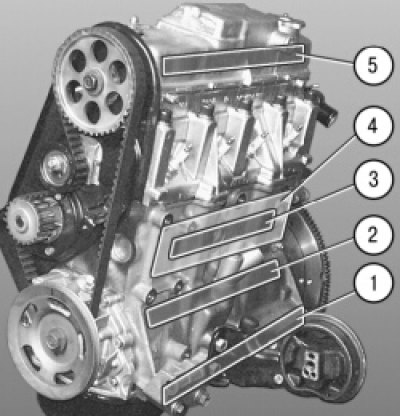
Engine knock listening zones
1. Knocking of main bearings is very dangerous; stop the engine immediately, you will have to go to a car service or garage by tow. Low-pitched knocking. It is heard in the lower part of the cylinder block, it noticeably increases under load and with an increase in rotation speed. Often its appearance is accompanied by a drop in oil pressure (the oil pressure warning light is on almost constantly).
2. The knocking of connecting rod bearings is very dangerous; stop the engine immediately, you will have to tow it to a car service or garage. The sound is rhythmic, ringing, metallic, medium tone. It increases significantly with increasing load and completely disappears when the spark plug is disconnected.
3. Piston pin knocking is dangerous; without loading the engine, you can drive to the car service or garage on your own. Rhythmic, high-pitched with a sharp metallic tint, audible in all engine operating modes and intensifies with increasing engine load. Completely disappears when the spark plug is disconnected.
4. The knocking sound of worn pistons and cylinders is not dangerous; without putting too much load on the engine, you can drive to a car service or garage on your own. A sound reminiscent of the clatter of clay pottery. It is especially audible on an unheated engine, and decreases or disappears as it warms up.
5. Valve knocking is not dangerous, you can drive to a car service or garage yourself. Metallic knocking against the background of a general dull noise. It is clearly audible at low and medium crankshaft speeds from the cylinder head side above the valve locations. Valve knocking is often confused with tappet knocking (the latter is very high-pitched and variable in volume - almost impossible to eliminate).
Detonation knocks are dangerous, but are usually eliminated by setting a later ignition timing. If you do not overload the engine, you can drive to a car service or garage yourself. Ringing metallic knocks that usually occur when accelerating the car. The cause is incorrect ignition timing, use of low-octane fuel, engine overload when engaging a higher gear too early, significant carbon formation in the combustion chambers. It is necessary to adjust the ignition (see the "Electrical Equipment" section) and use a special fuel additive to remove carbon deposits on the valves and in the combustion chambers.