




Warning! Faults in the vehicle's suspension and steering can lead to a serious accident!
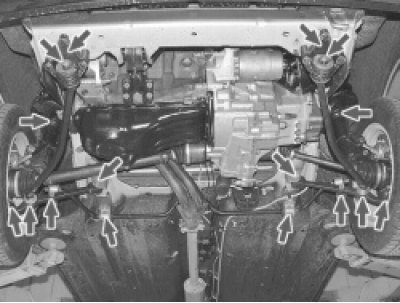
It is better to check the condition of the suspension by placing the car on a ramp, inspection pit or lift, and if this is not possible, you can do this work on a free level area, although with less convenience. In any case, you will need an assistant.
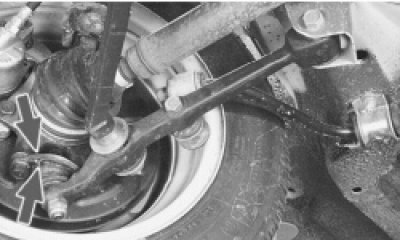
1. Carefully check the condition of the suspension parts. Pay attention to the condition of the rubber protective covers of the ball joints of the front suspension. Tears in the covers and the presence of cracks on them are unacceptable, since in this case moisture and dirt get into the joint, which leads to premature wear of the joint. Be sure to replace damaged parts.
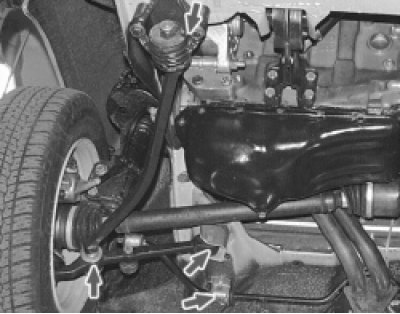
2. Check the condition of the rubber-metal hinges and rubber bushings of the lower arms, stabilizer and stretchers. The photo shows the right side of the car. On the left side, check the same places in a similar way.
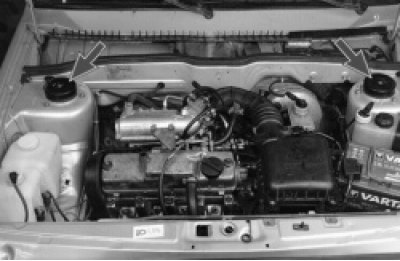
3. Open the hood, remove the plastic protective caps from the upper supports of the telescopic struts and check the condition of the upper support. There should be no cracks, tears, swelling, etc. on the rubber part of the support. After a preliminary inspection, you can proceed to a more detailed check.
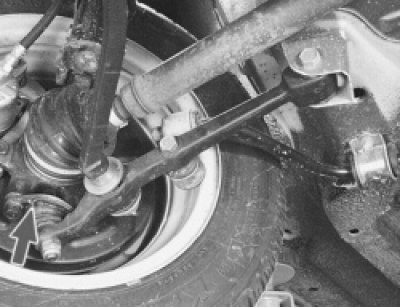
4. Ask an assistant to grab the upper part of the front wheel of a car parked on the road with both hands and shake it sharply in the transverse direction. At the same time, you should observe the presence of gaps in the front suspension joints. Pay special attention to the ball joint. Worn suspension joints must be replaced.
Helpful advice: It is easier to determine the presence of a gap (play) in the ball joint if you touch the ball joint with your hand while rocking the wheel.
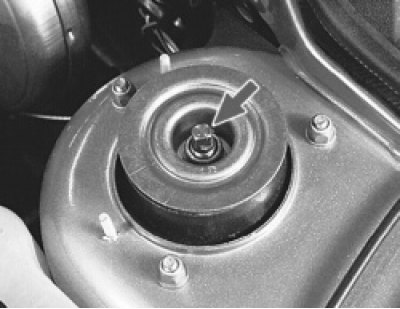
5. If there is no play in the suspension joints, check the tightening of the nut securing the shock absorber rod to the upper support of the strut.
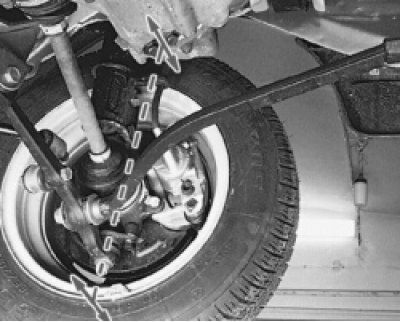
6. Jack up the car on the side being checked until the wheel is off the road. Place a strong support (tripod) under the body sill and lower the car slightly to load the support. Rock the wheel in a vertical plane, holding the top with one hand and the bottom of the wheel with the other. Increased knocking from the central part of the wheel indicates a large gap in the hub bearing.
Note: The knocking noise from the hub bearing will disappear if the test is repeated with the brake pedal depressed.
Warning! Do not attempt to tighten the hub nut to a torque greater than that recommended by the manufacturer to eliminate clearances. This may result in bearing failure and stripping of the nut and wheel drive joint threads.
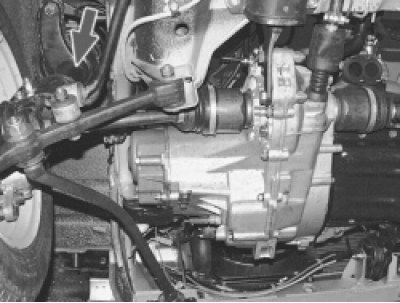
7. Inspect the telescopic suspension strut. Oil leaks indicate a faulty shock absorber. In this case, it is necessary to replace shock absorber or repair it. Check the integrity of the spring and compression buffer.
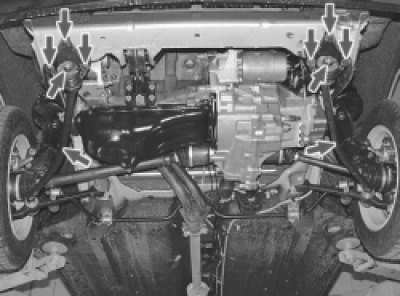
8. Check the brackets that secure the struts to the car body. The brackets must be securely bolted to the car body and not damaged.
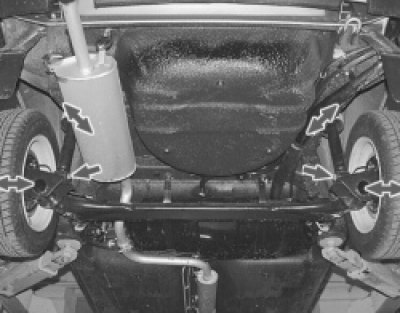
9. When checking the rear suspension, pay attention to the condition of the hub bearings, shock absorbers, springs, bump stops and the fastening of the shock absorber rods to the body. You can tighten the shock absorber rod nuts from the luggage compartment, after removing the seat belt reels and side paneling.
After replacing individual suspension parts, be sure to check and adjustment of front wheel alignment angles. This operation must be carried out on a special stand in a car service center, since incorrect installation of wheels leads to accelerated tire wear, increased fuel consumption, and deterioration of the vehicle's stability and controllability.
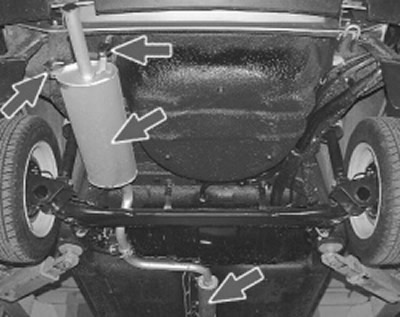
Pay attention to the exhaust system. Very often, due to the use of non-standard elements or a break in the muffler suspension elements, it can become a source of strong knocking, especially when revving. To check, stop the engine, carefully inspect the exhaust system, check the reliability of the fastening and suspension of the muffler. Taking the end of the exhaust pipe, swing the muffler up and down and from side to side - there should be no knocking.
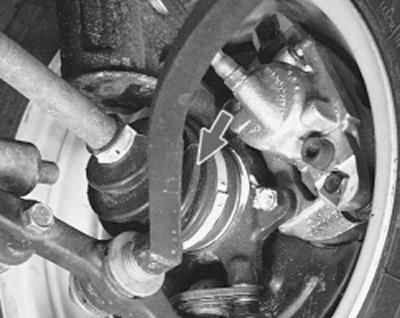
Knocking in the suspension is often confused with knocking in the constant velocity joints (CV joints) of the drive axle shafts. The sound is a ringing metallic clicking sound, which is especially noticeable when the accelerator pedal is pressed sharply with the front wheels turned at a large angle. As the CV joints wear out, the duration of the clicking increases. The only radical way to combat this knocking is to replace the CV joints.