




These two unified engines with a working volume of 649 and 750 cm³ differ in pistons and cylinder block (various diameters of inlet channels and valves), cylinder head gasket (different diameters of cylinder bores) and carburetors (various calibration data). In addition, there are differences in the size of the balancing masses of the flywheel, generator drive pulley and balancing shafts.
Engines with a compression ratio of 9.9 operate on AI-93 motor gasoline with an octane number according to the research method of at least 93.
High power and economic performance of the engines are achieved through the use of a compact combustion chamber, a two-chamber carburetor, selection of fuel and ignition system adjustments, selection of the shape of the intake and exhaust channels, valve timing, and reduction of mechanical losses in the engine as a whole.
The engine cylinders are combined with the upper part of the crankcase and represent a single casting - the cylinder block. This arrangement ensures the strength of the structure, its rigidity, compactness, reliability, and also reduces the weight of the engine.
The crankshaft is mounted on three supports at the bottom of the cylinder block. The front and rear ends of the crankshaft are sealed with self-tightening rubber seals.
Each engine cylinder has one intake and one exhaust valve. Pistons 25 have two compression rings and one oil scraper ring with a spring. The piston is connected to the connecting rod by a piston pin pressed into the upper head of the connecting rod.
The camshaft 12 is mounted on the cylinder head and is driven from the crankshaft by a toothed belt 10. The advantage of the drive is its simple design and lower weight compared to other types of transmissions.
For two-cylinder engines (what are engines mod. 1111 and 11113) the balance of the moving masses of the crank mechanism is worse compared to four-cylinder ones. This results in a higher level of engine vibration. If appropriate measures are not taken, these vibrations will have a negative effect on both the car body and the passengers. Therefore, to reduce vibrations, two balancing shafts 31 are installed on the right and left sides of the engine on engines of the 1111 and 11113 models, which are driven by gears from the crankshaft. These shafts have unbalanced masses and, when rotating, compensate for the inertial forces from the piston and connecting rod. In addition, to reduce vibrations, one-sided tides are made on the flywheel 28 and the pulley 5 of the generator drive. As a result of such design measures, the vibration of the engines is reduced to an acceptable level.
Since the 1111 and 11113 engines have different piston masses, they have correspondingly different imbalance values for the balance shafts, flywheel, and alternator drive pulley. Therefore, for distinction, these parts of the 11113 engine have marks. On the flywheel, there is an annular groove with a diameter of 135 mm on the side of attachment to the crankshaft. On the balance shafts, there is an annular groove near the seating surface for the rear bearing. On the alternator drive pulley, on the rear side, there is an annular groove with a diameter of 120 mm.
(The text is copied from the online resource: «VAZBOOK.RU»)
Cylinder block
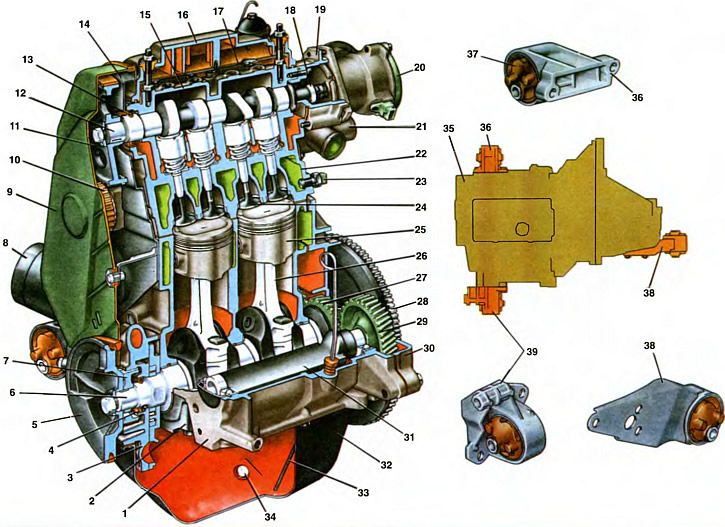
1. Cylinder block. 2. Cover of the first main bearing. 3. Oil pump. 4. Front crankshaft oil seal. 5. Generator drive pulley. 8. The crankshaft. 7. Camshaft drive pulley. 8. Oil filter. 9. Front gear belt protection cover. 10. Camshaft drive belt. 11. Camshaft pulley. 12. Camshaft. 13. Camshaft oil seal. 14. Rear curled gear belt cover. 15. Camshaft bearing housing. 18. Cylinder head cover. 17. Oil separator cover. 18. An eccentric for driving the fuel pump. 19. Housing of auxiliary units. 20. Spark moment sensor. 21. Exhaust pipe of the cooling jacket. 22. Cylinder heads. 23. Coolant temperature indicator sensor. 24. Inlet valve. 25. The piston. 26. Connecting rod. 27. Counterbalance shaft drive pinion. 28. Flywheel. 29. Counterbalance shaft pinion. 30. Rear crankshaft oil seal holder. 31. Balancing shaft. 32. Oil sump. 33. Oil level indicator. 34. Plug the oil drain hole. 35. Power unit (engine with gearbox and clutch). 38. Bracket with support of rear engine mount. 37. Engine mount support. 38. Bracket with support of left engine mount. 39. Bracket with support of front engine mount.
Cylinder block 1 is the basic part of the engine and serves to install and fasten mechanisms, devices and auxiliary units of the engine. The block is cast from special low-alloy cast iron.
Coolant passages are made along the entire height of the cylinders, which improves the cooling of the pistons and piston rings and reduces block deformations from uneven heating.
To increase rigidity, the lower plane of the block is lowered by 53 mm below the crankshaft axis. The block cylinders are divided into five classes by diameter, each with 0.01 mm, designated by the letters A, B, C, D, E:
| Class | Engine cylinder diameter 1111, mm | Engine cylinder diameter 11113, mm |
| A | 76,000...76,010 | 82,000...82,010 |
| IN | 76,010...76,020 | 82,010...82.020 |
| WITH | 76,020...76,030 | 82,020...82,030 |
| D | 76,030...76,040 | 82,030...82,040 |
| E | 76,040...76,050 | 82,040...82,050 |
The cylinder class is indicated on the bottom plane of the block opposite each cylinder.
The cylinder and the piston mating with it must have the same class. During repair, the cylinders can be bored and honed to increase the piston diameter by 0.4 and 0.8 mm.
In the lower part of the cylinder block there are three supports of the crankshaft main bearings with thin-walled steel-aluminum liners. The bearings have removable covers 2, which are fastened to the block with self-locking bolts. The holes for the crankshaft bearings in the cylinder block are machined together with the covers, which ensures high precision, the correct geometric shape of the holes and their alignment.
The middle main bearing shells are made without a groove on the inner surface. The outer main bearing shells had grooves on the inner surface before 1997 (both upper and lower). Since 1997, the lower shells of the outer main bearings are installed without a groove.
The bearing caps are not interchangeable and have marks on the outer surface (see chapter 9). The bearing supports and the corresponding covers are measured from the front end of the cylinder block. The covers are positioned so that the marks are on the generator installation side.
The middle support has sockets for installing thrust half rings that hold the crankshaft from axial movements. The axial clearance should be 0.06...0.26 mm. If the clearance exceeds the maximum allowable (0.35 mm), it is necessary to replace the half rings with repair ones increased by 0.127 mm. It should be borne in mind that the grooves located on one side of the half rings should face the thrust surfaces of the crankshaft.
The cylinder block is closed from below by a stamped steel crankcase 32. The crankcase has a partition to calm the oil. A gasket made of a cork-rubber mixture is installed between the oil crankcase and the cylinder block.
A holder 30 of the rear oil seal is attached to the cylinder block from the rear. The holder, pre-assembled with the oil seal, is installed on the cylinder block with the crankshaft placed in it and the main bearing caps tightened. The holder is attached to the cylinder block with bolts and spring washers.
In the front right part of the cylinder block jacket there is a cavity of the coolant pump. Below it the oil filter 8 is fixed. On the left side the generator is installed on the cylinder block. In the lower part on the left there is a lug for installing the engine on the suspension bracket.
In the front part of the cylinder block, an oil pump 3 is installed through a gasket, in the cover of which the front crankshaft oil seal 4 is located.
The exact position of the oil pump relative to the cylinder block and crankshaft is ensured by two mounting pins pressed into the pump housing, which enter the corresponding holes in the cylinder block.
Covers 9 and 14 are attached to the front end of the cylinder block, forming a cavity for the timing belt 10.
The clutch housing is attached to the rear end of the cylinder block. The exact position of the housing relative to the cylinder block and the alignment of the crankshaft and the primary shaft of the gearbox are ensured by two centering bushings pressed into the cylinder block.
Cylinder head
The cylinder head 22 is cast from an aluminum alloy and has wedge-shaped combustion chambers. The valve guide bushings and seats made of cast iron are pressed into the head. The dimensions of the inlet valve seat are larger than the dimensions of the exhaust valve seat. The seats, pre-cooled in liquid nitrogen, are inserted into the seats of the heated cylinder head. This ensures a reliable and durable fit of the seats in the head. The working chamfers of the seats are ground after their installation in the head concentrically to the holes in the valve guide bushings. A special shrinkage-free gasket on a metal frame is installed between the head and the cylinder block.
The head is centered on the cylinder block with two bushings and is attached to it with six bolts. To ensure uniform compression of the entire surface of the block gasket, to ensure reliable sealing and to prevent tightening of the bolts during subsequent maintenance of the car, the cylinder head mounting bolts are tightened evenly without jerking in four steps and in a strictly defined (shown on sheet 10) sequences:
- step 1: Tighten the bolts to a torque of 2 kgf·m;
- method 2 - tighten the bolts with a torque of 7.08...8.74 kgf·m;
- step 3 - turn the bolts 90°;
- step 4: Turn all the bolts 90° again.
In the upper part of the cylinder head there are three supports for the journals of the camshaft 12. The supports are detachable. The upper half is in the bearing housing 15, and the lower half is in the cylinder head. The mounting bushings of the camshaft bearing housing are located at the housing mounting studs. The holes in the supports are machined together with the bearing housing, and therefore the cylinder head can only be replaced together with the bearing housing.
A sealant of the KLT-75T type is applied to the surfaces of the cylinder head that are mated with the bearing housing, in the area of the extreme supports of the camshaft.
The bearing housing is installed and the nuts are tightened in two steps:
- step 1 - Pre-tighten the nuts in the sequence shown on Sheet 10 until the bearing housing surfaces are flush with the cylinder head. The housing mounting bushings should fit freely into their sockets;
- 2nd step - finally tighten the nuts to a torque of 2.2 kgf·m in the same sequence.
In the upper part of the head there are four sockets with a diameter of 35.320...36.345 mm for valve tappets.
The top of the cylinder head is closed by a cast aluminum cover 16 with a gasket.
The auxiliary unit housing 19 is attached to the rear end of the cylinder head.
The engine, clutch and gearbox assembly form a power unit, which is mounted on the vehicle subframe on three elastic supports. The supports support both the weight of the power unit and the loads that occur when the vehicle starts moving, accelerates and brakes. The supports reduce body vibration when the engine is running, ensure minimal engine vibrations, and protect the engine from impact loads when the vehicle is moving over uneven roads. The location of the supports, taking into account the center of gravity of the engine and power unit, helps reduce the transmission of vibration to the body. The design of the engine suspension eliminates the possibility of direct contact between engine parts and the body, which significantly reduces the transmission of noise and knocks from the running engine inside the body.
Valve timing
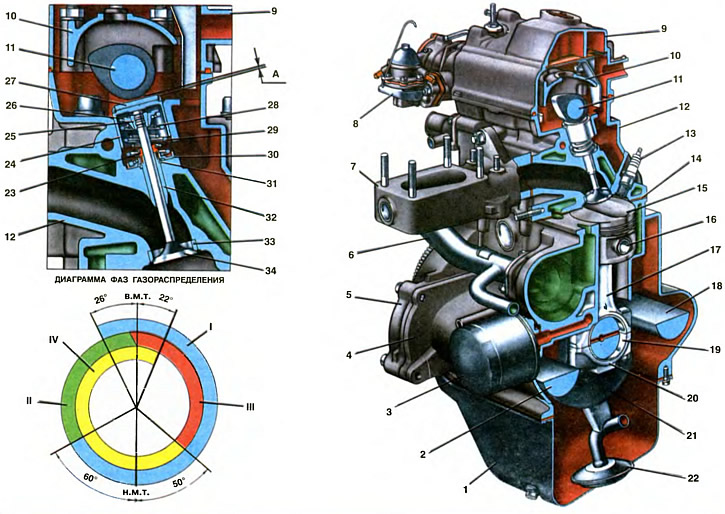
1. Oil pan. 2. Right balance shaft. 3. Oil filter. 4. Cylinder block. 5. Rear oil seal retainer. 6. Coolant pump inlet pipe. 7. Inlet pipe. 8. Fuel pump. 9. Cylinder head cover. 10. Camshaft bearing housing. 11. Camshaft. 12. Cylinder head. 13. Spark plug. 14. Cylinder head gasket. 15. Piston. 16. Piston pin. 17. Connecting rod. 18. Left balance shaft. 19. Crankshaft connecting rod bearing shell. 20. Connecting rod cap. 21. Crankshaft. 22. Oil filter receiver. 23. Valve deflector cap. 24. Valve tappet. 25. Valve cotter. 28. Valve spring plate. 27. Adjusting washer. 28. Inner valve spring. 29. Outer valve spring. 30. Spring support washer. 31. Retaining ring. 32. Valve guide sleeve. 33. Valve seat. 34. Inlet valve.
A — clearance in the valve drive mechanism on a cold engine: 0.15–0.25 mm for intake valves and 0.3–0.4 mm for exhaust valves.
I — combustible mixture intake
II - compression
III — working stroke
IV - exhaust gas release
During one working cycle, four strokes occur in the engine cylinder: intake of the combustible mixture, compression, power stroke and exhaust of exhaust gases. These strokes are completed in two revolutions of the crankshaft.
The intake valve begins to open before the piston approaches top dead center (TDC), i.e. in the piston position corresponding to 26° of crankshaft rotation before TDC. This is necessary so that the valve is fully open (when the piston goes down during the intake stroke of the combustible mixture) and through the fully open intake port, as much fresh combustible mixture as possible would enter.
The intake valve closes after the piston passes the bottom dead center (BDC), i.e. in the position corresponding to 60° of crankshaft rotation after BDC. Due to the inertial pressure of the stream of sucked-in combustible mixture, it continues to enter the cylinder when the piston has already begun to move upward, and thus ensures better filling of the cylinder. Thus, intake practically occurs in a time corresponding to a crankshaft rotation of 266°.
The exhaust valve begins to open before the working stroke is completely finished, before the piston approaches BDC, i.e. in the position corresponding to 50° of crankshaft rotation before BDC. At this point, the pressure in the cylinder is still quite high and gases begin to flow out of the cylinder intensively, causing their pressure and temperature to drop rapidly. This significantly reduces the engine work required to release gases and protects the engine from overheating.
The exhaust continues even after the piston passes TDC, i.e. when the crankshaft turns 22° after TDC. Thus, the exhaust cycle is 252°.
It is clear from the valve timing diagram that there is a moment (48° of crankshaft rotation near TDC) when both valves are open simultaneously - intake and exhaust, i.e. the exhaust and intake strokes are carried out with valve overlap. Due to the short time interval and small pressure differences, the valve overlap does not lead to the penetration of exhaust gases into the intake pipe, but on the contrary, the vacuum in the cylinder due to the inertia of the exhaust gas flow causes the suction of the combustible mixture into the cylinder and thereby improves its filling.
The described valve timing phases take place with a gap of A between the camshaft cam and the valve tappet on a cold engine.
To ensure that the opening and closing moments of the valves are coordinated with the corresponding piston positions determined by the crankshaft rotation angles (i.e. to ensure the correct installation of the valve timing), there are marks on the engine parts (see chapter 10):
- a - on the toothed pulley of the crankshaft drive;
- b - on the oil pump cover;
- in - on the generator drive pulley;
- g and d - on the front cover of the toothed belt;
- e - on the rear cover of the timing belt;
- f— on the camshaft pulley.
If the valve timing is set correctly, then when the piston of the first cylinder is at TDC at the end of the compression stroke, the "e" mark on the rear cover of the toothed belt should coincide with the "zh" mark on the camshaft pulley, and the "a" mark on the toothed pulley of the crankshaft drive should coincide with the "6" mark on the oil pump cover.
When the camshaft drive cavity is closed by the front cover, the crankshaft position can be determined by the "b" and "d" marks on the generator drive pulley and the front toothed belt cover. When the pistons are in TDC, the "b" mark on the generator drive pulley should coincide with the "d" mark on the camshaft drive cover.
When the marks match, the belt tension and clearances A in the valve mechanism are adjusted.
The clearance A between the camshaft cams and the adjusting washers on a cold engine should be equal to 0.15...0.25 mm for the intake valves and 0.3...0.4 mm for the exhaust valves. The clearance is set by selecting the thickness of the adjusting washer 27.
Spare parts include adjusting washers with a thickness of 3 to 4.5 mm, spaced every 0.05 mm. The thickness of the washer is marked on its lower surface using an electrograph.
If the clearances differ from the specified values, the valve timing diagram is distorted: with an increased clearance, the valves open late and close early, and with an insufficient clearance, they open early and close late. If there is no clearance, the valves remain slightly open all the time, which dramatically reduces the service life of the valves and seats.
The clearances between the cams and tappet washers are set with the cylinder head cover 9 and the front protective toothed belt cover removed, the spark plugs removed and no oil in the cylinder head oil baths in the following order.
The crankshaft is turned clockwise until the timing marks on the camshaft pulley and the rear cover of the timing belt are aligned, and then it is turned another 40...50° (2.5...3 teeth on the camshaft pulley). In this case, the combustion phase is in the first cylinder. The crankshaft should be turned by the generator drive pulley mounting bolt.
Using a set of feeler gauges, check the clearance at the 1st cam of the camshaft. If the clearance differs from the norm, then using the device, press the valve tappet and fix it in the lower position. Using a micrometer, measure the thickness of the removed adjusting washer. Then determine the thickness of the new washer using the formula: H = B + (A - C), where H is the thickness of the new washer; A - measured gap; B — thickness of the removed washer; C — nominal clearance.
Example
Let's say A = 0.26 mm; B = 3.75 mm; C = 0.2 mm (for intake valve). Then: H = 3.75 + (0.26 - 0.2) = 3.81 mm. Within the clearance tolerance of ±0.05 mm, we take the thickness of the new washer to be 3.8 mm.
A new adjusting washer is installed in the valve tappet, the retainer is removed and the clearance is checked again. If it is adjusted correctly, a 0.2 or 0.35 mm thick feeler gauge should come out with a slight pinch. By successively turning the crankshaft by half a turn, which corresponds to turning the mark on the camshaft pulley by 90°, the clearances of the remaining valves are adjusted according to the sequence specified in the table:
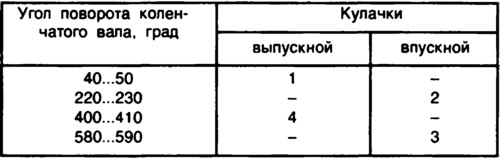
The cam numbers are counted in order from the camshaft pulley.
Engine operating order
For smooth engine operation and reduction of uneven loads on the crankshaft, the working processes in different cylinders must occur in a certain sequence. The sequence of alternation of the same strokes in different cylinders of the engine is called its operating order.
The order of operation of the engine cylinders depends on the location of the crankshaft journals and the camshaft cams. The sequence of alternation of strokes in the engine cylinders, occurring during two full revolutions of the crankshaft, is indicated in the table:
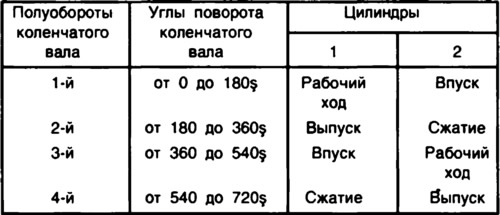
When the piston in the first cylinder moves down in the range from 0° to 180° of crankshaft rotation, combustion and expansion of gases occurs. During expansion, gases perform useful work, so this stroke is called the power stroke. In the second cylinder, lagging behind the first by 360°, the piston moves down and the combustible mixture is admitted.
Similarly, in the range from 180° to 360° of rotation of the first crank pin, compression occurs in the second cylinder and release in the first, etc.
When developing a family of engines and their systems for the new model, the designer set three main tasks: reducing weight and dimensions, reducing fuel consumption and meeting a set of environmental protection requirements. The reduction in weight and dimensions was ensured by the compact design of the engine mechanisms and systems. Improvement in engine efficiency was achieved by organizing the working process at a high (9.9) compression ratio and other measures discussed earlier. The design of the engine and its systems ensures that the requirements for exhaust gas toxicity are met.
The solution to the problem of reducing noise was facilitated by reduced clearances between the piston and the cylinder, in the crankshaft bearings, as well as the design of the valve drive with minimal clearances between the tappets and their guides in the cylinder head, better balance of the crankshaft, and the introduction of balance shafts.
The transmission of vibrations and noise has also been reduced as a result of the fact that the aluminum cylinder head cover is mounted on vibration-insulated rubber bushings.