




Types of tire wear due to improper wheel alignment
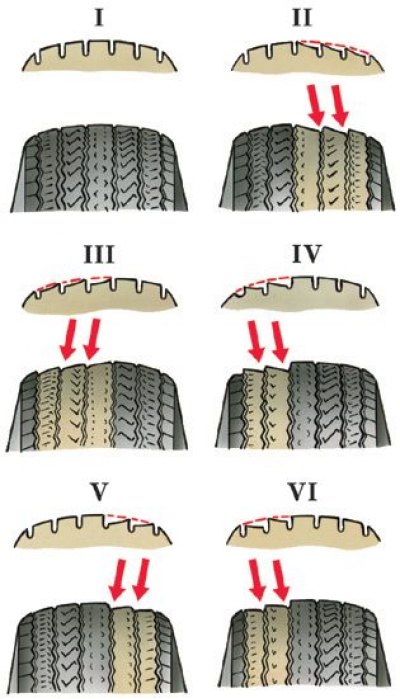
I – normal tread wear; II – increased front wheel toe-in (right wheel, rear view); III – negative toe-in of the front wheels (right wheel, rear view); IV – negative camber angle of the front wheels (right wheel, rear view); V – negative camber angle of the front wheels (left wheel, rear view); VI – negative camber angle of the rear wheels due to deflection of the rear axle beam (right wheel, rear view)
Types of tire wear due to abnormal tire pressure, large wheel imbalance or heavy braking
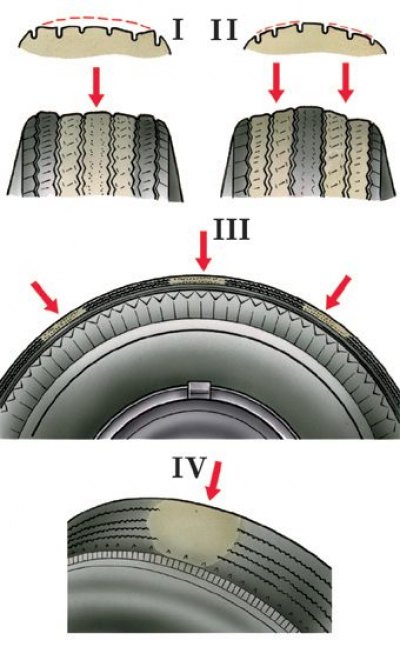
I – increased air pressure in the tire; II – low tire pressure; III – wheel imbalance exceeds permissible limits; IV – intense braking accompanied by wheel skidding
Cause | Method of elimination |
Noise and knocking in the suspension when the car is moving | |
| The shock absorbers are faulty | Replace or repair shock absorbers |
| The bolts securing the anti-roll bar have come loose | Tighten the rod mounting bolts and nuts; if the rubber cushions are worn out, replace them |
| Wear of rubber-metal hinges of levers | Replace the hinges |
| The shock absorber mounts have become loose or the rubber bushings of the shock absorber lugs have become worn out | Tighten the mounting bolts and nuts, replace the bushings in the shock absorber eye |
| Wear of ball joints of levers | Replace the ball joints |
| Increased clearance in wheel bearings | Adjust clearance or replace bearings |
| Large wheel imbalance | Balance the wheels |
| Wheel rim or disc deformation | Replace the disc assembly with the rim |
| Settling or breakage of the spring | Replace the spring |
| Wear of rubber bushings of rear suspension rods | Replace the bushings |
| Knocking from suspension "breakdown" due to destruction of compression buffers | Replace damaged buffers |
| Frequent breakdowns of the rear suspension due to overloading of the rear axle | Do not overload the vehicle |
The front wheel alignment angles cannot be adjusted | |
| Deformation of the lower arm axle | Replace the axle |
| Deformation of the suspension cross member in the area of the front mounting bolts of the lower arm axles | Repair or replace the crossmember |
| Wear of rubber-metal hinges | Replace the hinges |
| Deformation of the steering knuckle, suspension arms or front body elements | Replace deformed parts, straighten the front body elements |
Vehicle deviation from straight-line motion | |
| Different air pressure in tires | Set the tire pressure to normal |
| Front wheel alignment angles incorrect | Adjust the wheel alignment angles |
| Incorrect clearance in front wheel hub bearings | Adjust the gap |
| The steering knuckle or suspension arms are deformed | Replace deformed parts |
| Uneven elasticity of suspension springs | Replace the spring that has lost its elasticity |
| Incomplete release of the wheel brake mechanism | Fix the problem |
| Significant difference in tire wear | Replace worn tires |
| Increased imbalance of the front wheels | Balance the wheels |
| Rear axle offset due to deformation of rear suspension rods | Straighten or replace the rods |
Self-excited angular oscillation of the front wheels | |
| The air pressure in the tires is not correct | Set the tire pressure to normal |
| Increased clearance in wheel hub bearings | Adjust the gap |
| The shock absorbers are not working | Replace or repair shock absorbers |
| The nuts securing the ball joint pins have become loose | Check the reliability of the ball joint pins |
| Front wheel alignment angles incorrect | Adjust the wheel alignment angles |
| Wear of rubber-metal hinges of lever axles | Replace the hinges |
| Large wheel imbalance | Check and balance the wheels |
| Wear of ball joints | Replace the hinges |
Frequent suspension breakdowns | |
| Suspension spring sag | Replace the springs with new ones |
| The shock absorbers are not working | Replace or repair shock absorbers |
Increased clearance in ball joints | |
| Wear of the rubbing surfaces of the ball joint parts as a result of contamination caused by leaks in the protective cover or its damage | Replace the ball joint and protective boot |
Increased tire tread wear | |
| Driving at high speed on uneven roads | Choose your speed depending on the road conditions. |
| Too sharp acceleration of the car with wheel slippage | Avoid sudden acceleration |
| Frequent use of brakes with wheel locking | Use your brakes wisely |
| Wheel alignment angles are incorrect | Adjust the angles |
| Increased clearance in wheel hub bearings | Adjust the gap |
| Overloading the car | Do not exceed the permissible loads specified in the operating instructions |
| The recommended wheel rotation pattern was not followed | Rotate the wheels according to the operating instructions |
Squealing tires on turns | |
| Abnormal tire pressure | Bring your blood pressure back to normal |
| Incorrect front wheel alignment | Set the angles |
| The steering knuckle, suspension arms, cross member or front body elements are deformed | Replace deformed parts, straighten the front body elements |
Uneven tire tread wear | |
| Increased speed on turns | Reduce speed |
| Large wear of suspension joints and bushings | Repair the suspension |
| Wheel imbalance (the appearance of spots, evenly distributed around the circumference, on the outer tracks, and during prolonged driving with an unbalanced wheel, also on the central track) (see fig. Types of tire wear with abnormal air pressure in tires, large wheel imbalance or intensive braking, position III) | Balance the wheels |
| Uneven braking of wheels | Adjust the brake system |
| The shock absorbers are not working | Replace or repair shock absorbers |
| The wheel camber angle is incorrect (wear of the inner tread tracks) (See Fig. Types of tire wear due to incorrect wheel alignment, positions IV–V) | Adjust the camber angle of the wheels |
| Low tire pressure (heavy wear on the edges of the tread) (see fig. Types of tire wear with abnormal air pressure in tires, large wheel imbalance or intensive braking, position II) | Set the pressure to normal |
| High tire pressure (high wear in the middle part of the tread) (see fig. Types of tire wear with abnormal air pressure in tires, large wheel imbalance or intensive braking, position I) | Set the pressure to normal |
| Front wheel alignment is too low (wear of the inner tread tracks) (see fig. Types of tire wear due to improper wheel alignment, position III) | Adjust the wheel alignment |
| Increased front wheel alignment (wear of outer tread tracks) (see fig. Types of tire wear due to improper wheel alignment, position II) | Adjust the wheel alignment |
Wheel beating | |
| Wheel imbalance: | |
| uneven tread wear around the circumference; | balance the wheels or replace |
| displacement of balancing weights and tires during installation | balance the wheels |
| rim deformation | straighten the rim or replace it with a new one; balance the wheels |
| tire damage | replace the tire and balance the wheel |
| Increased clearance in wheel hub bearings | Adjust the gap |
Fluid leaking from shock absorber | |
| Wear or destruction of the rod seal | Replace the seal |
| Foreign mechanical particles getting onto the sealing edges of the seal | Wash shock absorber parts, replace or filter fluid |
| Shrinkage or damage to the tank sealing ring | Replace the ring |
| Notches, scratches, scuffs on the rod; complete wear of chrome plating | Replace worn or damaged piston rod and seal |
| Loosening the reservoir nut | Tighten the nut |
| Damage to the tank in the sealing ring area | Replace or repair the tank |
| Excessive amount of fluid in the shock absorber | Provide the required amount of liquid |
Insufficient shock absorber resistance during rebound stroke | |
| Leaky rebound or bypass valve | Replace damaged valve parts or repair them |
| Broken or stuck in the piston ring groove | Replace the ring or eliminate its sticking in the groove |
| Insufficient fluid due to leakage | Replace damaged parts and fill with fluid |
| Scoring on piston or cylinder | Replace damaged parts, replace fluid |
| Guide bush bore wear | Replace the guide bushing |
| The liquid is contaminated with mechanical impurities | Wash all parts, replace fluid |
| Recoil valve spring settlement | Replace the spring |
Insufficient shock absorber resistance during rebound stroke | |
| Compression valve leak | Replace damaged parts or repair them |
| Insufficient fluid due to leakage | Replace damaged parts and fill with fluid |
| Wear of the guide bushing and rod | Replace worn parts with new ones |
| The liquid is contaminated with mechanical impurities | Wash all parts, replace fluid |
| Worn or damaged compression valve discs | Replace the disks |
Knocking and creaking of shock absorbers | |
| Wear of rubber bushings in the lugs | Replace the bushings |
| Deformation of the casing due to impacts | Replace or repair the casing |
| Insufficient fluid due to leakage | Replace damaged parts, fill with liquid |
| Loosening of reservoir nuts, piston | Tighten the nuts |
| Piston seizure due to deformation of the cylinder, reservoir or rod | Replace or straighten parts |
| Loosening the shock absorber mounting nuts | Tighten the nuts |
| Failure of shock absorber parts | Replace damaged parts with new ones |