




Electrical equipment of car engine VAZ-21011

Technical characteristics of the battery
Technical characteristics of the battery Battery Type 6ST-55 Nominal voltage, V 12 Nominal capacity at 20-hour discharge mode and electrolyte temperature of 25°C at the beginning...
Technical characteristics of the battery Battery Type 6ST-55 Nominal voltage, V 12 Nominal capacity at 20-hour discharge mode and electrolyte temperature of 25°C at the beginning...
Bringing a dry-charged battery into working condition
Cars leaving the factory are equipped with batteries filled with electrolyte and charged. Spare parts may be supplied without electrolyte, dry-charged. 1. Remove any existing...
Cars leaving the factory are equipped with batteries filled with electrolyte and charged. Spare parts may be supplied without electrolyte, dry-charged. 1. Remove any existing...
Checking the electrolyte level
The electrolyte level should be 5–10 mm above the upper edge of the separators and not rise above the lower edge of the filler neck. During battery operation, the electrolyte...
The electrolyte level should be 5–10 mm above the upper edge of the separators and not rise above the lower edge of the filler neck. During battery operation, the electrolyte...
Checking the battery level
If the battery fails to operate, as well as during its maintenance, it is necessary to check the discharge of the battery with a battery hydrometer. At the same time, it is...
If the battery fails to operate, as well as during its maintenance, it is necessary to check the discharge of the battery with a battery hydrometer. At the same time, it is...
Charging the battery
1. After removing the battery from the vehicle, carefully clean it, especially its upper part, check the electrolyte level and, if necessary, bring it up to normal. 2. The battery...
1. After removing the battery from the vehicle, carefully clean it, especially its upper part, check the electrolyte level and, if necessary, bring it up to normal. 2. The battery...
Possible faults of the battery
Cause Method of elimination Battery discharge during vehicle operation Alternator drive belt slippage Adjust the belt tension Excessive contamination of the battery surface Clean...
Cause Method of elimination Battery discharge during vehicle operation Alternator drive belt slippage Adjust the belt tension Excessive contamination of the battery surface Clean...

Generator technical characteristics
Generator G-221 1 – cover from the contact ring side; 2 – rectifier block; 3 – bolt for fastening the rectifier block and stator winding terminals; 4, 5 – slip rings; 6 – rear...
Generator G-221 1 – cover from the contact ring side; 2 – rectifier block; 3 – bolt for fastening the rectifier block and stator winding terminals; 4, 5 – slip rings; 6 – rear...
Generator Checks
the "minus" of the battery must always be connected to ground, and the "plus" must be connected to the "30" terminal of the generator. Incorrect reverse connection of the battery...
the "minus" of the battery must always be connected to ground, and the "plus" must be connected to the "30" terminal of the generator. Incorrect reverse connection of the battery...
Checking the generator on the car
If the battery charge indicator light is on while the engine is running and the alternator drive belt tension is normal, then the generator's serviceability can be roughly...
If the battery charge indicator light is on while the engine is running and the alternator drive belt tension is normal, then the generator's serviceability can be roughly...

Testing the generator on the bench
Generator connection diagram on the test bench 1 – voltmeter; 2 – switch; 3 – ammeter; 4 – battery; 5 – rheostat; 6 – generator Testing on a stand allows you to determine the...
Generator connection diagram on the test bench 1 – voltmeter; 2 – switch; 3 – ammeter; 4 – battery; 5 – rheostat; 6 – generator Testing on a stand allows you to determine the...

Checking the generator with an electronic oscilloscope
Generator Rectified Voltage Waveform I – generator is OK; II – the valve is broken; III – break in the valve circuit The oscilloscope allows you to accurately and quickly check...
Generator Rectified Voltage Waveform I – generator is OK; II – the valve is broken; III – break in the valve circuit The oscilloscope allows you to accurately and quickly check...
Checking the excitation winding of the generator rotor
The serviceability of the winding and the reliability of the brushes' contact with the contact rings can be checked on a stand, without disassembling the generator, by measuring...
The serviceability of the winding and the reliability of the brushes' contact with the contact rings can be checked on a stand, without disassembling the generator, by measuring...
Checking the generator stator
The stator is checked separately, after disassembling the generator. The terminals of its winding must be disconnected from the rectifier valves. First of all, check with an...
The stator is checked separately, after disassembling the generator. The terminals of its winding must be disconnected from the rectifier valves. First of all, check with an...
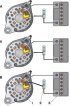
Checking the generator rectifier block valves
Rectifier block valve testing schemes A - checking both "positive" and "negative" valves simultaneously; B - checking "negative" valves; B - checking "positive" valves; 1 –...
Rectifier block valve testing schemes A - checking both "positive" and "negative" valves simultaneously; B - checking "negative" valves; B - checking "positive" valves; 1 –...

Disassembling the generator
Generator parts 1 - "negative" brush; 2 – brush holder; 3 – "positive" brush; 4 – neutral wire plug socket; 5 – insulating bushings of the contact bolt; 6 – rectifier block; 7 –...
Generator parts 1 - "negative" brush; 2 – brush holder; 3 – "positive" brush; 4 – neutral wire plug socket; 5 – insulating bushings of the contact bolt; 6 – rectifier block; 7 –...
Generator assembly
1. The generator is assembled in the reverse order of disassembly. 2. The misalignment of the holes in the generator cover paws should be no more than 0.4 mm. Therefore, during...
1. The generator is assembled in the reverse order of disassembly. 2. The misalignment of the holes in the generator cover paws should be no more than 0.4 mm. Therefore, during...
Replacing the generator brush holder
If the brushes are worn and protrude from the brush holder by less than 5 mm, replace the brush holder with brushes. Before installing the brush holder, blow out any carbon dust...
If the brushes are worn and protrude from the brush holder by less than 5 mm, replace the brush holder with brushes. Before installing the brush holder, blow out any carbon dust...
Replacing generator rotor bearings
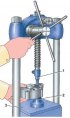
1. To remove a faulty bearing from the drive-side cover, unscrew the nuts of the screws that hold the bearing mounting washers, remove the washers with the screws, and press out...
1. To remove a faulty bearing from the drive-side cover, unscrew the nuts of the screws that hold the bearing mounting washers, remove the washers with the screws, and press out...
Replacing generator valves
In modern generators with a rectifier block, if one of the valves fails, the entire rectifier block must be replaced. In older generators, the "positive" valves were pressed into...
In modern generators with a rectifier block, if one of the valves fails, the entire rectifier block must be replaced. In older generators, the "positive" valves were pressed into...
Battery charge indicator lamp relay
The relay type RS-702 is designed to turn on the control lamp in the instrument cluster when the generator voltage is insufficient to charge the battery. The relay is installed in...
The relay type RS-702 is designed to turn on the control lamp in the instrument cluster when the generator voltage is insufficient to charge the battery. The relay is installed in...

Voltage regulator PP-380
Voltage regulator PP-380 1 – temperature compensating resistor 19 Ohm, 6 W; 2 – additional resistors 5.5 Ohm, 25 W; 3 – throttle; 4 – rack mounting nut; 5 – rack with lower...
Voltage regulator PP-380 1 – temperature compensating resistor 19 Ohm, 6 W; 2 – additional resistors 5.5 Ohm, 25 W; 3 – throttle; 4 – rack mounting nut; 5 – rack with lower...

Testing and adjustment of the PP-380 voltage regulator on the bench
Voltage regulator test circuit on the bench 1 – voltmeter with a scale of 15 V, accuracy class not lower than 0.5; 2 – main switch; 3 – voltage regulator; 4 – generator; 5 –...
Voltage regulator test circuit on the bench 1 – voltmeter with a scale of 15 V, accuracy class not lower than 0.5; 2 – main switch; 3 – voltage regulator; 4 – generator; 5 –...
Determining the faults of the voltage regulator PP-380
If the car battery is constantly overcharged, it is necessary, without removing the voltage regulator, to check it under the following conditions: the battery must be fully...
If the car battery is constantly overcharged, it is necessary, without removing the voltage regulator, to check it under the following conditions: the battery must be fully...
Repair of voltage regulator PP-380
Voltage regulator repair should only be carried out in exceptional cases; it is recommended to replace it. The following operations are allowed for repairing the regulator....
Voltage regulator repair should only be carried out in exceptional cases; it is recommended to replace it. The following operations are allowed for repairing the regulator....
Possible generator malfunctions, their causes and methods of elimination
Cause Method of elimination The indicator light is on or comes on intermittently while the car is moving Alternator drive belt slippage Adjust the belt tension Open circuit in...
Cause Method of elimination The indicator light is on or comes on intermittently while the car is moving Alternator drive belt slippage Adjust the belt tension Open circuit in...

Starter — design description
Starter ST-221 1 – drive gear; 2 – thrust half ring of the overrunning clutch; 3 – overrunning clutch roller; 4 – centering ring of the overrunning clutch; 5 – outer ring of the...
Starter ST-221 1 – drive gear; 2 – thrust half ring of the overrunning clutch; 3 – overrunning clutch roller; 4 – centering ring of the overrunning clutch; 5 – outer ring of the...
Technical characteristics of the starter
Technical characteristics of the starter Nominal power, kW 1,3 Current consumption at rated power, no more than, A 260 (290*) Current consumption in the braked state, no more...
Technical characteristics of the starter Nominal power, kW 1,3 Current consumption at rated power, no more than, A 260 (290*) Current consumption in the braked state, no more...

Checking the starter on the stand
Wiring diagram for testing the starter on the stand 1 – starter; 2 – voltmeter with a scale limit of at least 15 V; 3 – rheostat 800 A; 4 – ammeter with 1000 A shunt; 5 – switch;...
Wiring diagram for testing the starter on the stand 1 – starter; 2 – voltmeter with a scale limit of at least 15 V; 3 – rheostat 800 A; 4 – ammeter with 1000 A shunt; 5 – switch;...
Checking the starter's functionality
1. By closing switch 5 (see Fig. Wiring diagram for testing the starter on the stand ), with a current source voltage of 12 V, turn on the starter three times with different...
1. By closing switch 5 (see Fig. Wiring diagram for testing the starter on the stand ), with a current source voltage of 12 V, turn on the starter three times with different...
Testing the starter in full braking mode
1. Brake the stand's toothed ring gear, turn on the starter and measure the current, voltage and braking torque, which for the 35.3708 starter should be no more than 550 A, no...
1. Brake the stand's toothed ring gear, turn on the starter and measure the current, voltage and braking torque, which for the 35.3708 starter should be no more than 550 A, no...
Testing the starter in idle mode
1. Remove the toothed ring gear of the stand from engagement with the starter pinion. Turn on the starter and measure the current it consumes and the rotation speed of the starter...
1. Remove the toothed ring gear of the stand from engagement with the starter pinion. Turn on the starter and measure the current it consumes and the rotation speed of the starter...
Checking the starter traction relay
Until 1983, a single-winding traction relay was installed on ST-221 starters. For a starter with such a relay, check the current consumption, which should not exceed 23 A. 1....
Until 1983, a single-winding traction relay was installed on ST-221 starters. For a starter with such a relay, check the current consumption, which should not exceed 23 A. 1....
Checking the mechanical data of the starter
1. Use a dynamometer to check the spring pressure on the brushes, which for new brushes should be 9.8±0.98 N (1±0.1 kgf). 2. If the brushes are worn to a height of 12 mm, replace...
1. Use a dynamometer to check the spring pressure on the brushes, which for new brushes should be 9.8±0.98 N (1±0.1 kgf). 2. If the brushes are worn to a height of 12 mm, replace...

Disassembling the starter
Starter parts 1 – starter cover on the drive side; 2 – rubber plug; 3 – drive lever; 4 – traction relay; 5 – stator pole; 6 – stator winding service coil; 7 – shunt coil of the...
Starter parts 1 – starter cover on the drive side; 2 – rubber plug; 3 – drive lever; 4 – traction relay; 5 – stator pole; 6 – stator winding service coil; 7 – shunt coil of the...

Checking the technical condition of starter parts
Anchor 1. Check with a megohmmeter or a lamp powered by 220 V to see if the armature winding is shorted to ground. 2. Voltage is supplied through the lamp to the collector plates...
Anchor 1. Check with a megohmmeter or a lamp powered by 220 V to see if the armature winding is shorted to ground. 2. Voltage is supplied through the lamp to the collector plates...
Assembling the starter
1. Before assembly, lubricate the helical splines of the anchor shaft and the overrunning clutch hub, the gear and the cover bushings with engine oil. Lubricate the drive ring...
1. Before assembly, lubricate the helical splines of the anchor shaft and the overrunning clutch hub, the gear and the cover bushings with engine oil. Lubricate the drive ring...
Possible starter malfunctions, their causes and methods of elimination
Cause Method of elimination When the starter is turned on, the anchor does not rotate, the traction relay does not operate The battery is faulty or completely discharged Charge...
Cause Method of elimination When the starter is turned on, the anchor does not rotate, the traction relay does not operate The battery is faulty or completely discharged Charge...
This section is available on russian, bulgarian, belarusian, ukrainian, serbian, croatian, romanian, polish, slovak, hungarian
Share with friends:
- General information
- Vehicle description
- Vehicle device
- Vehicle operation
- Maintenance
- Main malfunctions
- Applications
- Power unit
- Engine repair
- Cooling and lubrication system
- Supply system
- Transmission
- Clutch
- Transmission
- Cardan gear
- Rear axle
- Chassis
- Front suspension
- Rear suspension
- Steering
- Brake system
- Body
- Exterior
- Interior
- Electrical equipment
- Engine electrics
- Equipment and devices
- General information
- Specifications
- Operation and maintenance
- Power unit
- Engine repair
- Cooling system
- Lubrication system
- Power and exhaust system
- Ignition system
- Engine electrics
- Transmission
- Clutch
- Car gearbox
- Cardan gear
- Rear axle
- Chassis
- Car suspension
- Steering
- Brake system
- Body
- Exterior
- Interior
- Doors and locks
- Electrical equipment
- Equipment and devices
- Lighting and signaling