




Car engine repair VAZ-21011 «Zhiguli»

Features of the engine design
Longitudinal and transverse section of the engine Engine mount 1 – support casing; 2 – Front engine mount support; 3 – cylinder block flange; 4 – bracket; 5 – intermediate plate;...
Longitudinal and transverse section of the engine Engine mount 1 – support casing; 2 – Front engine mount support; 3 – cylinder block flange; 4 – bracket; 5 – intermediate plate;...

Possible engine malfunctions, their causes and methods of elimination
Cause Method of elimination The engine does not start No fuel in carburetor: – fuel lines or filters of the carburetor and fuel pump are clogged – flush and blow out the fuel...
Cause Method of elimination The engine does not start No fuel in carburetor: – fuel lines or filters of the carburetor and fuel pump are clogged – flush and blow out the fuel...
Removal and installation the engine
1. Place the car on a lift or over an inspection pit, place chocks under the front wheels and lift the rear axle on one or both sides. 2. Remove the hood, disconnect the wires...
1. Place the car on a lift or over an inspection pit, place chocks under the front wheels and lift the rear axle on one or both sides. 2. Remove the hood, disconnect the wires...

Disassembling the engine
Removal the flywheel 1 – key; 2 – flywheel; 3 – flywheel mounting bolt; 4 – washer; 5 – A.60330/R retainer for holding the flywheel from turning; 6 – Front clutch housing cover...
Removal the flywheel 1 – key; 2 – flywheel; 3 – flywheel mounting bolt; 4 – washer; 5 – A.60330/R retainer for holding the flywheel from turning; 6 – Front clutch housing cover...

Engine assembly
Marks on the main bearing caps and the cylinder block reference number The number of supports is calculated from the front of the engine. Cylinder Head Bolt Tightening Sequence...
Marks on the main bearing caps and the cylinder block reference number The number of supports is calculated from the front of the engine. Cylinder Head Bolt Tightening Sequence...
Engine bench testing
The repaired engine is subjected to bench tests (running-in) without load according to the following cycle: 820–900 min⁻¹ – 2 min; 1000 min⁻¹ – 3 min; 1500 min⁻¹ – 4 min; 2000...
The repaired engine is subjected to bench tests (running-in) without load according to the following cycle: 820–900 min⁻¹ – 2 min; 1000 min⁻¹ – 3 min; 1500 min⁻¹ – 4 min; 2000...
Checking the engine on a car
1. Install the engine on the car, carefully check the correct installation. 2. Let the engine run for a while, then check: check for coolant and fuel leaks in the pipe...
1. Install the engine on the car, carefully check the correct installation. 2. Let the engine run for a while, then check: check for coolant and fuel leaks in the pipe...

Features of the cylinder block device
Main dimensions of the cylinder block The cylinder block is cast from special low-alloy high-strength cast iron. The cylinders are bored directly in the block and do not have...
Main dimensions of the cylinder block The cylinder block is cast from special low-alloy high-strength cast iron. The cylinders are bored directly in the block and do not have...
General cleaning and inspection of the cylinder block
1. Wash the cylinder block thoroughly and inspect the oil passages. 2. Blow out and dry the cylinder block with compressed air, especially the oil passages. 3. Inspect the...
1. Wash the cylinder block thoroughly and inspect the oil passages. 2. Blow out and dry the cylinder block with compressed air, especially the oil passages. 3. Inspect the...
Checking the cylinder block for leaks
1. If there is a suspicion of coolant getting into the crankcase, then check the cylinder block for leaks on a special stand. To do this, having plugged the openings of the...
1. If there is a suspicion of coolant getting into the crankcase, then check the cylinder block for leaks on a special stand. To do this, having plugged the openings of the...

Cylinders — Checking the condition
Measuring cylinders with a bore gauge 1 – bore gauge; 2 – setting the bore gauge to zero using caliber A.96137 Cylinder Measurement Diagram A and B are the directions of...
Measuring cylinders with a bore gauge 1 – bore gauge; 2 – setting the bore gauge to zero using caliber A.96137 Cylinder Measurement Diagram A and B are the directions of...
Parting plane with cylinder head
Examination There may be deformations on the plane of the cylinder block-head joint. Therefore, check the plane of the joint using a ruler and a set of feeler gauges. The ruler is...
Examination There may be deformations on the plane of the cylinder block-head joint. Therefore, check the plane of the joint using a ruler and a set of feeler gauges. The ruler is...

Features of the design of pistons and connecting rods
Main dimensions of piston, connecting rod, piston pin and piston rings Piston The piston is made of aluminum alloy and coated with a layer of tin to improve the running-in...
Main dimensions of piston, connecting rod, piston pin and piston rings Piston The piston is made of aluminum alloy and coated with a layer of tin to improve the running-in...
Pressing out the piston pin
1. The pin must be removed using a press, using the A.60308 mandrel and a support with a cylindrical recess into which the piston is placed. Before pressing out the pin, remove...
1. The pin must be removed using a press, using the A.60308 mandrel and a support with a cylindrical recess into which the piston is placed. Before pressing out the pin, remove...
Cleaning pistons and connecting rods
1. Remove any carbon deposits that have formed on the piston crown and in the piston ring grooves, and remove all deposits from the piston and connecting rod oil passages. 2....
1. Remove any carbon deposits that have formed on the piston crown and in the piston ring grooves, and remove all deposits from the piston and connecting rod oil passages. 2....
Selecting a piston for a cylinder
Calculated clearance between piston and cylinder (for new parts) is 0.05–0.07 mm. It is determined by measuring the cylinders and pistons and is ensured by installing pistons of...
Calculated clearance between piston and cylinder (for new parts) is 0.05–0.07 mm. It is determined by measuring the cylinders and pistons and is ensured by installing pistons of...

Checking the clearance between the piston and the pin
The pin is pressed into the upper head of the connecting rod with tension and rotates freely in the piston bosses. Attention! According to the outer diameter, the pins are divided...
The pin is pressed into the upper head of the connecting rod with tension and rotates freely in the piston bosses. Attention! According to the outer diameter, the pins are divided...

Checking the clearances between piston grooves and rings
Height clearance 1. Check the height clearance between the grooves and rings by inserting the ring into the corresponding groove (1 – piston ring, 2 – piston, 3 – feeler gauge...
Height clearance 1. Check the height clearance between the grooves and rings by inserting the ring into the corresponding groove (1 – piston ring, 2 – piston, 3 – feeler gauge...
Checking the clearance between the connecting rod bearings and the crankshaft
The clearance between the connecting rod bearings and the crankshaft can be checked by calculation and by measuring the parts. The nominal calculated gap is 0.036–0.086 mm. If it...
The clearance between the connecting rod bearings and the crankshaft can be checked by calculation and by measuring the parts. The nominal calculated gap is 0.036–0.086 mm. If it...

Piston mass control
Scheme of metal removal from a piston to adjust its mass The arrows indicate the places where metal can be removed. The mass of pistons in one engine must not differ from each...
Scheme of metal removal from a piston to adjust its mass The arrows indicate the places where metal can be removed. The mass of pistons in one engine must not differ from each...

Assembly of the connecting rod and piston group
1. Since the pin is inserted into the upper head of the connecting rod with tension, heat the connecting rod to 240°C to expand its head. To do this, place the connecting rods in...
1. Since the pin is inserted into the upper head of the connecting rod with tension, heat the connecting rod to 240°C to expand its head. To do this, place the connecting rods in...

Checking the pin pressing
Assembled piston-pin-connecting rod kit mounted on fixture A.95615 for pin pressing-out test 1 – indicator pin in contact with the end of the rod; 2 – the head of the rod in...
Assembled piston-pin-connecting rod kit mounted on fixture A.95615 for pin pressing-out test 1 – indicator pin in contact with the end of the rod; 2 – the head of the rod in...

Parallelism of the axes of the lower head of the connecting rod and the piston pin
Checking the parallelism of the piston pin and connecting rod lower head axes 1 – assembled connecting rod-pin-piston kit; 2 – retractable knives; 3 – emphasis; 4 – caliber...
Checking the parallelism of the piston pin and connecting rod lower head axes 1 – assembled connecting rod-pin-piston kit; 2 – retractable knives; 3 – emphasis; 4 – caliber...

Features of the crankshaft and flywheel
Main dimensions of connecting rod and main journals of the crankshaft and their fillets Crankshaft The crankshaft is a five-bearing, cast iron crankshaft. The surfaces of the...
Main dimensions of connecting rod and main journals of the crankshaft and their fillets Crankshaft The crankshaft is a five-bearing, cast iron crankshaft. The surfaces of the...
Cleaning the lubrication system channels
1. To clean, remove the channel plugs. Then run through the plug sockets with the countersink A.94016/10, put on the spindle A.94016, thoroughly wash the channels with gasoline...
1. To clean, remove the channel plugs. Then run through the plug sockets with the countersink A.94016/10, put on the spindle A.94016, thoroughly wash the channels with gasoline...

Main and connecting rod journals
Permissible runout of the main surfaces of the crankshaft Examination 1. Install the crankshaft on two prisms (see fig. Permissible runout of the main surfaces of the crankshaft)...
Permissible runout of the main surfaces of the crankshaft Examination 1. Install the crankshaft on two prisms (see fig. Permissible runout of the main surfaces of the crankshaft)...
Main bearing shells
Do not perform any adjustment operations on the liners. If there are any scuffs, scratches or deviations, replace the liners. The clearance between the crankshaft journals and the...
Do not perform any adjustment operations on the liners. If there are any scuffs, scratches or deviations, replace the liners. The clearance between the crankshaft journals and the...
Flywheel — Checking the condition
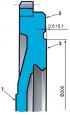
Flywheel 1 – mounting surface to the crankshaft flange; 2 – clutch mounting surface; 3 – supporting surface of the driven clutch disc 1. Check the condition of the ring gear; if...
Flywheel 1 – mounting surface to the crankshaft flange; 2 – clutch mounting surface; 3 – supporting surface of the driven clutch disc 1. Check the condition of the ring gear; if...

Checking the axial clearance of the crankshaft
Checking the axial clearance of the crankshaft The axial movement of the crankshaft is limited by two thrust half rings installed on both sides of the rear main bearing. A...
Checking the axial clearance of the crankshaft The axial movement of the crankshaft is limited by two thrust half rings installed on both sides of the rear main bearing. A...

Features of the cylinder head and valves
Main dimensions of cylinder head, valves and guide bushings The cylinder head is common for four cylinders, cast from aluminum alloy. It is unified, i.e. the same for engines...
Main dimensions of cylinder head, valves and guide bushings The cylinder head is common for four cylinders, cast from aluminum alloy. It is unified, i.e. the same for engines...
Removal and installation the cylinder head on a car
The cylinder head is removed from the engine on the vehicle if it is not necessary to remove the engine itself to fix the problem or if it is only necessary to remove carbon...
The cylinder head is removed from the engine on the vehicle if it is not necessary to remove the engine itself to fix the problem or if it is only necessary to remove carbon...
Disassembly and assembly of the cylinder head
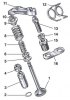
Valve Mechanism Parts 1 – valve; 2 – retaining ring; 3 – guide bushing; 4 – oil deflector cap; 5 – outer spring support washer; 6 – inner spring support washer; 7 – inner spring;...
Valve Mechanism Parts 1 – valve; 2 – retaining ring; 3 – guide bushing; 4 – oil deflector cap; 5 – outer spring support washer; 6 – inner spring support washer; 7 – inner spring;...
Cleaning the cylinder head
1. Install the head on the stand A.60353. 2. Remove carbon deposits from the combustion chambers and from the surface of the exhaust ports with a wire brush driven by an electric...
1. Install the head on the stand A.60353. 2. Remove carbon deposits from the combustion chambers and from the surface of the exhaust ports with a wire brush driven by an electric...

Checking and grinding valve seats
Intake valve seat profile I - new saddle; II – saddle after repair Exhaust valve seat profile I - new saddle; II – saddle after repair The shape of the valve seat chamfers is...
Intake valve seat profile I - new saddle; II – saddle after repair Exhaust valve seat profile I - new saddle; II – saddle after repair The shape of the valve seat chamfers is...
Valves — Cleaning and Checking
1. Remove carbon deposits from the valves. Check if the stem is deformed and if there are any cracks on the plate; if damaged, replace the valve. 2. Check whether the working...
1. Remove carbon deposits from the valves. Check if the stem is deformed and if there are any cracks on the plate; if damaged, replace the valve. 2. Check whether the working...

Valve guide bushings
1. Check the clearance between the guide bushings and the valve stem by measuring the diameter of the valve and the guide bushing bore. The installation clearance for new bushings...
1. Check the clearance between the guide bushings and the valve stem by measuring the diameter of the valve and the guide bushing bore. The installation clearance for new bushings...
Oil deflector caps of guide bushings
The oil deflector caps must not have any separation of the rubber from the fittings, cracks or excessive wear of the working edge. When repairing an engine, it is recommended to...
The oil deflector caps must not have any separation of the rubber from the fittings, cracks or excessive wear of the working edge. When repairing an engine, it is recommended to...
Valve Levers — Checking
1. Check the condition of the lever working surfaces that mate with the valve stem, the camshaft cam and the spherical end of the adjusting bolt. If these surfaces are scored or...
1. Check the condition of the lever working surfaces that mate with the valve stem, the camshaft cam and the spherical end of the adjusting bolt. If these surfaces are scored or...

Valve springs — checking
Basic data for checking the outer valve spring Basic data for checking the internal valve spring Lever Spring Test Scheme A – size in free state; B – size under load 1. Make sure...
Basic data for checking the outer valve spring Basic data for checking the internal valve spring Lever Spring Test Scheme A – size in free state; B – size under load 1. Make sure...
Cylinder Head Gasket — Check
The surfaces of the gasket must not have any damage. They must be smooth, without dents, cracks, swellings and fractures. Peeling of the facing material from the reinforcement is...
The surfaces of the gasket must not have any damage. They must be smooth, without dents, cracks, swellings and fractures. Peeling of the facing material from the reinforcement is...

Checking the cylinder head for leaks
Checking the tightness of the cylinder head on the device A.60334 1, 2, 4 – plugs; 3 – fixture plate; 5 – flange with water supply nipple 1. For hydraulic testing of cylinder head...
Checking the tightness of the cylinder head on the device A.60334 1, 2, 4 – plugs; 3 – fixture plate; 5 – flange with water supply nipple 1. For hydraulic testing of cylinder head...

Features of the camshaft device
Main dimensions of the camshaft and bores in the camshaft bearing housing Section of cylinder head along exhaust valve 1 – cylinder head; 2 – exhaust valve; 3 – oil deflector cap;...
Main dimensions of the camshaft and bores in the camshaft bearing housing Section of cylinder head along exhaust valve 1 – cylinder head; 2 – exhaust valve; 3 – oil deflector cap;...

Adjusting the clearance between the levers and the camshaft cams
1. Adjust the gaps on a cold engine, having first adjusted the chain tension. After adjustment, the gap should be 0.14–0.17 mm. 2. Turn the crankshaft clockwise until the mark on...
1. Adjust the gaps on a cold engine, having first adjusted the chain tension. After adjustment, the gap should be 0.14–0.17 mm. 2. Turn the crankshaft clockwise until the mark on...
Adjusting the camshaft chain tension
1. Loosen cap nut 1 (see Fig. Section of chain tensioner ) tensioner. In this case, rod 3 is released and the chain is tensioned by shoe 7 (see Fig. Scheme of the camshaft drive...
1. Loosen cap nut 1 (see Fig. Section of chain tensioner ) tensioner. In this case, rod 3 is released and the chain is tensioned by shoe 7 (see Fig. Scheme of the camshaft drive...
Checking the camshaft
The bearing journals of the camshaft must not have any nicks, dents, scratches, or aluminum dragging from the bearing housings. Wear on the working surfaces of the cams exceeding...
The bearing journals of the camshaft must not have any nicks, dents, scratches, or aluminum dragging from the bearing housings. Wear on the working surfaces of the cams exceeding...
Checking the camshaft bearing housing
1. Wash and clean the camshaft bearing housing and oil supply passages. 2. Check the diameter of the holes in the bearings. If the gap between the camshaft journals and the...
1. Wash and clean the camshaft bearing housing and oil supply passages. 2. Check the diameter of the holes in the bearings. If the gap between the camshaft journals and the...

Timing Chain Tensioner — Disassembly and Assembly
Basic data for checking the tensioner spring Disassembly and assembly 1. To disassemble the chain tensioner, remove the cap locking nut 1 (see Fig. Section of chain tensioner ),...
Basic data for checking the tensioner spring Disassembly and assembly 1. To disassemble the chain tensioner, remove the cap locking nut 1 (see Fig. Section of chain tensioner ),...

Camshaft drive chain
Device 67.7824.9521 for checking chain wear (stretching) 1 – roller; 2 – adjusting nut; 3 – counterweight Chain wear (stretch) check diagram 1 – rollers Check and replace 1. Wash...
Device 67.7824.9521 for checking chain wear (stretching) 1 – roller; 2 – adjusting nut; 3 – counterweight Chain wear (stretch) check diagram 1 – rollers Check and replace 1. Wash...
This section is available on russian, bulgarian, belarusian, ukrainian, serbian, croatian, romanian, polish, slovak, hungarian
More articles from other manuals on VAZ cars:
➠ Power unit: Engine repair VAZ-2115 (1997-2012)
➠ Electrical equipment: Engine electrics VAZ-2107 (1982-2012)
➠ Electrical equipment: Engine electrics VAZ-2109 (1984-1997)
➠ Electrical equipment: Engine electrics VAZ-21214 (1994-2006)
➠ Electrical equipment: Engine electrics VAZ-2106 (1976-2006)
➠ Power unit: Engine repair VAZ-2115 (1997-2012)
➠ Electrical equipment: Engine electrics VAZ-2107 (1982-2012)
➠ Electrical equipment: Engine electrics VAZ-2109 (1984-1997)
➠ Electrical equipment: Engine electrics VAZ-21214 (1994-2006)
➠ Electrical equipment: Engine electrics VAZ-2106 (1976-2006)
Share with friends:
- General information
- Vehicle description
- Vehicle device
- Vehicle operation
- Maintenance
- Main malfunctions
- Applications
- Power unit
- Engine repair
- Cooling and lubrication system
- Supply system
- Transmission
- Clutch
- Transmission
- Cardan gear
- Rear axle
- Chassis
- Front suspension
- Rear suspension
- Steering
- Brake system
- Body
- Exterior
- Interior
- Electrical equipment
- Engine electrics
- Equipment and devices
- General information
- Specifications
- Operation and maintenance
- Power unit
- Engine repair
- Cooling system
- Lubrication system
- Power and exhaust system
- Ignition system
- Engine electrics
- Transmission
- Clutch
- Car gearbox
- Cardan gear
- Rear axle
- Chassis
- Car suspension
- Steering
- Brake system
- Body
- Exterior
- Interior
- Doors and locks
- Electrical equipment
- Equipment and devices
- Lighting and signaling