




Rear Brake Wheel Cylinders Test Scheme
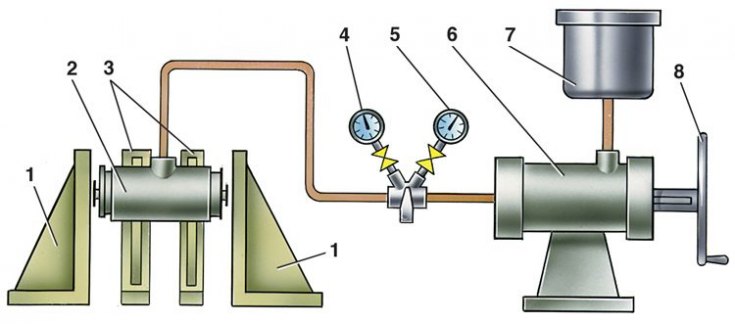
1 – piston stops; 2 – tested cylinder; 3 – cylinder bracket; 4 – low pressure gauge; 5 – high pressure gauge; 6 – cylinder for creating pressure; 7 – vessel; 8 – flywheel
1. Install the cylinder on the stand, connect the pipeline from the pressure gauges to it and bleed the system.
2. Adjust stops 1 so that the wheel cylinder pistons rest against them.
3. Check for fluid leaks. Connect a low pressure gauge.
4. Slowly rotate the flywheel of the drive cylinder control to set the fluid pressure to 0.05 MPa (0.5 kgf/cm²).
5. Make sure the set pressure is maintained for 5 minutes.
6. Repeat the test similarly at a pressure of 0.1; 0,2; 0,3; 0,4; 0.5 MPa (1; 2; 3; 4; 5 kgf/cm²).
7. Reduce the pressure and connect the high pressure gauge. Following the rules given, repeat the tests at a pressure of 5; 10; 15 MPa (50; 100; 150 kgf/cm²).
8. Pressure loss due to fluid leakage through sealing elements, pipeline connections, fluid inlet fittings or through casting pores is not permitted.
9. A slight decrease in pressure – no more than 0.5 MPa (5 kgf/cm²) over 5 minutes – is allowed, especially at higher pressures, due to shrinkage of the seals.