




Rear Brake Wheel Cylinders Test Scheme
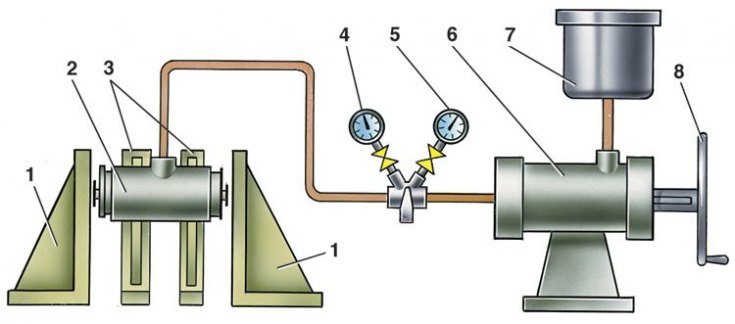
1 – piston stops; 2 – tested cylinder; 3 – cylinder bracket; 4 – low pressure gauge; 5 – high pressure gauge; 6 – cylinder for creating pressure; 7 – vessel; 8 – flywheel
1. Before checking, make sure that the slave cylinder parts move freely in the cylinder.
2. Install the cylinder on the stand, connect the pipeline from the pressure gauges to it and bleed the system.
3. Adjust stops 1 so that the pistons are spread apart to the greatest possible distance.
4. Check for fluid leaks. Connect a low pressure gauge; slowly rotating the flywheel of the drive cylinder control, set the fluid pressure to 0.05 MPa (0.5 kgf/cm²).
5. Make sure the set pressure is maintained for 5 minutes.
6. Repeat the test in a similar manner at a pressure of 0.1–0.2–0.3–0.4–0.5 MPa (1–2–3–4–5 kgf/cm²).
7. Reduce the pressure and connect a high pressure gauge.
8. Following the above rules, repeat the tests at a pressure of 5–10–15 MPa (50–100–150 kgf/cm²). No pressure drop is allowed due to fluid leakage through sealing elements, pipeline connections, fluid pumping nozzles, or through casting pores. A slight (no more than 0.5 MPa (5 kgf/cm²) over 5 min) pressure drop is allowed, especially at higher pressures, due to seal shrinkage.